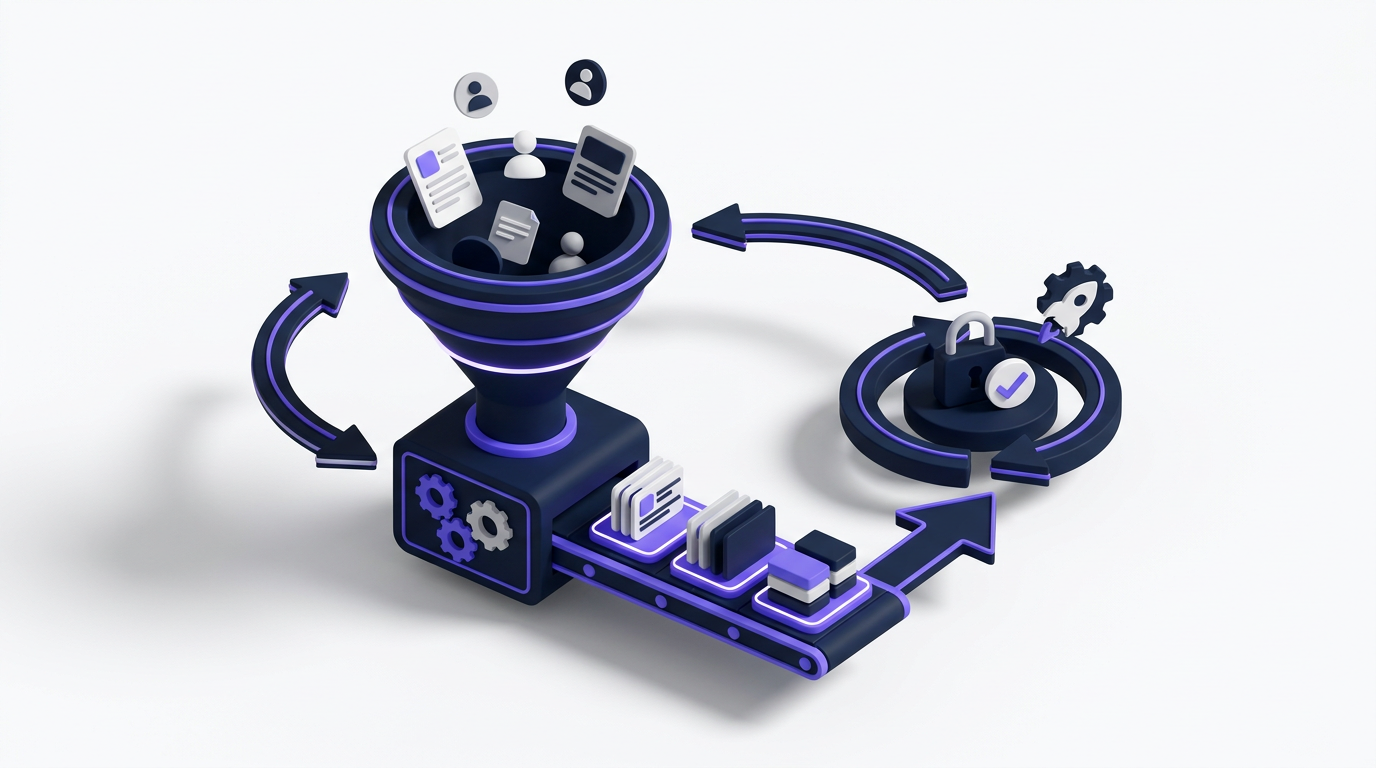
Feature requests often arrive through support tickets, sales calls, chat messages, and private documents. Product managers then spend hours consolidating comments, while customers get little indication that anyone acted on their feedback.
A SaaS feedback tool puts that work into one visible process. Upvoty connects feedback boards, prioritization, a product roadmap, and release updates so product teams can manage requests without maintaining separate systems.
Quick answer: How to use a SaaS feedback tool
Use this workflow to turn scattered customer comments into product decisions:
- Create one feedback board for each product or clear request category.
- Collect ideas through a public portal, an in-app widget, and internal submissions.
- Merge duplicate requests while preserving every customer's vote.
- Add context such as account segment, potential revenue, urgency, and use case.
- Prioritize requests using demand and strategic fit rather than votes alone.
- Publish approved work to a customer-facing roadmap with clear statuses.
- Announce shipped improvements in a changelog and notify the original voters.
The result is a repeatable feedback loop rather than an inbox of disconnected opinions.
How a SaaS feedback tool collects requests
Start by deciding where customers should submit feedback. Do not open five unrelated channels and expect the product team to reconcile them later.
A public portal works well when customers should browse existing requests before creating a new one. An in-app feedback widget reduces friction because users can submit an idea without leaving the product, and an Aha Ideas alternative helps organize those submissions. Sales and support teams should also have a way to log requests on behalf of customers who share feedback during conversations.
Consider a fictional reporting platform called MetricFlow. Its customers repeatedly ask for scheduled CSV exports. One user creates the request at feedback.metricflow.example, another sends it through the application widget, and an account manager records the same need after a renewal call.
All three submissions should reach the same board. The customer wording can remain intact, but the request needs enough context to be useful. Ask which workflow is blocked, how the customer handles it now, and how often the problem occurs. Avoid long forms. Every required field lowers submission completion.
Use custom submission forms when different boards need different context. A bug board might ask for browser and reproduction steps, while a feature request board asks about the desired outcome.
This is what a public voting board gives customers before they submit another copy of an existing idea:
!Public voting boards for customer feedback and feature requests
How feedback software organizes duplicate requests
Duplicate management affects the quality of every later decision. If MetricFlow leaves three scheduled-export requests separate, the team sees fragmented demand and customers cannot follow one authoritative update.
Merge those submissions into a canonical request such as “Schedule recurring CSV exports.” Preserve the original voters and comments so no account disappears from the record. Upvoty includes Merge AI to support this part of the workflow, but a product manager should still confirm that suggested duplicates describe the same underlying need.
Similar wording does not always mean the same request. “Export every Monday” and “send a report to clients every Monday” may require different delivery methods, permissions, and audit controls. Combining them too early can produce a feature that satisfies neither group.
Set ownership next. Assign a product manager, add an initial priority, and use internal notes for details customers should not see. The request record should show what users asked for and what the team learned, without exposing private contract or account information.
For a more detailed operating model, use this feature request management workflow to define intake, review, prioritization, and follow-up responsibilities.
How to prioritize customer feedback for SaaS products
A vote is evidence of demand, not an automatic instruction to build. Large customers may submit feedback privately, new users may not discover the voting board, and strategically important infrastructure work may attract few public votes.
For MetricFlow, the scheduled-export request supports a common reporting workflow. The team reviews which customer segments requested it, whether it affects renewals, how users currently work around the limitation, and whether the feature fits the reporting strategy. It also checks engineering scope. Scheduling exports may require background jobs, permission controls, storage rules, and failure notifications.
Use a consistent prioritization method. Record the same factors for every serious candidate so the most vocal account does not reset the roadmap during each meeting. Customer segments help distinguish broad demand from a cluster limited to one plan, industry, or account type.
Revenue context is useful, but it can distort decisions when treated as the only score. One high-value request may be custom work with little reuse. A modest request shared across the target market may produce more durable product value. The guide to prioritizing feedback by revenue, segment, and demand explains how to combine these signals without reducing the decision to vote totals.
Document rejected requests too. A short reason such as “not aligned with the reporting product” prevents the same proposal from returning to every planning session.
Turn SaaS feedback into a public product roadmap
Move an item to the roadmap only after the team has agreed on its status. Publishing every popular suggestion as planned work creates expectations before feasibility and timing are understood.
MetricFlow approves recurring CSV exports but does not promise a release date. The team places the item under “Planned,” explains the intended outcome, and leaves implementation details private until the scope is stable. When development starts, the status changes to “In progress.”
Use broad, honest statuses. Customers usually need to know whether an idea is being considered, planned, built, or released. They do not need access to sprint assignments or uncertain internal deadlines.
The customer view should make progress understandable without exposing the engineering backlog:
!Public product roadmap showing what is planned and in progress
A roadmap creates trust only when it stays current. Define who changes statuses and how frequently the board is reviewed. The practical guide to building a public product roadmap covers wording, status design, and expectation management.
Close the SaaS customer feedback loop after release

Shipping the feature does not close the loop if the original requesters never hear about it. Connect the completed roadmap item to a changelog post and notify its voters.
For MetricFlow, the release note explains where to configure scheduled exports, which permissions are required, and what happens when delivery fails. It avoids generic copy such as “exports are better.” Customers need enough detail to use the change.
Automatic voter notifications remove the need to search old tickets and email each requester manually. The notification should link to the release details and, when appropriate, ask users whether the delivered feature solves the original problem.
That final response can reveal a scope gap. MetricFlow may learn that customers also need spreadsheet delivery rather than CSV files. Keep that as a related request instead of quietly reopening the completed item. The article on closing the feedback loop with a changelog shows how to make release communication part of product operations.
How to choose the right SaaS feedback tool
Choose based on the full workflow, not the submission form alone. A basic idea board can collect votes, but the team may still need separate software for prioritization, roadmap publishing, and release communication.
| Option | Collection | Prioritization context | Customer roadmap | Release follow-up | Best fit |
|---|---|---|---|---|---|
| Dedicated SaaS feedback tool | Portal, widgets, and team submissions | Votes, comments, tags, and customer context | Built into the workflow | Changelog and voter notifications | SaaS teams managing recurring product demand |
| Survey tool | Structured responses and ratings | Strong for research questions, weaker for ongoing requests | Usually absent | Requires a separate communication process | Time-limited discovery and satisfaction research |
| Help desk | Tickets, email, and chat | Rich account conversations but fragmented product demand | Usually separate | Direct ticket replies | Support cases and individual customer issues |
| Shared spreadsheet | Manual entry | Fully configurable but labor intensive | Not customer friendly | Manual email or support outreach | Very early teams with low request volume |
Check privacy, access, and administration before rollout. Customer records should follow applicable data-handling obligations, including the principles defined in Article 5 of the GDPR. If the portal is public, review form labels, keyboard operation, and error messages against the W3C Web Content Accessibility Guidelines.
Test the actual journey. Submit an idea, merge it, add context, place it on a roadmap, publish a release note, and verify the notification. A polished board can hide weak administration or an awkward follow-up process.
Canny, Featurebase, and Nolt are common options in this category. Compare current functionality, limits, administration, and pricing on each vendor's own site. Upvoty provides its current pricing and plan details for direct review.
How Upvoty works as a SaaS feedback tool
Upvoty follows the same sequence a product team uses to process a request. Customers first submit ideas through feedback boards or a product widget. They can find related ideas, vote, and add context rather than opening another private ticket.
Inside the dashboard, the product team reviews new submissions, merges duplicates, applies tags, records internal notes, and assigns ownership. For MetricFlow, the three scheduled-export submissions become one request without losing the people who asked for it.
The team then evaluates demand using votes, comments, segments, and its own product criteria. Once approved, the request moves to the public roadmap, where customers can follow its status without seeing internal development tasks.
After release, the team publishes the update through the changelog. Voters receive an update, completing the path from initial request to shipped improvement.
This connected record is more useful than copying titles between a spreadsheet, project tracker, and email platform. It also leaves room for an honest “not planned” decision. Customers receive a clear status, and the product team keeps the reasoning attached to the request.
Common mistakes with SaaS feedback tools
The first failure mode is treating the board as a popularity contest. Votes should influence planning, but they cannot replace product strategy, customer segmentation, technical review, or commercial context.
Another mistake is publishing roadmap dates before engineering has validated the scope. Use status categories until the team can support a specific commitment. Update the roadmap when priorities change rather than leaving an outdated promise visible.
Do not collect feedback without assigning an owner. A board with hundreds of unreviewed requests makes the company look less responsive, not more customer-focused. Set a review schedule and close requests that are duplicates, unsupported, or outside the product direction.
Finally, avoid asking customers to repeat information your team already has. Pass known account context into the process where possible, then ask only for the missing use case.
SaaS feedback tool FAQ
What is a SaaS feedback tool?
A SaaS feedback tool is software for collecting, organizing, prioritizing, and responding to product feedback from SaaS customers. It commonly includes feedback boards, voting, comments, customer segmentation, a public roadmap, and release updates.
Is feature voting enough to prioritize a SaaS roadmap?
No. Voting shows expressed demand, but it does not measure strategic fit, engineering effort, urgency, account value, or whether non-voters share the same problem. Use votes as one input alongside customer context and product goals.
Should a feedback board be public or private?
Use a public board when customers benefit from discovering existing ideas and seeing responses. Use a private board for internal feedback, sensitive products, controlled customer groups, or requests containing confidential information. Some teams need both.
Can a SaaS feedback tool replace a help desk?
Usually not. A help desk manages individual support conversations, while a feedback platform consolidates recurring product needs across customers. Connect the processes so support agents can attach a ticket to an existing feature request instead of creating an isolated note.
Where does AI fit into customer feedback management?
AI can help identify similar submissions, group themes, and analyze large sets of comments. Keep a person responsible for merge decisions and roadmap priorities. Two requests can look similar in text while requiring different permissions, integrations, or user experiences.
How quickly should product teams respond to feedback?
Acknowledge submissions promptly, but do not promise development before review. Customers benefit more from an accurate status than a quick commitment that later disappears. Review new items on a consistent schedule and notify voters when the status materially changes.
Bring collection, prioritization, roadmap updates, and release communication into one accountable process. Use Upvoty to build your SaaS feedback workflow and give customers a clear path from request to product update. Read next: UserVoice Alternative for Feedback, Roadmaps, and Changelogs. Read next: Public Feedback Boards: What to Share, Moderate, and Keep Private. Read next: How to Choose Feedback Software for a Growing SaaS Team.