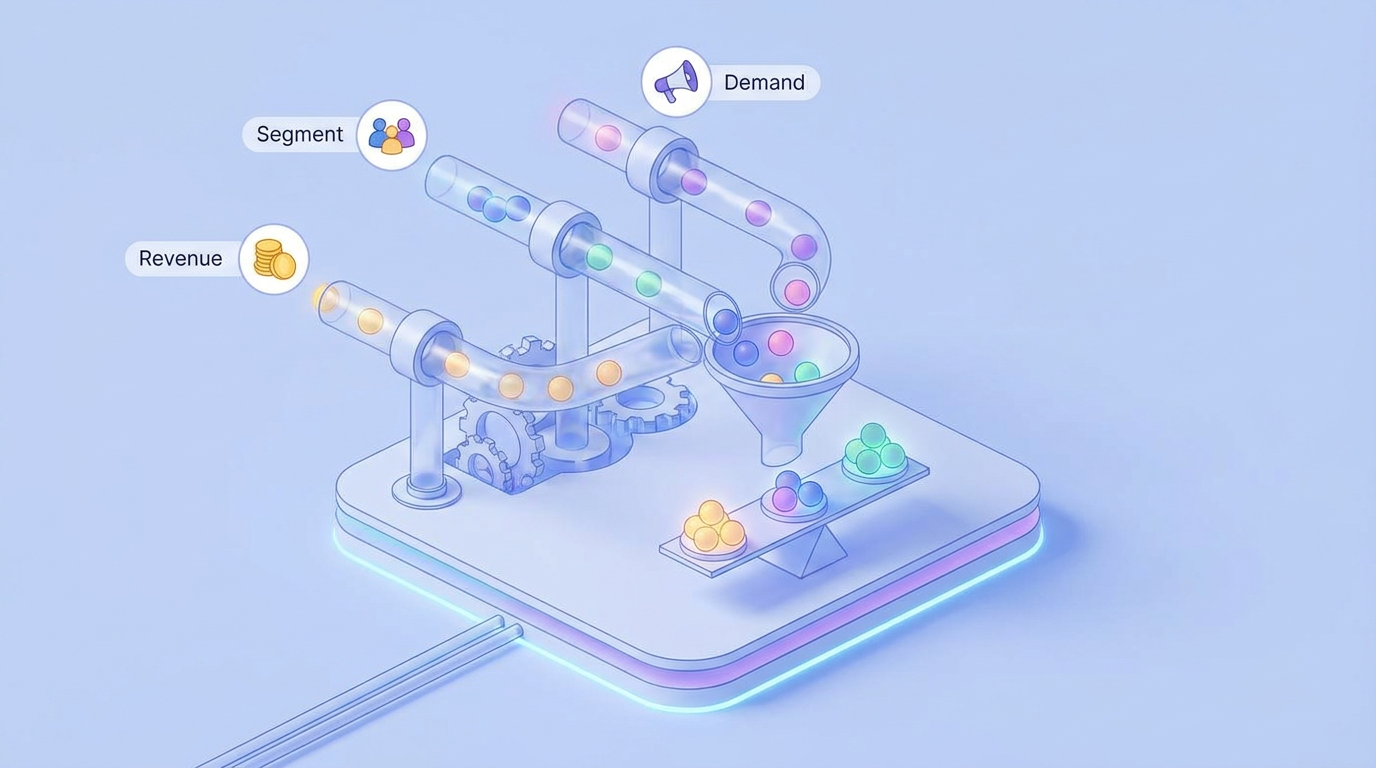
A feature request with 240 votes may come from free users who rarely use the affected workflow. Another request with 35 votes could be blocking renewals across several high-value accounts. Sorting by vote count alone puts the louder request first, even when the smaller request matters more to the business and its target customers.
Customer feedback prioritization needs several signals. Upvoty helps teams collect demand on a structured feedback board, but votes should begin the decision process rather than finish it.
Customer feedback prioritization: the quick answer
Use this workflow to prioritize requests without allowing one metric to control the roadmap:
- Merge duplicate requests and count demand at the account level.
- Attach account value, customer tier, use case, and lifecycle stage.
- Measure request velocity over a defined recent period.
- Rate each request against current product strategy.
- Add confidence, expected impact, and estimated effort.
- Score requests with explicit weights and capped revenue influence.
- Review the leading requests as a group before committing.
- Publish selected work to the roadmap and close the loop after release.
The exact weights can change by product stage. The process should not.
Build a reliable customer feedback prioritization dataset
Scoring unreliable records produces unreliable priorities. Start by consolidating duplicate requests, separating feature requests from defects, and identifying the account behind each vote.
Export the last 90 days first. A recent window is easier to clean and reveals whether current demand differs from the backlog accumulated over several years. Keep older requests available, but do not let their lifetime vote totals hide changes in the market.
For every request, capture a consistent minimum dataset: unique voting accounts, total users represented, account value, customer tier, use case, first request date, most recent request date, current status, strategic theme, and estimated effort. Record whether the request came from a customer, prospect, churned account, internal team, or partner.
Account-level counting prevents one large organization from appearing to be 40 separate pieces of demand because 40 employees voted. User-level counts still matter for workflow breadth, but account-level demand should be visible beside them.
Merge requests by customer outcome, not wording
Customers describe the same need in different language. “Email a weekly report,” “scheduled PDF delivery,” and “send dashboards to executives” may all point to scheduled reporting. They should normally be grouped under one outcome before scoring.
Do not merge requests merely because they mention the same part of the product. Export controls and scheduled reports both involve reporting, but they solve different jobs. Combining them inflates demand and produces a vague solution that is difficult to scope.
A useful canonical request has a clear URL and outcome, such as feedback.example.com/b/feature-requests/scheduled-pdf-reports. Preserve the original customer comments beneath it. Those comments explain why the request exists and often expose a smaller solution than the initial feature description suggests.
The broader feature request management workflow covers intake, deduplication, ownership, and status changes in more detail.
Weight revenue in customer feedback prioritization
Revenue provides useful context because requests can affect renewals, expansion, and sales opportunities. It becomes dangerous when teams treat every dollar associated with a request as guaranteed revenue impact.
An account worth $50,000 annually requesting a feature does not mean the feature is worth $50,000. The customer may renew without it. The feature may serve only five users. A sales opportunity may list it as desirable rather than required.
Separate three types of commercial evidence:
- Revenue at risk has a confirmed renewal, retention, or contractual concern.
- Expansion potential has a defined opportunity connected to the capability.
- Revenue represented means paying accounts voted, without evidence of risk or expansion.
These categories should not receive equal weight. Confirmed retention evidence is stronger than a salesperson attaching an open opportunity to a popular request. Ask for the source, date, account, and exact customer statement when commercial urgency is claimed.
Cap the revenue component of the score. Without a cap, one unusually large account can override product strategy and push the team toward custom development. A practical model converts revenue bands into a 0-to-5 rating rather than inserting raw annual recurring revenue into the formula.
For example, a request can receive a commercial rating of 5 when it affects several valuable accounts and has documented retention or expansion evidence. A request linked to one large account but no confirmed consequence might receive 2 or 3. This preserves commercial context without pretending the financial outcome is certain.
Also check concentration. Ten target accounts requesting the same workflow usually provide stronger market evidence than one account representing the same combined revenue.
Prioritize customer feedback by segment and customer tier
Customer tier explains what an account pays or how it is supported. Segment explains whether the account resembles the customers the product is intended to serve. Keep the fields separate.
A premium plan does not automatically make an account strategically relevant. A large company may be using the product in an unusual way, while 15 smaller accounts could represent the use case the product team wants to grow.
Define segments using attributes that affect product decisions. These might include company size, industry, role, geography, technical maturity, regulated status, or primary job to be done. Avoid creating dozens of segments that cannot influence a decision.
Then calculate request distribution. If 70 percent of support volume comes from small accounts but the current strategy focuses on mid-market finance teams, raw request volume will naturally favor the wrong group. Segment weighting corrects that bias.
| Our running example is an illustrative B2B reporting SaaS. |
|---|
| It has four prominent requests: scheduled PDF reports, dark mode, SAML SSO, and CSV formatting controls. |
| Dark mode has the most votes, but many come from individual users on entry plans. |
| Scheduled PDF reports appear repeatedly among mid-market accounts that distribute reports to executives. |
| SAML SSO is concentrated among enterprise prospects and customers. |
This does not make dark mode unimportant. It changes the evidence supporting it.
Customer tier can also reveal expected capability. SAML SSO may be essential for enterprise adoption even if few users actively vote for it. Security teams and procurement contacts often do not use public voting boards, so their needs enter through sales calls, security reviews, and account management.
Segment analysis works best when paired with qualitative context. The principles in this guide to voice of customer research help distinguish repeated wording from a repeated underlying problem.
Use request velocity to find rising customer demand
Lifetime votes favor old requests. Request velocity shows what is gaining attention now.
Choose a fixed period, usually 30, 60, or 90 days, and count new voting accounts rather than only new individual votes. Compare that number with the preceding period. A request that gained 12 new accounts this month after averaging two per month deserves investigation, even if its lifetime total remains modest.
Record the source of the increase. A spike can reflect real demand, but it can also come from a sales campaign, one customer sharing the board internally, a pricing change, or a prominent link in the application.
The scheduled reporting request in the example has 84 lifetime votes and 11 new account votes in the last 30 days. Dark mode has 241 lifetime votes but only seven new account votes during the same period. That recent movement strengthens the case for scheduled reports.
Do not automatically promote every fast-growing request. Velocity indicates a change that requires explanation. Read the new comments and speak to several customers. If the increase followed a recent redesign that removed an existing workaround, the team may need to fix regression rather than build a large new capability.
Use the same date window across requests. Mixing 30-day growth for one request with 90-day growth for another makes comparison meaningless.
Add strategic context to customer feedback prioritization
A backlog is not a substitute for product strategy. Before scoring requests, define the product outcomes that matter during the planning period.
These outcomes need to be specific enough to reject work. “Improve reporting” is too broad. “Help finance teams distribute recurring executive reports without manual exports” gives the team a clear basis for evaluating scheduled delivery, templates, permissions, and export controls.
Rate strategic fit against the current Product Goal, product principles, and committed themes. The official Scrum Guide describes the Product Goal as the long-term objective for the Scrum Team and makes clear that the Product Backlog is ordered rather than simply accumulated.
Use a short scale with written definitions. A score of 5 could mean the request directly advances a current product outcome. A 3 supports an adjacent outcome. A 1 has customer value but does not support the current direction.
Strategy should not become a convenient veto. If a request has strong demand but low strategic fit, record that conflict. It may indicate that the strategy is wrong, that acquisition is bringing in unsuitable customers, or that the product is serving a use case the company has not acknowledged.
This is also where product teams should examine growth assumptions. Feedback from customers acquired through a narrow campaign may not represent the wider market. The article on using feedback data to improve paid acquisition explains how product evidence and acquisition targeting affect each other.
Score customer feedback without creating false precision
A score creates consistency, not certainty. Keep the model understandable enough that a product manager can explain why one request ranked above another without opening a complex spreadsheet.
One workable formula is:
Priority = ((Demand × 0.30) + (Commercial value × 0.20) + (Target segment fit × 0.20) + (Strategic fit × 0.30)) × Confidence ÷ Effort
Rate the first four factors from 0 to 5. Use a confidence multiplier such as 0.5 for weak evidence, 0.8 for reasonable evidence, and 1.0 for validated evidence. Estimate effort with a relative scale such as 1, 2, 3, 5, and 8.
The weights are not universal. A young product seeking repeatable demand may weight segment fit and learning more heavily. A mature B2B platform approaching enterprise renewals may give additional weight to commercial risk and compliance.
This table shows the evidence for the illustrative reporting SaaS. The figures are sample planning inputs, not Upvoty customer results.
| Request | Lifetime votes | ARR represented | New account votes, 30 days | Strategic fit, 0-5 | Relative effort | Planning decision |
|---|---|---|---|---|---|---|
| Scheduled PDF reports | 84 | $186,000 | 11 | 5 | 3 | Validate scope, then plan |
| Dark mode | 241 | $72,000 | 7 | 1 | 2 | Keep open and monitor |
| SAML SSO | 46 | $410,000 | 9 | 4 | 5 | Run enterprise discovery |
| CSV formatting controls | 63 | $128,000 | 4 | 3 | 1 | Deliver as a smaller near-term improvement |
The table prevents an obvious mistake: choosing dark mode because it has the most votes. It also prevents a second mistake, which would be choosing SAML SSO solely because the associated accounts represent the most revenue.
CSV formatting controls may move first because they address a clear reporting problem at low effort. Scheduled PDF reports can follow after discovery confirms scheduling, recipient permissions, file format, and delivery controls. SAML SSO needs deeper validation because its commercial value is high but its implementation and maintenance cost are larger.
Prioritization involves choices between evidence that cannot always be reduced to one common unit. This talk offers a useful way to think about decisions where no option dominates every criterion.
Review customer feedback priorities as a team
Do not let the spreadsheet make the final decision. Hold a short review with product, engineering, design, customer success, sales, and support representatives who can challenge the inputs.
Send the ranked list before the meeting. During the review, focus on the top group, unexpected movements, weak evidence, and requests where one account controls most of the score. Avoid debating every backlog item.
Ask engineering to challenge effort and dependency assumptions. Ask customer success to separate general enthusiasm from renewal risk. Ask sales to distinguish closed-lost evidence from a prospect’s broad wish list. Ask product and design whether the request describes the problem or prematurely specifies a solution.
For scheduled PDF reports, discovery might show that most customers do not need a full scheduling engine. They need a weekly email containing a secure report link. That smaller solution reduces file retention, permission, and attachment-size concerns.
Record the decision and its rationale. “Not now because current demand is concentrated outside our target segment” is useful. “Low priority” is not. A decision log prevents the same argument from restarting each quarter.
When customer records are joined with account value and behavioral data, collect only what the decision requires. The European Commission’s explanation of GDPR data minimisation states that personal data should be adequate, relevant, and limited to what is necessary. Use account identifiers where possible and restrict access to sensitive commercial notes.
How Upvoty supports customer feedback prioritization
A scoring framework still needs a reliable operational flow. Upvoty removes several manual handoffs around collection, demand visibility, roadmap communication, and release follow-up while leaving strategic and commercial judgment with the product team.
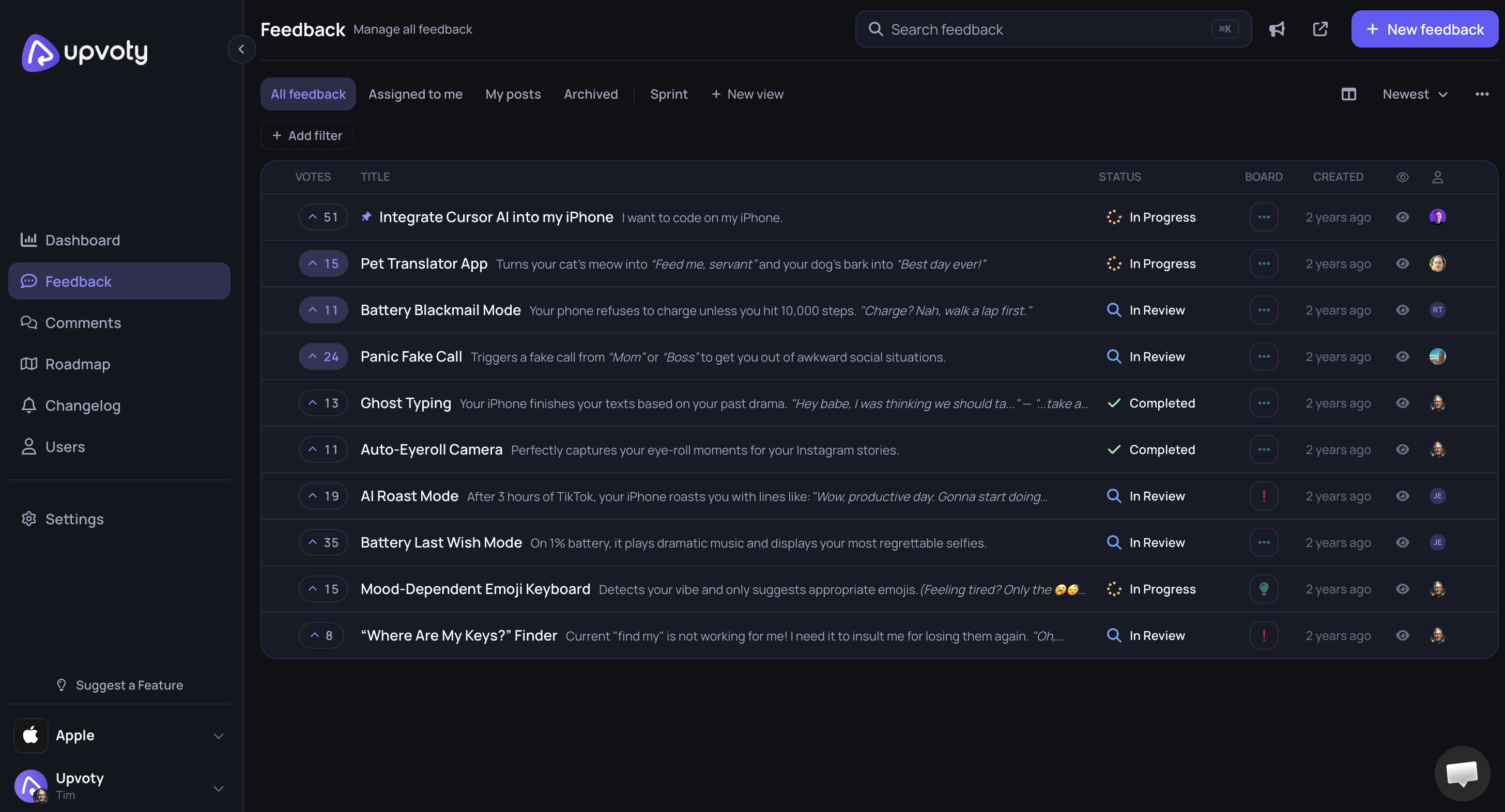
First, customers submit requests and vote through a public or private board. Related feedback can be managed around a shared request instead of remaining scattered across support tickets, call notes, and spreadsheets. Product teams can review demand and comments in the dashboard while checking account value and segment context from their internal customer records.
This is what the feedback management workspace looks like when requests and activity are brought into one dashboard.
Next, the team applies its prioritization model. Upvoty supplies organized feedback and voting evidence. Product leaders still decide how much weight to give revenue, segment fit, velocity, strategy, confidence, and effort. That separation is healthy because no feedback platform can determine company strategy from votes alone.
Once a request is selected, move the relevant initiative to a customer-facing product roadmap. Publish only the level of commitment the team can support. “Under consideration,” “planned,” and “in progress” communicate different promises, so status definitions should be agreed internally.
The guide to writing a clear product roadmap explains how to communicate direction without turning every idea into a fixed delivery commitment.
After release, use the product changelog to explain what changed, who benefits, and how to use it. Return to the original request and notify the people who contributed. This closes the loop and gives the team a useful validation group for the shipped solution.
Teams comparing different systems should evaluate whether they need collection alone or a connected board, roadmap, and changelog workflow. The product feedback tools selection guide provides practical criteria, while the Upvoty and Canny comparison covers two common options. Canny, Featurebase, and Nolt should be checked on their own current pricing pages before making a cost comparison.
Common customer feedback prioritization mistakes
The most common failure is treating votes as a binding referendum. Voting lowers the effort required to express interest, but it does not measure urgency, willingness to pay, workflow importance, or implementation cost.
Another failure is attaching total account revenue to every request from that account. This makes popular requests among large customers appear financially guaranteed. Record the strength of the commercial evidence and cap its effect.
Teams also over-segment their data. If every industry, plan, role, region, and company size becomes a separate category, the sample for each combination becomes too small to guide a decision. Use segments connected to strategy.
Watch for stale accumulation. An old request may have hundreds of votes from former customers, inactive accounts, or users acquired under a previous positioning. Show recent velocity and active-account demand beside lifetime totals.
Effort estimates can distort the model as well. Dividing by effort strongly favors small work, which can fill a roadmap with minor improvements while larger strategic capabilities never advance. Reserve capacity for larger themes rather than expecting one score to allocate every engineering week.
Finally, avoid publishing every high-scoring request as a promise. Discovery can change scope, dependencies can emerge, and customer evidence can weaken. A public roadmap should communicate direction with honest status definitions, not act as a fixed contract.
Customer feedback prioritization FAQ
Should the feature with the most votes be built first?
No. Vote count shows expressed demand, but it does not show which segments voted, how quickly demand is growing, whether the request supports strategy, or how costly it will be to deliver. Use votes as one input beside account-level demand, commercial evidence, segment fit, strategy, confidence, and effort.
How much weight should revenue get in feedback prioritization?
For many B2B SaaS teams, 15 to 25 percent is a reasonable starting range, but the right weight depends on concentration, product stage, and renewal risk. Convert revenue into capped bands and distinguish represented revenue from documented retention or expansion impact. Test whether one large account can dominate the result. If it can, reduce or cap the weight.
How often should product teams reprioritize customer feedback?
Review new demand continuously and run a structured scoring review monthly or quarterly, depending on release cadence. Recalculate sooner when a major renewal risk, regulatory requirement, product incident, or strategic change appears. Do not reorder committed development every time a new vote arrives.
How do you prioritize feedback from prospects versus customers?
Track the sources separately. Customer feedback reflects real product use, while prospect feedback can reveal adoption barriers and market expectations. Give prospect requests more confidence when several qualified opportunities report the same blocker and sales records the outcome. Avoid treating an unqualified pipeline total as certain product value.
Can customer feedback prioritization be automated with AI?
AI can help group similar requests, summarize comments, and identify themes in a large dataset. It should not make roadmap commitments on its own. Strategic fit, account risk, evidence quality, security implications, and development effort require accountable human review. Check merged groups manually because superficially similar comments can describe different outcomes.
What should happen to feedback that is not selected?
Keep it visible with an accurate status and rationale. Continue collecting votes and comments, then monitor whether velocity, segment distribution, or strategy changes. Reject requests only when the team is confident they do not fit the product. A clear “not planned” status can be more respectful than leaving customers waiting indefinitely.
If you need to combine structured voting with clearer roadmap and release communication, use Upvoty to create the feedback workflow around your prioritization model. Keep strategic judgment with the product team, while giving customers a consistent place to contribute and follow progress. Read next: How to Close the Customer Feedback Loop with a Changelog. Read next: Using MCP to Analyze Customer Feedback in ChatGPT, Claude, and Cursor. Read next: Customer Feedback Repository: Collect, Prioritize, and Act. Read next: Customer Feedback Prioritization With the RICE Framework.