A customer sees their feature request marked as “planned,” checks again three months later, and finds no explanation or visible progress. The roadmap still looks active, but its information can no longer be trusted.
Public product roadmap software helps prevent that breakdown by connecting feedback, product decisions, delivery statuses, and release communication in one visible workflow. Upvoty supports this model through its product roadmap software, feedback boards, and changelog.
Quick answer: how to build a public product roadmap
Use the following workflow to create a roadmap customers can understand and your team can maintain:
- Define a small roadmap structure based on customer-facing outcomes.
- Connect roadmap items to the requests and votes behind them.
- Create statuses with precise internal rules.
- Decide which plans should be public, private, or shared selectively.
- Assign owners and establish a regular update schedule.
- Write each roadmap item with context, scope, and honest uncertainty.
- Move shipped work into a changelog and notify interested customers.
The rest of this guide explains each step in that order.
1. Structure your public product roadmap around outcomes
Start with fewer categories than you think you need. A public roadmap is not a copy of your engineering backlog, so it does not need every sprint, technical task, bug, dependency, or internal milestone.
A practical structure usually has three to five visible stages. For example, a SaaS team might use Under Consideration, Planned, In Progress, and Shipped. Customers can understand those labels without knowing how the development team runs its sprints.
Consider an illustrative billing platform that collects feedback at feedback.example.com. One popular request asks for bulk invoice export. Internally, the work involves permissions, export formats, background processing, and audit logs. Publishing each technical task would make the roadmap noisy. The public item should instead describe the customer outcome: “Export multiple invoices in one file.”
Organize items around product areas only when those areas are meaningful to customers. Labels such as Billing, Reporting, Mobile, and Integrations work because users know where to look. Internal team names such as Squad Blue or Platform Enablement do not.
A time-based view can be useful, but exact dates create risk when discovery is incomplete. Now, Next, and Later communicate sequence without turning an early intention into a deadline. Quarterly groupings offer more precision, though customers may reasonably treat “Q3” as a delivery commitment.
Use the least precise structure that still helps customers make decisions. If an integration is important to a pending purchase, “Later” may not give the buyer enough information. In that case, a private conversation can provide context without publishing a date the team cannot defend.
For additional guidance on naming and arranging roadmap entries, see these tips for writing a clear product roadmap.
2. Connect customer requests to public roadmap items
A trustworthy public product roadmap should show that planned work has a reason to exist. That reason may include customer demand, strategic direction, retention risk, technical health, or regulatory requirements. Votes are useful evidence, but they are not the entire prioritization model.
For the billing platform, assume the team has received several versions of the bulk export request. One customer asks for CSV export, another asks for a ZIP file containing PDFs, and a third wants scheduled exports sent to cloud storage. Treating these as three unrelated ideas would split demand and hide the common problem.
First, consolidate duplicate requests under the broader need: customers must move many invoice records out of the product efficiently. Keep the details attached as supporting evidence. Product discovery can then determine which export formats belong in the first release.
This is where feedback boards for product teams should connect directly to roadmap planning. When related requests are associated with one planned item, product managers retain the original comments, voters, use cases, and demand signals. Customers also avoid submitting the same idea repeatedly.
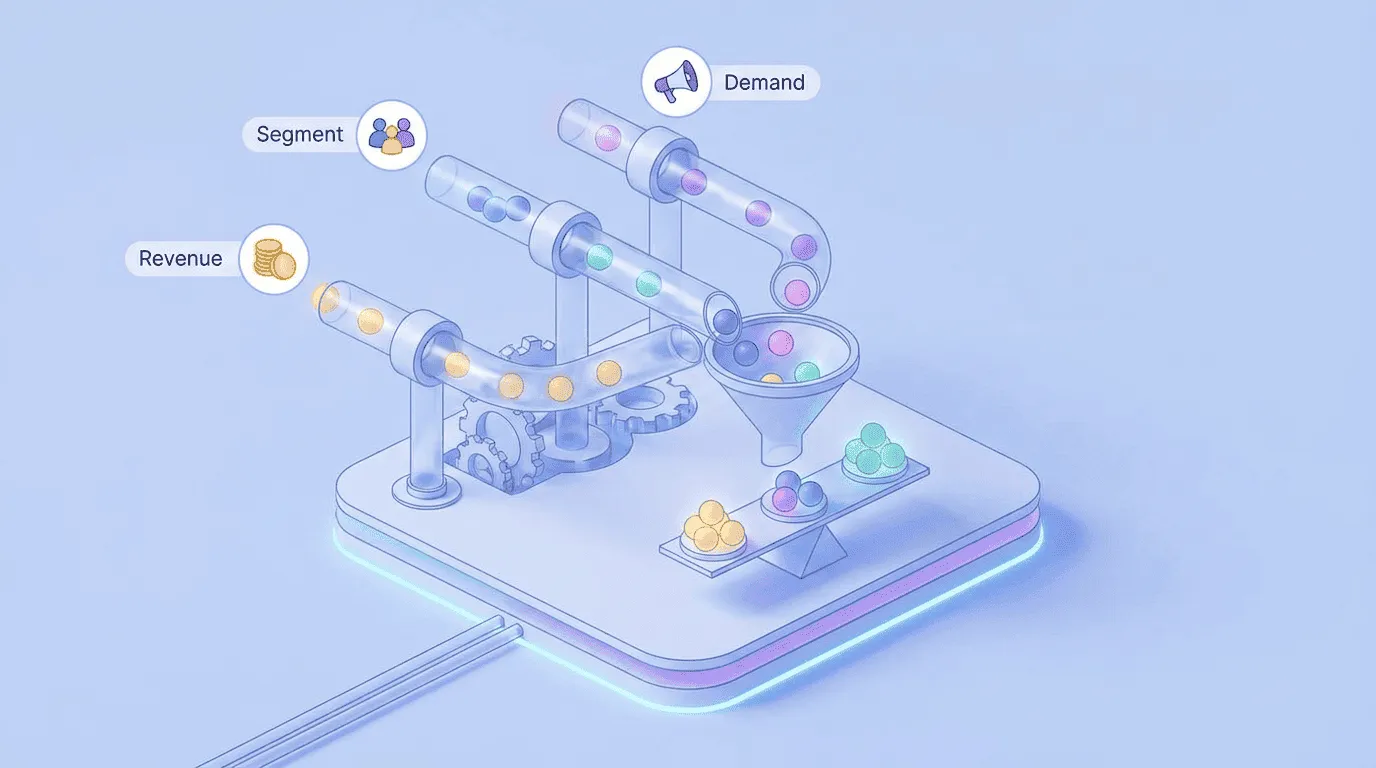
Do not automatically promote the most-voted request. Ten votes from occasional users may matter less than three detailed requests from customers who perform the task daily. Contract value can also influence priority, but revenue should not erase product strategy or the needs of smaller accounts. The practical method in customer feedback prioritization by revenue, segment, and demand explains how to combine these inputs without reducing every decision to a vote count.
For the export example, the team might move the request onto the roadmap because it affects finance administrators across several account segments, fits the reporting strategy, and removes repetitive manual work. The roadmap description should communicate that reasoning without exposing account names or commercial details.
3. Choose public roadmap statuses customers can interpret
Status names only work when every person updating the roadmap applies them consistently. Write an internal definition for each status, including entry criteria, exit criteria, and who can authorize the change.
The following model gives customers useful information while preserving room for product discovery:
| Public status | What it means internally | What customers can reasonably expect | Main risk |
|---|---|---|---|
| Under Consideration | The problem is being reviewed or researched | The team has acknowledged the need but has not committed to delivery | Customers may mistake interest for approval |
| Planned | The outcome has been approved and placed in the delivery plan | The team intends to build it, although scope or timing may change | “Planned” becomes a permanent waiting room |
| In Progress | Active design, development, or validation is underway | Work has started, but release is not guaranteed on a specific date | Status stays unchanged during a pause |
| Shipped | The capability is available to its intended audience | Customers can use it or follow release instructions | Phased access is not explained |
Avoid vague labels such as Open, Active, or Future unless you define them beside the roadmap. “Open” could mean open for voting, accepted for review, or approved for development.
For bulk invoice export, Under Consideration begins when the product manager starts reviewing workflows and technical constraints. Planned begins only after the team approves a feasible first scope. In Progress starts when delivery work actually begins, not when somebody creates an engineering ticket.
If development pauses, say so. Moving an item back to Planned can feel uncomfortable, but leaving it In Progress for six months does more damage. Add a short update explaining that priorities or dependencies changed. Customers are generally better served by an unwelcome fact than a status that quietly stopped meaning anything.
Do not use Shipped until the intended users can access the result. If bulk export is available only to a small beta group, label the release accordingly in the item description.
4. Set privacy rules for your public product roadmap
Not every product decision belongs in public. Security work, contractual commitments, potential acquisitions, unannounced partnerships, and experiments with uncertain legal implications may require restricted visibility.
Create three visibility levels: public, customer-only, and internal. A public item can be indexed and shared broadly. A customer-only item may require authentication or access to a private board. Internal items remain available to the product team without appearing on the customer-facing roadmap.
Before publishing an entry, check whether it exposes:
- A customer’s name, comment, email address, or contract terms
- Security weaknesses that have not been resolved
- Confidential partner or vendor negotiations
- Unapproved dates presented as commitments
- Internal employee names or sensitive operational notes
- Personal data that lacks a valid reason for publication
The EU’s General Data Protection Regulation establishes principles such as data minimization and purpose limitation. Even when a roadmap request is submitted publicly, avoid copying personal information into the roadmap description unless it is necessary and appropriately handled.
The billing platform can publicly show that bulk invoice export is planned. It should not reveal that a named customer requested the feature during a contract renewal. That commercial context can remain attached to the underlying request for authorized staff.
Privacy should also work at the board level. A B2B company may operate one public roadmap for general improvements and a separate private roadmap for enterprise customers. Keep the status definitions consistent across both so an item does not appear committed in one place and speculative in another.
5. Set a reliable public roadmap update frequency
Update frequency should match how quickly the product plan changes. Weekly review works well for teams shipping frequently. A monthly review may be enough for products with longer development cycles. Quarterly maintenance alone is usually too slow for an active customer-facing roadmap.
Assign one owner for roadmap hygiene. That person does not need authority over every product decision, but they must be able to ask item owners for an update and correct stale information.
Run the review from oldest activity to newest. Look first for In Progress items that have not changed recently, Planned items without an owner, and Under Consideration entries that have accumulated new evidence. Then check whether recently shipped work still appears in an active column.
For the bulk export item, the product manager might add an update after discovery clarifies that CSV will ship first while PDF bundling remains under consideration. That note preserves the original outcome without pretending the first release covers every variation.
Record meaningful changes rather than publishing activity for its own sake. “Work continues” tells a reader very little. “The first release will support CSV exports of up to 5,000 invoices; scheduled delivery is not included” gives users information they can act on.
A public timestamp is useful because it lets customers judge freshness. It also creates healthy internal pressure. An item marked In Progress with no update for four months invites a question that the team should already have asked.
Use reminders, but do not let automatic reminders generate automatic promises. A person familiar with the item should approve each status change and public note.
6. Write roadmap updates that explain scope and uncertainty
A good roadmap entry answers four questions: what problem is being addressed, who experiences it, what outcome the team is pursuing, and what remains uncertain.
Write “Export multiple invoices in CSV format from the invoice list” instead of “Improve exports.” The first version sets a visible boundary. It also helps customers explain whether the planned solution addresses their request.
Avoid language that sounds more certain than the decision behind it. “We are targeting September” is different from “Available September 1.” If the date is not a commitment, state what could change it, such as beta findings or a dependency on another release.
The rationale matters too. This short TED talk is useful for understanding why communication becomes more persuasive when it starts with purpose rather than a list of features.
Apply that principle carefully. The reason for bulk export is not that the team wants to add another reporting option. It is that finance administrators spend too much time retrieving invoices one by one.
Publish deeper context outside the roadmap card
Roadmap cards need to stay scannable, but some changes deserve a fuller explanation. A separate article can document the customer problem, explain scope decisions, show early workflows, and answer questions that would overwhelm the card itself.
Treat these posts as product communication rather than search-driven announcements. Link the article from the roadmap item, then link back to the item so readers can follow status changes. Keep the two sources consistent. If the roadmap says CSV export is In Progress while the article still promises CSV and PDF delivery in the same release, customers will not know which statement governs.
Do not write a long article for every small change. Reserve deeper posts for decisions that affect workflows, packaging, migration, access, or previously communicated scope. Short roadmap notes remain better for routine movement between statuses.
7. Connect the roadmap to shipped updates
A roadmap should not end when an item reaches Shipped. Customers who voted or commented need to know what became available, what changed from the initial proposal, and where they can find it.
Create a changelog entry that describes the delivered capability in past or present tense. Include access requirements, rollout conditions, and links to relevant instructions. Then notify the customers connected to the original request.
For the billing example, the final update could state that workspace administrators can export up to 5,000 invoices as a CSV file from the invoice list. It should also clarify that scheduled exports and PDF bundles were not included in this release. Those unshipped needs can remain as separate feedback items rather than disappearing.
This closed loop prevents a common failure: the team delivers something related to a request, marks the entire request complete, and leaves customers to discover that their specific use case was excluded.
A dedicated product changelog gives shipped work a permanent place outside the active roadmap. Keep the roadmap focused on what is being considered or built, while the changelog records what customers can use now.
How Upvoty supports a public product roadmap workflow
Running this process with documents, spreadsheets, and separate survey tools creates repeated administrative work. Feedback must be copied into planning files, roadmap statuses must be updated manually, and release messages need another audience list.
Inside Upvoty, the workflow starts with a feedback board where customers submit requests, comment, and vote. Product teams can organize related requests before deciding whether the underlying problem belongs on the roadmap. The process described in this feature request management workflow is useful when duplicate suggestions have different wording or scope.
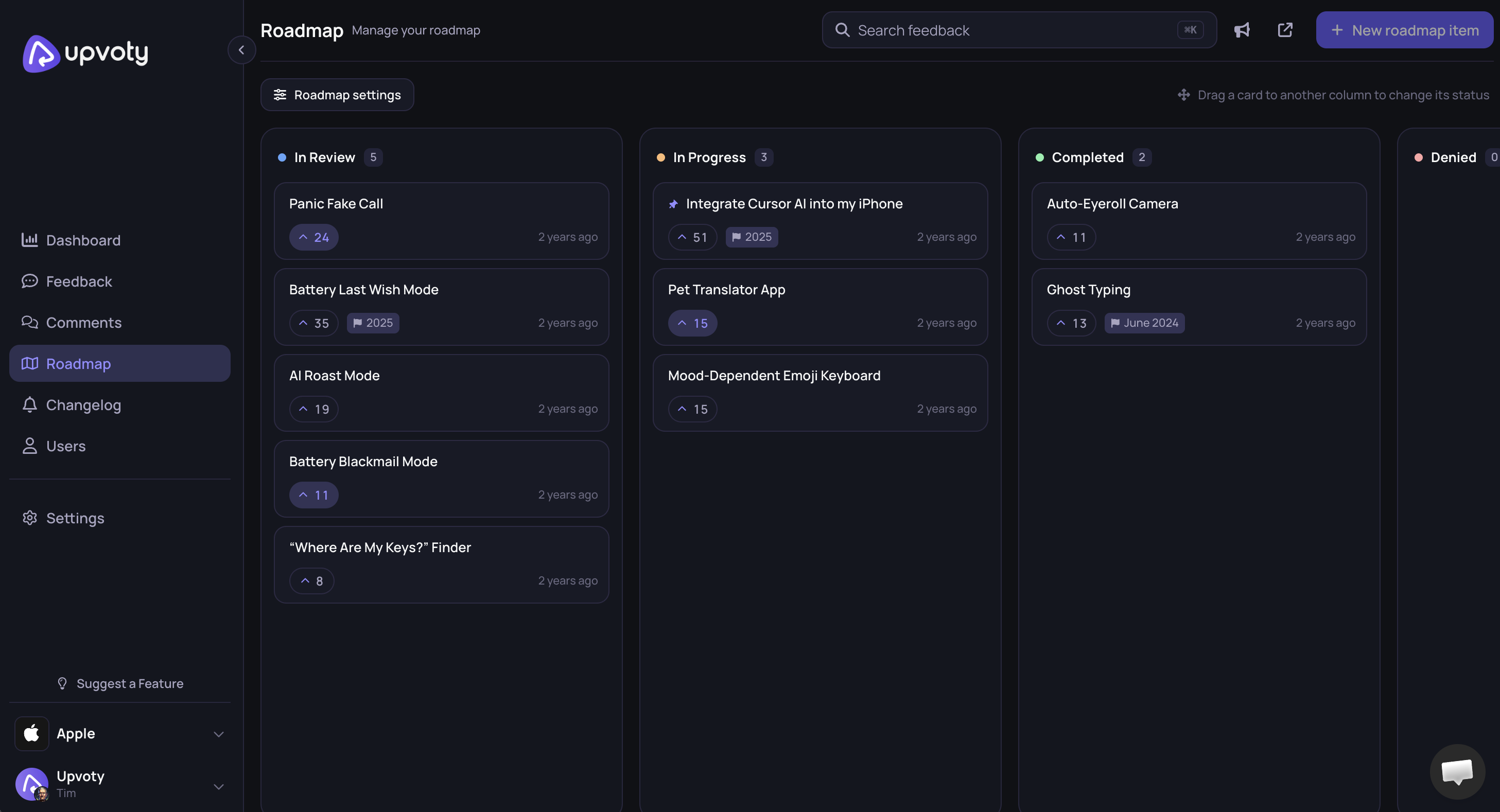
The team then creates and maintains roadmap items in the product dashboard. Statuses make planned work understandable to customers without publishing the engineering backlog.
This screenshot shows the roadmap management view used to organize planned work.
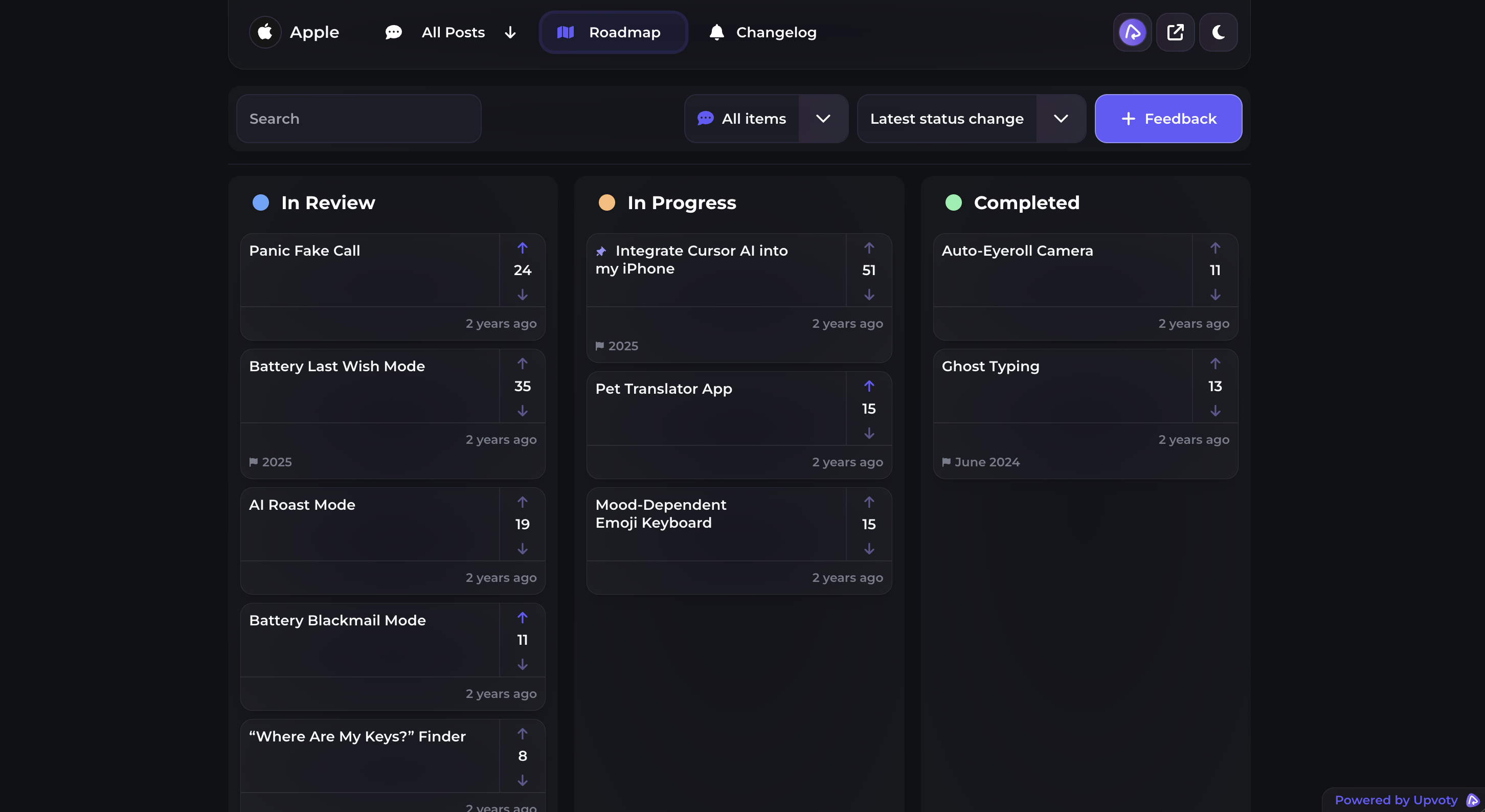
Next, the public roadmap gives customers a visible place to check progress rather than asking support for individual updates. Teams can decide which boards are public or private according to their communication needs.
The customer-facing result keeps planned work visible in a simpler format.
When work ships, the team can publish an update through the changelog. The value comes from continuity: requests, roadmap decisions, and release communication remain parts of one process rather than unrelated records.
This setup does not remove the need for product judgment. Upvoty can make evidence and communication easier to manage, but a team must still decide whether a request fits its strategy, what scope is viable, and which promises it is prepared to make.
Common public product roadmap mistakes
Publishing too much is as risky as publishing too little. A roadmap containing dozens of minor tasks makes important changes difficult to find. It also creates a maintenance burden that tends to produce stale entries.
The most damaging mistakes are usually operational:
- Treating votes as binding commitments
- Leaving items In Progress after work has paused
- Publishing exact dates before dependencies are understood
- Combining several customer outcomes in one oversized item
- Marking partial delivery as complete without explaining exclusions
- Failing to notify the people who submitted the original request
Another mistake is turning the roadmap into a sales promise. Sales teams can use it to discuss direction, but planned items should not silently become contractual obligations. Establish an internal rule for what representatives may say about dates, scope, and availability.
Accessibility also affects trust. Use descriptive labels, readable contrast, keyboard-accessible controls, and text that does not rely on color alone. The Web Content Accessibility Guidelines provide the standard reference for making web interfaces more usable for people with disabilities.
Finally, do not delete uncomfortable history without explanation. If a planned item is cancelled, move it to an appropriate status and state why. A short, factual note is better than making the item vanish after customers have followed it for months.
How to choose public product roadmap software
Evaluate software against the whole feedback loop, not just the visual roadmap. Confirm that it can collect requests, consolidate duplicates, preserve comments and votes, control visibility, publish understandable statuses, and communicate shipped changes.
Test the exact workflow with one real request. Submit it as a customer, merge or organize related feedback, move the resulting item through your statuses, publish it to the intended audience, and close it with a release update. This trial reveals more than a polished sample board.
Upvoty, Canny, Featurebase, and Nolt approach feedback and roadmaps with different interfaces, packaging, and workflow choices. Check each vendor’s own pricing page for current numbers and confirm which privacy controls and notification options are included. Upvoty’s pricing page provides its current plan details, while this practical product feedback tools guide explains the broader selection criteria.
Pay particular attention to administration. A tool may look excellent during setup but become difficult to maintain once hundreds of requests, comments, and duplicate ideas accumulate. Ask who will own moderation, status updates, customer notifications, and archived entries before choosing the system.
Public product roadmap software FAQ
Should a public roadmap include release dates?
Include dates only when the organization is prepared to stand behind them. Date ranges or quarter targets may be appropriate for work with understood scope and dependencies. Use status-based planning for earlier items, and explain that timing may change.
How many items should be on a public product roadmap?
There is no universal limit. Publish enough items to communicate meaningful direction while keeping every entry current. If the team cannot review each visible item at least monthly, the roadmap probably contains too much detail.
Should customers be allowed to vote on roadmap items?
Voting helps measure relative interest and identify people to contact for research. It should not function as an automatic queue. Combine votes with customer segment, problem severity, strategic fit, usage evidence, revenue context, effort, and risk.
What is the difference between a feedback board and a public roadmap?
A feedback board collects problems, ideas, comments, and votes. A roadmap communicates which outcomes the product team is considering, planning, or building. Not every request should become a roadmap item, and one roadmap item may address several related requests.
Can a public roadmap contain private items?
The customer-facing view cannot expose private items, but the underlying roadmap system can support multiple visibility levels. Teams often maintain public entries alongside customer-only boards and internal planning items. Verify permissions from a logged-out browser and a test customer account.
How often should roadmap statuses be updated?
Review active items weekly or monthly according to the pace of delivery. Update an item whenever its status, scope, timing, or availability changes materially. Do not wait for the next scheduled review when published information has already become inaccurate.
What should happen when a planned feature is cancelled?
State that it is no longer planned and give a concise reason when possible. Priorities, technical constraints, weak validation, or a better alternative may change the decision. Preserve connected requests so the evidence remains available if the problem returns.
Does a public roadmap create legal commitments?
It can create commercial expectations, even when it is not intended as a contract. Use careful language, avoid unsupported guarantees, and have legal counsel review roadmap disclaimers or sales practices when commitments could affect agreements.
A credible roadmap connects requests, decisions, delivery, and release communication without pretending every plan is certain. See how Upvoty can support that public roadmap workflow, then test it with one active customer request from submission through shipment. Read next: Idea Management Software. Read next: Product Roadmap Software That Connects Feedback to Delivery. Read next: How Product Changelog Software Helps Customers Find Relevant Updates.