A feedback board can fill up quickly while the product team still lacks a defensible answer to a basic question: which request should enter the next planning cycle? Duplicate posts, thin voter context, and feedback arriving through several channels make raw vote totals hard to use.
Teams reviewing Nolt alternatives should assess the full decision workflow. Upvoty is built around that workflow, from collecting requests through boards and widgets to merging related feedback, applying context, and sharing roadmap progress.
Quick answer: how to choose among Nolt alternatives
Use this workflow to compare platforms before moving feedback data:
- List every place customers currently submit requests, including your board, support inbox, and product UI.
- Test how each tool creates one canonical request from similar submissions.
- Add the customer context that influences priority, such as segment, account value, and use case.
- Score a sample of real requests with demand, strategic fit, effort, and urgency.
- Check how planned, in-progress, and released decisions reach voters.
- Run the workflow with 20 to 30 existing requests before committing to a migration.
For a direct platform-level review, see the detailed Upvoty Nolt alternative comparison.
What to evaluate in Nolt alternatives before you switch
A useful comparison starts with the work your team performs each week. Public voting is only the intake layer. Product managers also need to spot overlap, understand who asked, retain internal reasoning, and provide customers with a clear outcome.
Use a live set of requests during evaluation. Consider AuroraDesk, a B2B help desk product with requests in a public board, Intercom conversations, and quarterly account reviews. Three customers submit variations of the same need: "SAML login," "enterprise SSO," and "Okta provisioning."
The team needs one parent request, links to all affected accounts, a record of why the request matters, and a way to update each requester when the work ships. A platform demo that only shows a clean voting board leaves the difficult work untested.
| Candidate | Collection workflow to examine | Consolidation and priority test | Best evaluation question |
|---|---|---|---|
| Nolt | Public requests and votes | Review how related submissions are grouped and enriched | Can a PM trace one initiative back to every supporting request? |
| Canny | Board, forms, and feedback sources | Review data fields, merges, and planning handoff | Does the team retain account context during triage? |
| Featurebase | Portal and in-product collection | Review duplicate handling, segmentation, and status flow | Can different customer groups receive relevant updates? |
| Upvoty | Boards, widgets, and custom submission forms | Use Merge AI, Smart Tags, segments, notes, and priorities | Can the team turn scattered feedback into a documented decision? |
Vendor capabilities and plan limits change. Run the same sample through each shortlisted product and check each vendor's current documentation and pricing before purchase.
How to collect feedback before duplicate requests spread
Collection quality shapes every later decision. Give customers an obvious route to submit ideas, then make that route available where the feedback naturally occurs.
For AuroraDesk, the product team keeps a public board for discoverability and places an in-product prompt near the account settings page, where SSO requests usually appear. The support team uses a structured form when adding feedback from conversations. Each submission captures the problem, desired outcome, company, and affected workflow.
Upvoty supports feedback boards, a feedback widget, and custom submit forms. These routes help teams capture a request with enough detail for a later merge decision.
Keep the form focused. Ask for the job the customer needs to complete, plus optional supporting detail. Long forms lower submission quality and create vague entries that consume triage time.
For teams that collect personal data alongside requests, define the minimum information required, retention expectations, and access roles. The European Commission's GDPR guidance covers core principles such as purpose limitation and data minimization. Teams serving UK users can also use the ICO guidance on data protection by design when setting up intake processes.
How Nolt alternatives should handle duplicate feedback
Duplicates are valuable evidence. They show a shared need, even when customers use different words. The operational goal is a clean parent request that retains every original signal.
In the AuroraDesk example, a PM searches for "SSO" before approving the new "Okta provisioning" request. The team merges it into the existing enterprise authentication parent, adds the new customer as a voter, and records that SCIM provisioning is a related requirement rather than the immediate scope.
This is where a manual process often slows down. The board may show one popular request while the support team holds a separate set of conversations about the same issue. A recurring triage session helps, but it requires discipline and a shared rule for when two requests describe the same outcome.
Use Merge AI to surface likely overlaps, then keep a human reviewer responsible for the final merge. Similar wording can represent separate problems. "Export invoices" and "schedule invoice exports" share a topic while calling for different product work.
The practical test is traceability. Open a prioritized request and confirm that the team can see each linked voter, related submission, internal note, and reason for the current status.
How to prioritize feedback beyond vote counts
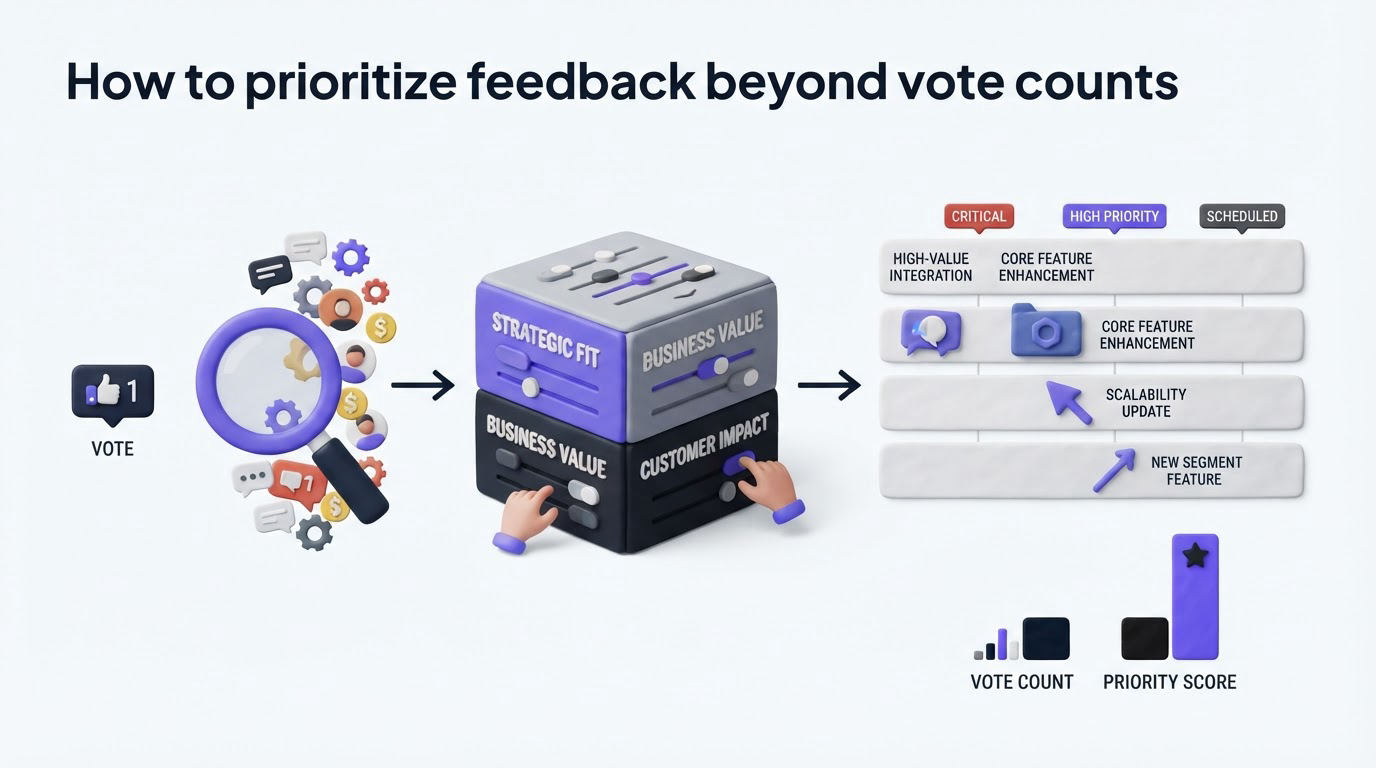
Votes indicate breadth of demand. Product decisions also need customer value, strategic direction, feasibility, risk, and timing.
AuroraDesk finds 43 votes across its consolidated SSO request. Seven come from enterprise accounts with an upcoming renewal, while several smaller accounts use basic authentication successfully. The team sets SSO as a high priority, places SCIM provisioning in a later discovery track, and documents the commercial and security rationale in an internal note.
Create a repeatable review model with four inputs:
- Demand: voters, linked accounts, and recurring support themes
- Customer impact: blocked workflows, retention risk, and expansion potential
- Product fit: alignment with the current strategy and target segment
- Delivery reality: engineering effort, dependencies, security review, and opportunity cost
Segments make the first two inputs more useful by separating feedback from groups such as trial users, enterprise customers, or a specific plan. Internal notes and assignees and priorities preserve the decision record around the request.
For a deeper scoring method, read Upvoty's guide to prioritizing customer feedback by revenue, segment, and demand. Export the last 90 days of requests first, then compare the highest-voted entries with the accounts and segments behind them.
How Upvoty supports the full Nolt alternative workflow
The strongest reason to switch comes from reducing the handoffs between collection, triage, planning, and customer communication. Here is how the AuroraDesk workflow runs in Upvoty.
First, customers submit through the public board, widget, or a tailored form. Their request enters the feedback dashboard alongside submissions added by the support team.
Next, the PM reviews similar entries. Merge AI assists with identifying overlap, while the PM confirms whether the entries belong under a single parent request. Smart Tags label topics such as authentication, reporting, or mobile use cases.
Then, the PM adds segments and internal notes to the consolidated request. AuroraDesk can see that enterprise accounts drive the SSO demand, assign an owner, and set the priority based on the evidence gathered.
This dashboard view shows the working layer where a product team can organize requests and review the evidence behind them.
!Upvoty dashboard for managing customer feedback and feature requests
Finally, the team moves approved work into a visible plan and posts a release update when it ships. A public roadmap shows direction, while a changelog gives customers a concrete release record. This workflow helps product teams avoid a common failure mode: closing a request internally while customers continue to assume it disappeared.
Learn how to structure those outward-facing updates in the guide to closing the customer feedback loop with a changelog.
Common mistakes when comparing Nolt alternatives
A migration can preserve the same operational problems when the team moves data without redesigning the process. Avoid importing every historical post unchanged. Archive stale requests, merge clear duplicates, and keep a migration log for anything that affects reporting.
Another frequent issue is treating a public roadmap as a delivery commitment. Use broad status categories, include enough context to set expectations, and update them when priorities change. The guide to building a public product roadmap customers can trust explains how to communicate direction without overpromising.
Also define ownership. One person should review new submissions on a fixed cadence, while product, support, and sales teams need a shared path for adding context. The workflow in this feature request management guide provides a practical operating model for that handoff.
FAQ about Nolt alternatives
What should I migrate from Nolt?
Move active requests, voter associations, status history, tags, and any internal context that still informs upcoming decisions. Archive outdated ideas separately so old demand does not distort current prioritization.
Can a public feedback board work for B2B SaaS?
Yes. Use a public board for transparent ideas and roadmap communication, then apply segments and internal notes for account-sensitive context. Private boards can suit internal teams, beta groups, or customers with confidentiality requirements.
How often should a product team review feedback?
Review new submissions weekly for fast-moving products. Run a deeper prioritization session before each planning cycle, using consolidated demand and customer context instead of a raw list of posts.
Is AI safe for merging customer feedback?
AI can speed up candidate matching, especially across a large volume of similarly worded requests. Keep a product owner in the approval step, since requests with related language can carry different scope, urgency, or technical constraints.
If your team needs a clearer route from feature requests to prioritization and customer updates, see how Upvoty works. Start with a sample of your real feedback, test the merge and prioritization flow, and choose the setup your team can operate consistently.