A feature request arrives in support, three customers post variations of it in Slack, and sales adds another version to a spreadsheet. By the time the product team reviews the idea, nobody can tell how much demand exists or which accounts are affected. Upvoty and other product feedback tools solve this by giving requests one structured path from submission to release.
Quick answer: how to choose the best product feedback tool
The best product feedback tools fit the complete workflow, not just the collection step:
- Map your intake channels - Decide where customers, support agents, and internal teams will submit feedback.
- Test feedback collection - Confirm that the tool supports public, private, and internal submissions where needed.
- Evaluate voting and duplicate handling - Check whether customers can support an existing idea instead of creating another copy.
- Run a real prioritization session - Add customer segment, demand, revenue relevance, effort, and strategic context.
- Publish a sample roadmap - Verify that statuses communicate direction without promising a delivery date.
- Ship an update through the changelog - Make sure voters and subscribers can learn what happened to their request.
- Review AI capabilities carefully - Test outputs, permissions, source traceability, and data handling rather than accepting an AI label.
- Calculate the operating cost - Include seats, tracked users, boards, integrations, moderation, and administration time.
For most SaaS teams wanting feedback boards, voting, a public roadmap, and a changelog in one focused product, Upvoty is a strong choice. Canny suits organizations that need broader enterprise workflows, Featurebase combines feedback with an expanding support-oriented feature set, and Nolt works well when simplicity is more important than advanced prioritization.
Best product feedback tools compared
This comparison focuses on the four products most likely to appear on a SaaS team's shortlist. Capabilities and packaging change, so confirm critical requirements in a trial and check each vendor's current pricing page before purchasing.
| Tool | Feedback collection and voting | Prioritization | Roadmap and changelog | AI capabilities | Pricing approach | Best fit |
|---|---|---|---|---|---|---|
| Upvoty | Public or private boards, comments, voting, and request management | Central dashboard for reviewing demand and managing statuses | Customer-facing roadmap and changelog are part of the connected workflow | Feedback can be analyzed through MCP workflows in supported AI clients | Public paid plans with limits varying by plan; check Upvoty pricing | SaaS teams wanting a focused feedback-to-release workflow without assembling several products |
| Canny | Public and private feedback boards, voting, comments, and internal submissions | Strong segmentation and prioritization options, with more advanced controls on higher plans | Roadmaps and changelog capabilities support customer communication | AI-assisted feedback processing and related automation vary by plan | Free entry option plus paid tiers; advanced functionality can materially increase cost | Larger product organizations that need account data, segmentation, and mature internal processes |
| Featurebase | Feedback boards, voting, comments, and in-app feedback options | Request organization, prioritization, and user context | Roadmap and changelog included alongside a broader product communication suite | AI functions extend into feedback and support workflows | Free entry option and paid tiers based on the selected feature set and usage | Teams that want feedback management close to support and in-app communication |
| Nolt | Clean boards with voting, comments, moderation, and private board options | Lightweight status and request management | Roadmap-style views are available, while release communication is less extensive than broader suites | AI is not the main reason to choose the product | Straightforward paid subscription structure; verify current limits and add-ons | Small teams that value a simple voting board and low administrative overhead |
No row settles the decision by itself. A tool can have every named feature and still create unnecessary work if support cannot merge duplicates, product managers cannot preserve account context, or customers never hear when an idea ships.
We will use one worked example throughout this guide: a 12-person B2B invoicing software team assessing requests for a Xero export. Customers have submitted /requests/xero-export, /requests/accounting-export, and /requests/send-invoices-to-xero. Sales also has two notes from prospects, while support has an unresolved conversation from an existing customer.
How the best product feedback tools collect requests
Start with the places where feedback already appears. These commonly include support conversations, sales calls, customer interviews, account reviews, in-app prompts, email, and a public board. Replacing every channel is unrealistic. The product feedback tool should become the system of record behind those channels.
For the invoicing team, the ideal public request is /requests/xero-export. Support should be able to connect its conversation to that request rather than asking the customer to submit it again. Sales should attach prospect context internally. A customer visiting the board should find the existing request before posting another version.
Test three submission paths during a trial. Submit as a signed-in customer, as an anonymous visitor if that is permitted, and as an internal teammate recording feedback on someone's behalf. Then inspect what the product manager receives. Look for the customer's identity, organization, source, original wording, submission time, and any private context.
Public boards produce transparency, but they also expose weak moderation. Spam, confidential account details, angry comments, and duplicate ideas all need a defined treatment. Private boards reduce those risks but make discovery and voting harder. Some teams need both: a public board for broadly relevant ideas and a private board for a customer advisory group or beta program.
Upvoty provides dedicated feedback boards for product teams, while Canny, Featurebase, and Nolt also center their collection experience on boards. The meaningful differences appear in permissions, branding, moderation, custom fields, and how internal feedback is connected to an external post.
Run this test with ten requests copied from your real backlog. Synthetic requests are usually too clean.
How feature voting should work in product feedback software
Voting is useful when it reduces duplicate submissions and gives customers a lightweight way to register interest. It is not a democratic product planning system. One vote from an account considering cancellation may matter more than twenty casual votes from free users, while a strategically necessary security feature may receive no public votes at all.
In the worked example, the team merges the two duplicate Xero requests into /requests/xero-export. Existing votes, comments, and subscribers should move to the surviving post or remain traceable. A poor merge process loses context or leaves customers subscribed to a dead URL.
After merging, review how each tool answers practical questions:
- Can moderators merge posts without deleting comments or voter information?
- Can customers see that their request was merged into another idea?
- Can the team identify which organizations voted?
- Can voting be limited to signed-in users or selected customer groups?
- Can staff add a vote on behalf of a customer without exposing private notes?
- Are voters notified when the status changes?
Watch for voting bias. Public boards favor ideas that are easy to understand, relevant to many users, and already visible near the top. Infrastructure work, accessibility improvements, compliance requirements, and specialist workflows often look weaker than they are.
The invoicing team should therefore record the Xero request's vote total without treating it as a priority score. Keep the raw signal. Add commercial and strategic context separately.
For a deeper treatment of deduplication, ownership, and status management, use this feature request management workflow as the operating model for your trial.
How product feedback tools support prioritization
A practical prioritization process combines customer evidence with product judgment. At minimum, the team needs to know who requested the idea, how often the underlying problem occurs, which customer segments are affected, what outcome they need, and what implementation constraints exist.
Return to the Xero export. The merged request now has one visible demand total, but the decision still lacks context. The team tags the affected accounts as accounting firms, records that two prospects mentioned the capability, and notes that several customers currently export a CSV as a workaround. Engineering identifies a dependency: invoice tax mappings do not yet match every Xero configuration.
That information changes the discussion. The idea is not simply “popular.” It has a defined segment, a current workaround, acquisition relevance, and nontrivial delivery risk.
A workable evaluation record might contain:
- Demand from distinct organizations, not only individual votes
- Customer segment and account status
- Revenue relevance without allowing one large account to dictate the roadmap
- Problem frequency and severity
- Strategic fit with the product's target market
- Estimated effort, uncertainty, and dependencies
Do not force every decision into a single calculated score. RICE, weighted scoring, and similar models can structure discussion, but apparently precise numbers often rest on uncertain inputs. Preserve the notes behind each score so the team can revisit assumptions.
Canny is often considered when detailed account segmentation and larger-company workflows are central requirements. Featurebase offers prioritization within a broader suite. Nolt keeps the process lighter. Upvoty focuses on organizing feedback, votes, comments, and statuses so product teams can make decisions without losing the customer thread.
Use the same five real requests in every shortlisted tool and conduct a 30-minute planning session. Measure how quickly participants can answer why each idea matters. This reveals more than a feature checklist. The guide to prioritizing customer feedback by revenue, segment, and demand provides a fuller scoring process without reducing the decision to vote counts.
Comparing public roadmaps and changelogs
A feedback board captures demand. A roadmap communicates direction. A changelog records what actually shipped. The connection among those stages determines whether customers experience a closed feedback loop or a collection exercise that goes nowhere.
For the Xero export, the team first changes the request from “Under review” to “Planned.” It then adds the initiative to a customer-facing roadmap under “Next,” but does not publish a date because the tax-mapping dependency remains unresolved. When the first version ships, the team publishes a changelog entry explaining supported invoice types, setup steps, and known limitations.
Roadmap tools should let you separate public communication from internal delivery detail. Customers may need to know that Xero export is planned. They do not need sprint assignments, engineering estimates, security notes, or a provisional date that has not been approved.
Status language matters too. “Considering,” “Planned,” “In progress,” and “Released” are understandable. A roadmap filled with vague labels or overdue calendar dates damages confidence. The practical process in building a public product roadmap customers can trust explains how to show direction without turning every item into a promise.
This screenshot shows how customer-facing initiatives can be organized in a dedicated roadmap dashboard.
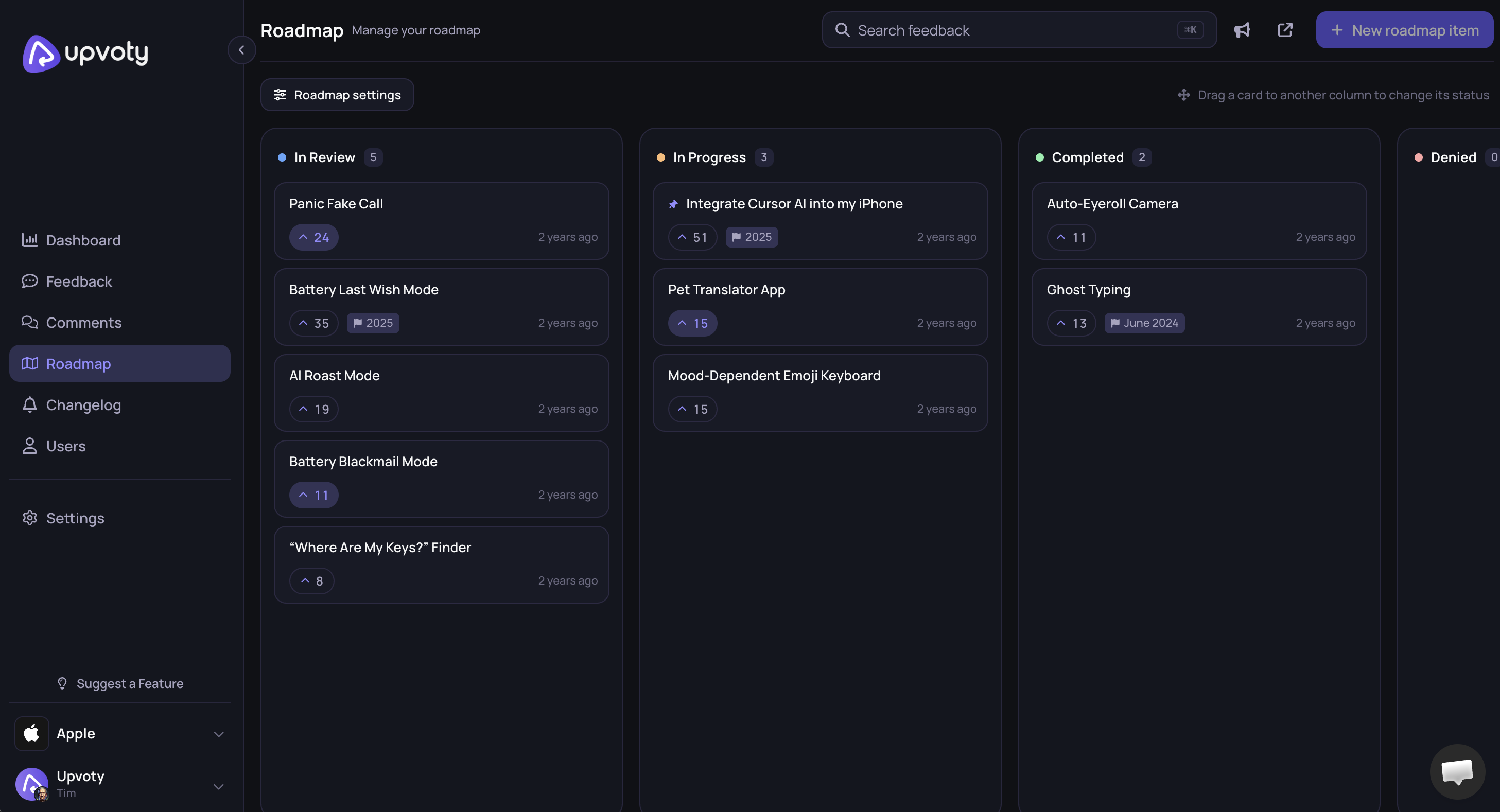
Changelog testing should be equally concrete. Publish a sample release, connect it to the original request, and check the subscriber experience. Confirm whether voters receive a useful notification and whether the release remains easy to find later. Upvoty includes separate product roadmap and product changelog capabilities within the same customer communication flow.
How to assess AI in customer feedback tools
AI can help cluster similar requests, summarize long threads, extract themes, and answer questions across a feedback repository. It can also merge ideas that describe different problems, erase useful nuance, or produce a confident answer without showing which customers supplied the evidence.
Use a controlled test. Give the system the three Xero-related posts, a request for QuickBooks export, and a request for importing Xero contacts. Ask it to identify duplicates and explain the grouping. The two Xero export variations belong together. Importing contacts is a different workflow, and QuickBooks is a separate integration even though the broad theme is accounting.
Require source traceability. If an AI-generated summary says enterprise customers need two-way Xero synchronization, the product manager should be able to inspect the original comments. Otherwise, an incorrect synthesis can enter a roadmap discussion as if it were customer evidence.
Also verify where data goes, who can query it, and whether private notes are included. The NIST AI Risk Management Framework offers a useful structure for considering validity, transparency, privacy, and accountability when AI features affect decisions.
Upvoty supports an MCP-based workflow for querying feedback through compatible tools such as ChatGPT, Claude, and Cursor. The practical guide to analyzing customer feedback with MCP shows how that approach connects feedback data to an AI client. Canny and Featurebase provide their own AI-assisted functions. Nolt is a better fit when AI is not a purchasing requirement.
Do not buy a product because it generates attractive summaries. Buy it if the underlying feedback remains organized, permissioned, and inspectable.
How to compare product feedback software pricing
Vendor pricing pages rarely describe the full operating cost. One tool may charge by manager seat, another by tracked user, and another by access to a particular module. Roadmaps, private boards, custom domains, single sign-on, integrations, or AI usage may sit behind higher plans.
Create a fixed scenario before requesting quotes. For example, price each tool for five internal managers, one public board, one private board, a public roadmap, a changelog, custom branding, and your expected number of identified customers. Ask each vendor to price the same scenario.
Include these cost categories:
- Subscription and required add-ons
- Additional manager, contributor, or support seats
- Tracked-user or monthly-active-user limits
- AI usage limits and overage rules
- Setup, migration, and branding work
- Monthly moderation and administration time
A lower subscription can become expensive if a product manager spends several hours every month exporting data, reconciling duplicates, and manually notifying customers. Conversely, a broad platform may be poor value when a small team uses only its voting board.
Check Upvoty's current plans directly. For Canny, Featurebase, and Nolt, review each vendor's own pricing page without relying on an old comparison article. Record the quote date because packaging changes.
Security and governance belong in this review. Confirm data export options, deletion procedures, authentication controls, roles, and the treatment of personal data. Teams serving people in the European Union should assess their obligations under the official General Data Protection Regulation text. Public boards should also be tested against the W3C Web Content Accessibility Guidelines rather than judged only by appearance.
How the feedback workflow runs inside Upvoty
A tool earns its place when it removes handoffs from the daily process. In Upvoty, the invoicing team can run the Xero request through the same sequence used in this comparison.
First, the team creates a feedback board and gives customers a clear place to submit requests. When variations of the Xero idea appear, moderators manage them from one dashboard and keep discussion centered on the canonical request. Customers vote and comment without the team maintaining a parallel spreadsheet.
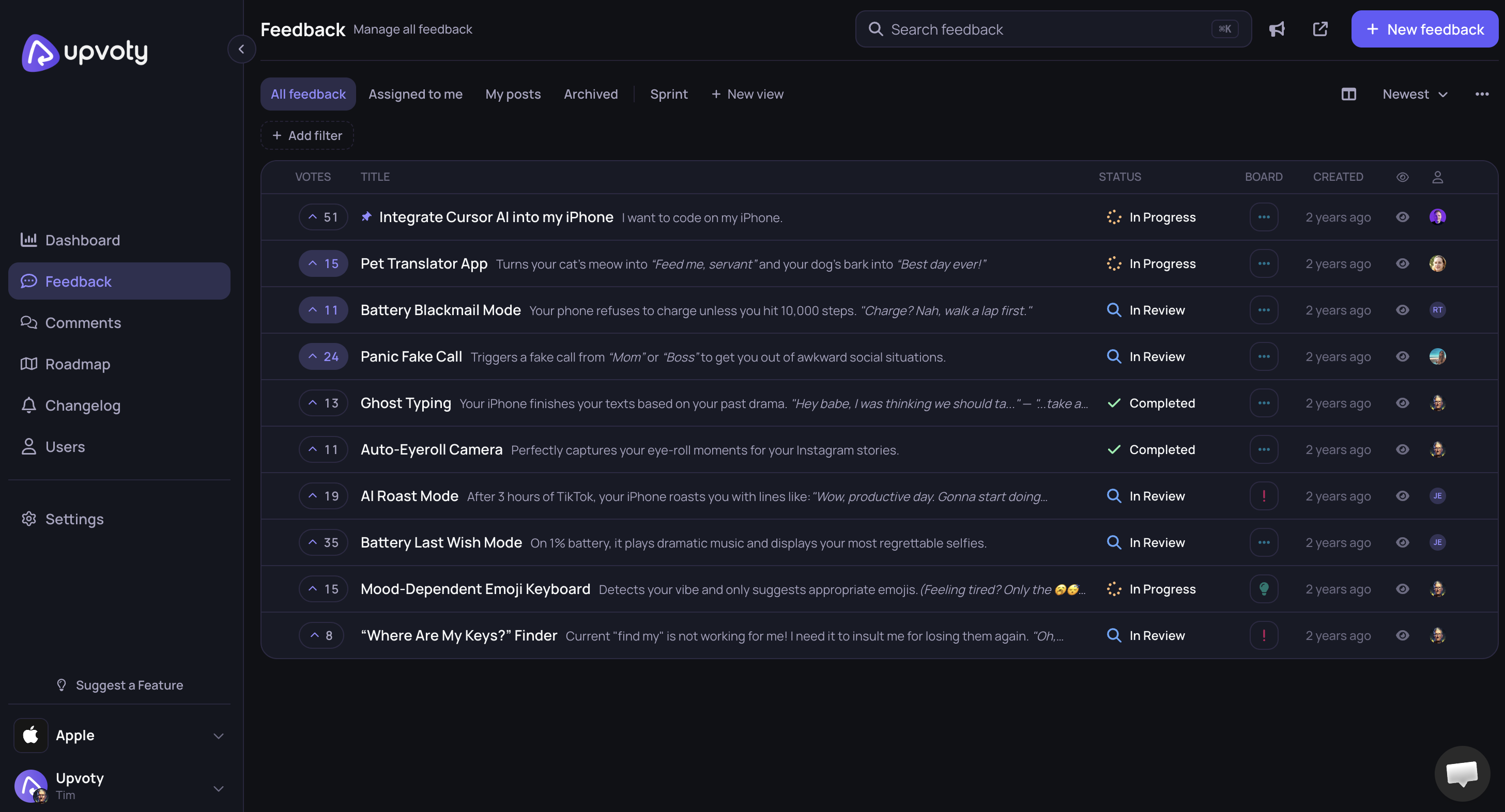
Next, the product manager reviews the request with its visible demand and customer discussion. Internal decision-making still belongs to the team. Upvoty supplies the organized evidence and status controls rather than pretending that the highest vote total must win.
This dashboard view shows the operational side of reviewing feedback and request activity.
Once the Xero export is approved, it moves onto the roadmap with customer-safe wording. The public view communicates progress while engineering retains its detailed delivery plan elsewhere. When development finishes, the team publishes a changelog update and closes the loop with the people who showed interest.
Finally, the feedback repository remains available for deeper analysis, including MCP-based queries through supported AI clients. That sequence matters: collect, consolidate, evaluate, communicate, release, and learn. There is no need to reconstruct the customer history at the end.
The live Upvoty demo is useful for testing this workflow with your own sample requests. Bring duplicates, private context, and one idea you ultimately decide not to build. A polished happy path will not expose the operational gaps.
Which product feedback tool should you choose?
Choose Upvoty when your team wants public or private feedback boards, feature voting, a customer-facing roadmap, and a changelog in one focused workflow. It is particularly relevant for SaaS companies that need to show customers what happened after they submitted an idea.
Choose Canny when advanced segmentation, account context, and enterprise-oriented controls justify a potentially higher budget and more complex setup. Test which capabilities require higher plans before committing.
Choose Featurebase when feedback is part of a broader support and in-app communication strategy. Confirm that the wider suite replaces tools you already pay for, since overlap can reduce the value of consolidation.
Choose Nolt when the primary requirement is a clean, simple voting board. It can be the right answer for a small team that does not need deep prioritization, extensive release communication, or AI analysis.
If two tools remain close, run a two-week pilot. Import the same requests, invite the same internal roles, publish the same roadmap item, and send the same release update. Select the product that preserves context with the fewest manual steps.
Common mistakes when selecting product feedback tools
The first mistake is choosing from screenshots. Most boards look clear with six carefully written requests. Real backlogs contain duplicates, unclear titles, confidential details, abandoned ideas, and comments that mix several problems.
The second is treating voting as prioritization. Votes show expressed interest under the conditions created by the board. They do not measure implementation cost, strategic relevance, urgency, retention risk, or the quality of a workaround.
The third is buying for collection while ignoring closure. Customers become less willing to share feedback when requests sit unchanged for months. Define who reviews new posts, how often statuses change, and when voters receive updates. This guide to closing the feedback loop with a changelog covers the release side in more detail.
The fourth is skipping export and deletion tests. Add sample data, export it, delete a user, and inspect what remains. Do this before procurement, not after a customer submits a privacy request.
The fifth is comparing entry prices instead of usable configurations. A free plan that excludes a required private board or integration is not your actual plan. Price the workflow your team will operate for the next year.
FAQ about the best product feedback tools
What is the best product feedback tool for a small SaaS team?
Upvoty is a strong fit when a small SaaS team wants feedback boards, voting, a roadmap, and a changelog without adopting a much broader product suite. Nolt is also worth considering when the requirement is mainly a simple voting board. Test both with real duplicates and customer notifications.
Is Canny better than Upvoty?
It depends on the workflow. Canny can suit larger organizations that need advanced segmentation and enterprise controls. Upvoty is a focused alternative for teams that want to connect feedback collection, roadmap communication, and changelog updates. The detailed Upvoty versus Canny comparison covers the practical differences.
Do public feature votes tell us what to build next?
No. Votes provide one demand signal. Combine them with affected customer segments, problem severity, strategic fit, revenue relevance, effort, risk, and available alternatives. Keep the voter data attached to the request so the team can interpret the count correctly.
Should our product roadmap be public?
A public roadmap works when customers benefit from seeing direction and the team can maintain it. Use broad time horizons or status groups when dates remain uncertain. Keep technical dependencies, security details, and unapproved commitments in the internal delivery system.
Can AI prioritize customer feedback automatically?
AI can summarize, classify, cluster, and retrieve feedback, but final prioritization needs human judgment. Test whether every AI-generated claim can be traced to its source. Restrict access to private notes and verify how the vendor processes customer data.
Can a feedback tool replace Jira or another delivery tracker?
Usually not. Product feedback software manages customer evidence, requests, voting, external statuses, roadmaps, and release communication. Delivery trackers manage engineering tasks, dependencies, sprints, and technical execution. The two systems serve different audiences, even when integrations connect them.
How do we migrate from a spreadsheet or another feedback platform?
Clean duplicates before importing, preserve original customer associations, map old statuses to the new workflow, and redirect important public URLs where possible. Export the source data first. Then migrate a small batch and verify comments, voters, timestamps, and private notes before moving the complete backlog.
The strongest choice is the tool your team will use from first request through release notification. See how Upvoty supports that complete feedback workflow, then test it with several real requests from your backlog rather than a clean demo dataset. Read next: How to Use an In-App Feedback Widget in Your SaaS Product. Read next: Product Feedback Management. Read next: Best Feedback Management Tools: Evaluation Checklist for Product Teams. Read next: Best Feedback Management Tools: Evaluation Checklist for Product Teams.