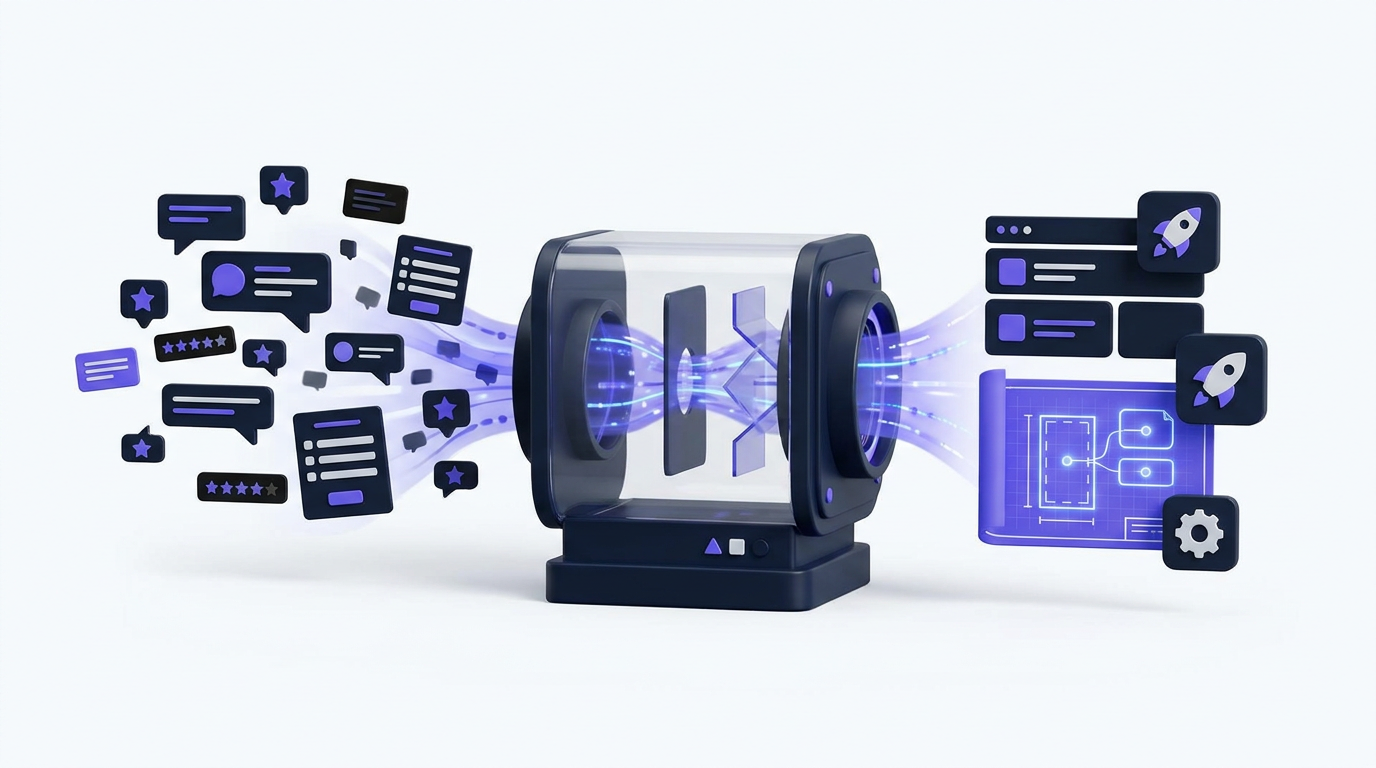
Feature requests arrive through support tickets, sales calls, surveys, and internal messages. Without a consistent analysis process, the loudest request can appear more important than the one affecting a valuable customer segment or blocking several deals.
Customer feedback analytics turns those scattered signals into evidence your product team can review, prioritize, and act on. Upvoty supports this process by connecting feedback boards, votes, product decisions, a public roadmap, and release communication.
Quick answer: Use this customer feedback analytics workflow to move from raw input to a defensible product decision.
- Collect feedback in a central system while preserving its source and customer context.
- Merge duplicates without losing votes, comments, or the language customers used.
- Categorize feedback by problem, product area, segment, and workflow stage.
- Measure demand using unique customers, votes, revenue context, urgency, and strategic fit.
- Review qualitative comments to understand the underlying job and expected outcome.
- Prioritize requests with a documented scoring method and a product review.
- Publish selected work to a roadmap and notify customers when it ships.
- Measure whether the release solved the original problem.
How customer feedback analytics works
Customer feedback analytics combines quantitative signals with qualitative evidence. Votes and request counts show the breadth of demand. Comments, support conversations, and account context explain why that demand exists.
Consider a fictional SaaS company offering scheduling software. Its team receives 23 requests for recurring appointment exceptions. Twelve arrive through support, six through sales notes, and five through a feedback board. The wording varies: “skip public holidays,” “blackout dates,” “pause a recurring booking,” and “exclude office closure days.”
Counting each phrase as a separate feature would understate demand. Combining everything into a broad “calendar improvements” category would hide the actual use case. The team needs a normalized request named “exceptions for recurring appointments,” with the original comments retained underneath it.
That distinction matters. Normalization makes analysis possible, while the raw language protects against an inaccurate interpretation.
What to measure in customer feedback
No single metric establishes priority. A request with 100 anonymous votes may be less relevant than one raised by eight customers in the product's target segment.
Use a mix of evidence:
- Unique customers and accounts requesting the outcome
- Vote volume, including changes over time
- Customer segment, plan, or use case
- Revenue influenced or at risk
- Frequency and severity of the problem
- Strategic fit and estimated delivery effort
In the scheduling example, 23 requests are the starting point. The team then finds that 14 requests come from multi-location businesses, nine mention manual weekly workarounds, and four are attached to active sales opportunities. Those details make the request easier to compare with other work.
Centralize feedback before analyzing it
Export recent feedback from each active source first. Use the last 90 days if the backlog is large, then import older records after the taxonomy and merge rules have been tested.
Preserve the source, account, date, request owner, original wording, and any related product area. Removing this context during import creates a clean-looking dataset that cannot answer useful questions later.
The collection structure should match how customers naturally submit requests. A dedicated feedback board for product teams gives users one place to post ideas, comment, and vote. It also reduces repeated requests because customers can find an existing idea before creating another.
This public input should not replace private support or research conversations. Some feedback contains account-specific details, security concerns, or unreleased plans. Keep sensitive records private and publish only what is suitable for a shared board.
The EU's GDPR data processing principles require personal data to be adequate, relevant, and limited to what is necessary. Apply that standard when attaching customer identities or commercial context to feedback records.
Organize customer feedback analytics without losing context
Start with a small taxonomy that product managers can apply consistently. Useful dimensions include product area, problem type, customer segment, status, and desired outcome. Avoid creating dozens of narrow tags during the first pass.
For the recurring appointment example, the product area is “Scheduling,” the problem is “Recurring booking exceptions,” and the outcome is “Avoid editing individual appointments.” “Public holidays” remains a phrase in the underlying comments rather than becoming the only category.
Duplicate handling is a common failure point. Teams often close a duplicate and discard its metadata. Merge the record instead. Transfer its votes, subscribers, comments, source information, and account context to the canonical request.
The following structure keeps different feedback sources comparable without pretending they contain the same level of evidence.
| Feedback source | Preserve during analysis | Strongest signal | Main limitation |
|---|---|---|---|
| Public feedback board | Votes, comments, subscribers, submission date | Visible demand and customer language | Votes may overrepresent active community members |
| Support ticket | Account, issue severity, workaround, ticket link | Operational pain and frequency | Agents may summarize the request differently |
| Sales conversation | Segment, opportunity context, objection, owner | Purchase friction | Prospects can request features they may not use |
| Customer interview | Transcript notes, workflow, desired outcome | Detailed problem understanding | Small sample size |
| Cancellation feedback | Account history, stated reason, alternatives considered | Retention risk | Reasons may be incomplete or simplified |
Upvoty's feature request management workflow explains how collection, duplicate management, voting, prioritization, and updates fit into one operating process.
Use customer feedback analytics to prioritize requests
Create a scoring model that helps reviewers ask consistent questions. Do not let the score make the final decision automatically.
A practical model can include demand, target-segment relevance, problem severity, strategic fit, confidence, and effort. Define each score in plain terms. For example, a severity score of five might mean the customer cannot complete a core workflow, while a score of one indicates a minor inconvenience with a simple workaround.
Return to the scheduling company. Its recurring appointment exception request has moderate overall vote volume, strong concentration among multi-location accounts, repeated evidence of manual work, and clear alignment with a plan to serve operations teams. It receives a high confidence rating because support tickets and interviews describe the same problem.
A separate request for custom calendar colors has more public votes but little evidence of workflow impact. The product team keeps it open but prioritizes appointment exceptions first. The decision is recorded with the request so sales and support can explain it consistently.
Read the detailed guide to prioritizing feedback by revenue, segment, and demand before adding commercial weighting to your model. Revenue context is useful, but letting one large account determine the roadmap can create product debt and weaken positioning.
Connect feedback analytics to a public product roadmap
Analysis creates value only when it changes a decision or prompts further research. Once a request is approved, connect the underlying feedback to a roadmap item rather than copying it into a disconnected planning document.
A customer-facing roadmap should communicate status and direction without presenting every idea as a promise. Use a small set of clear stages, such as planned, in progress, and complete. Avoid exact release dates until the team has enough delivery confidence to stand behind them.
The scheduling team moves “Recurring appointment exceptions” to planned and publishes a short problem statement. It does not promise support for every calendar provider or exception rule. During discovery, subscribers can add examples that help the team define scope.
This product screenshot shows how roadmap items can be presented so customers know what is planned and what has moved into delivery.
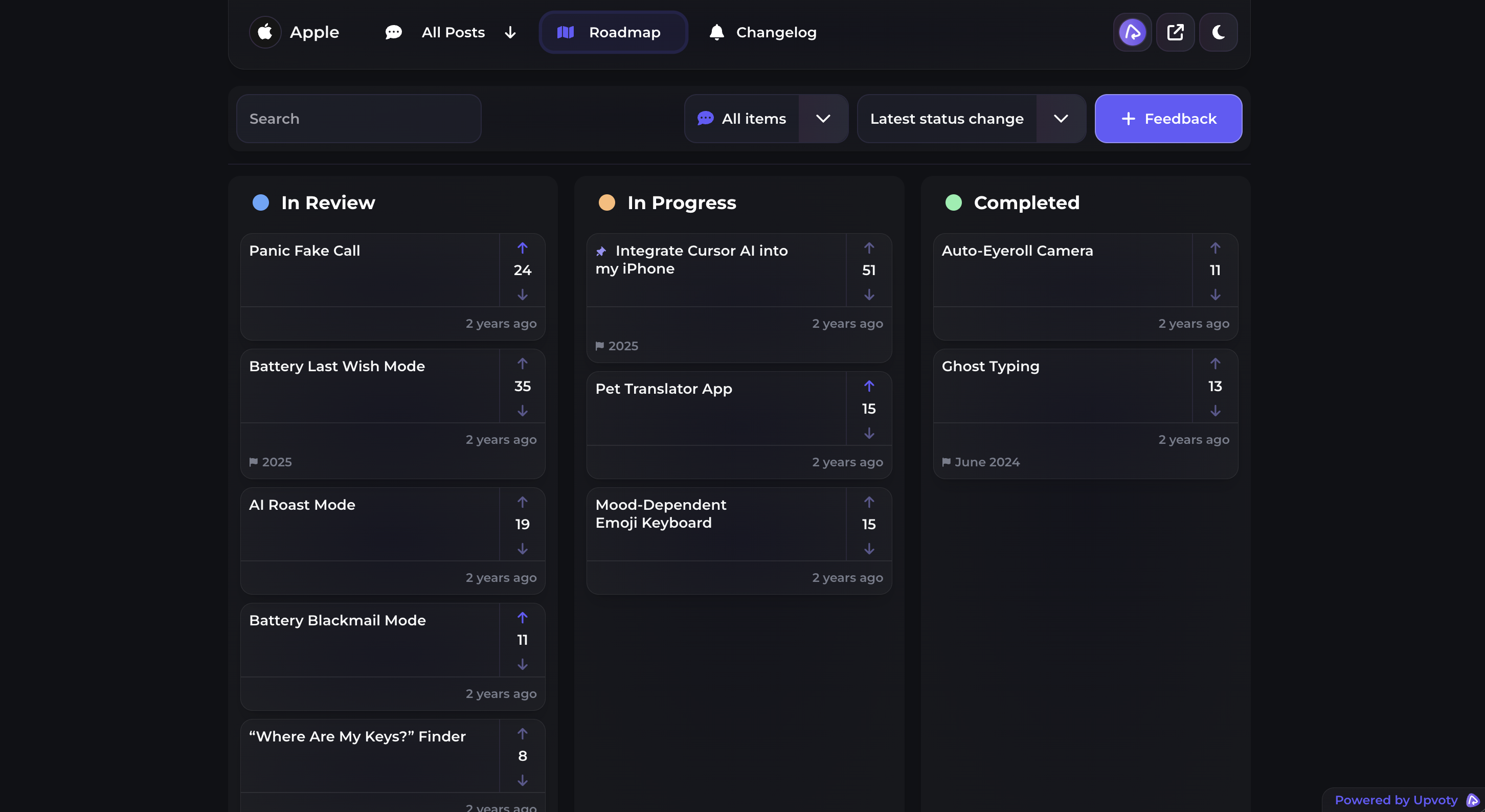
Use Upvoty's product roadmap software to connect customer demand with visible delivery stages. The guide to building a public product roadmap customers can trust covers status wording, scope, and expectation management in more detail.
Customer feedback analytics in Upvoty, step by step
A spreadsheet can support an early feedback process, but it becomes harder to maintain as duplicate requests, comments, status updates, and customer notifications accumulate. Upvoty removes the handoffs between those parts of the workflow.
First, users submit requests to a feedback board, vote on existing ideas, and add context in comments. The product team manages those records from one dashboard rather than reconciling separate public forms and planning sheets.
Next, the team reviews demand and organizes related feedback. Votes provide a visible quantitative signal, while comments preserve the customer language behind the request. Product managers can evaluate the evidence alongside their own strategy, research, and delivery constraints.
This dashboard view shows feedback and analytics in the same product workspace.
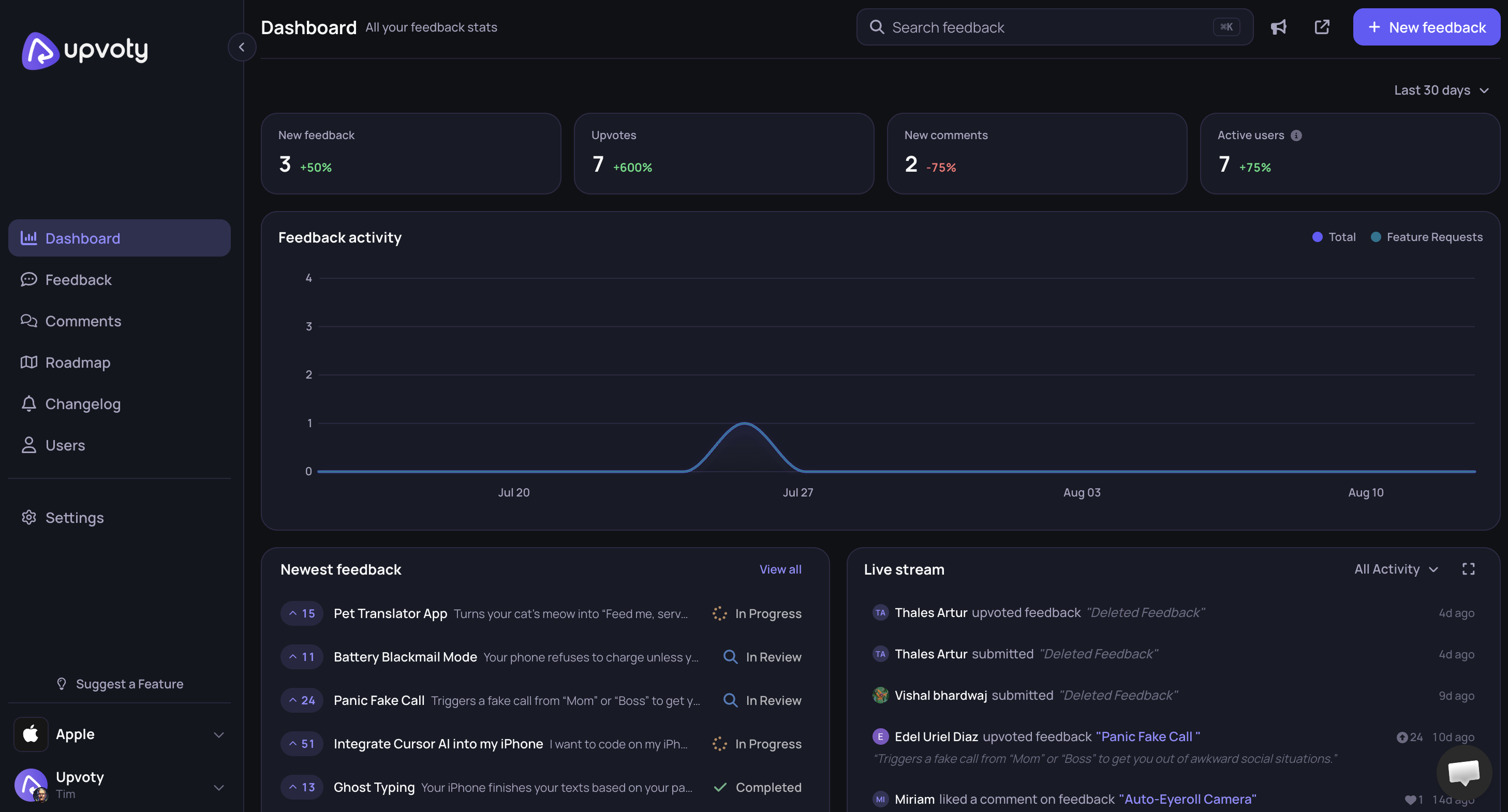
When a request is accepted, the team can move the work onto a public roadmap. Customers see progress without opening another portal or asking support for an update.
After release, the team publishes an update through the product changelog. Subscribers can see that the request moved from feedback to delivery. Follow the practical process for closing the customer feedback loop with a changelog to write updates that reference the problem solved rather than listing technical changes alone.
Teams that want deeper analysis can also review how to analyze customer feedback with ChatGPT, Claude, and Cursor. Use AI to group themes and inspect larger sets of comments, but verify every category against source records before making a roadmap decision.
Measure customer feedback after a feature ships
Marking an item complete is not proof that the problem was solved. Return to the users who requested it and check whether their workflow changed.
For recurring appointment exceptions, the scheduling company should inspect adoption among the multi-location accounts that raised the issue. It should also review whether related support tickets decline and whether users still report manual editing around closures.
Send a focused follow-up. Ask whether the feature handles the original use case, what remains manual, and whether the customer discovered the update. Broad satisfaction surveys will not provide the same diagnostic detail.
A weak release may produce high initial usage because customers test it, followed by abandonment because the rules are too limited. That is a useful result. Reopen the analysis with the new evidence rather than treating shipped status as the end of the feedback record.
The NIST Privacy Framework can help teams structure privacy risk management when customer behavior, account attributes, and feedback are combined for analysis.
Customer feedback analytics FAQ
What is customer feedback analytics?
Customer feedback analytics is the process of collecting, organizing, and evaluating customer requests, comments, votes, survey responses, and account context. The purpose is to identify recurring problems, compare demand, prioritize product work, and measure whether shipped changes solved the original need.
Can customer feedback analytics be automated with AI?
AI can summarize comments, suggest themes, identify possible duplicates, and help review large volumes of text. Human review remains necessary because similar wording may describe different workflows, while different wording may refer to the same underlying problem. Protect sensitive customer data and confirm categories against the original records.
Are feature votes enough to prioritize a roadmap?
No. Votes measure visible interest, not strategic value or problem severity. Combine votes with unique account count, target-segment relevance, qualitative evidence, revenue context, confidence, and delivery effort. Publish clear statuses so voting does not create an implied promise.
Should our customer feedback board be public or private?
Use a public board when customers benefit from discovering existing ideas, adding votes, and tracking progress. Keep sensitive reports, account-specific requests, and confidential product plans private. Many product teams need both public participation and internal review.
How do we compare Upvoty with Canny, Featurebase, or Nolt?
Compare how each product handles feedback collection, duplicate requests, voting, moderation, roadmaps, changelogs, user access, analytics, and ongoing administration. Check each vendor's own pricing page for current numbers, then use the product feedback tools selection guide to run a structured evaluation with your real workflow.
How quickly should we respond to customer feedback?
Acknowledge feedback promptly, but do not promise delivery before review. Give customers a visible status and explain what happens next. When the request moves, notify subscribers again so they do not need to chase your support team.
Turn scattered votes and comments into a traceable process from request to release. Use Upvoty for customer feedback analytics when your team needs one place to collect demand, set priorities, publish roadmap progress, and close the loop. Read next: Customer Feedback Repository: Collect, Prioritize, and Act. Read next: How to Use an In-App Feedback Widget in Your SaaS Product. Read next: How to Create a Customer Feedback Portal That Customers Actually Use.