A growing feedback inbox creates a familiar product problem: five customers describe the same need in five different ways, urgent accounts sit beside casual requests, and the team spends hours reading before it can discuss priorities. Valuable context gets buried in the volume.
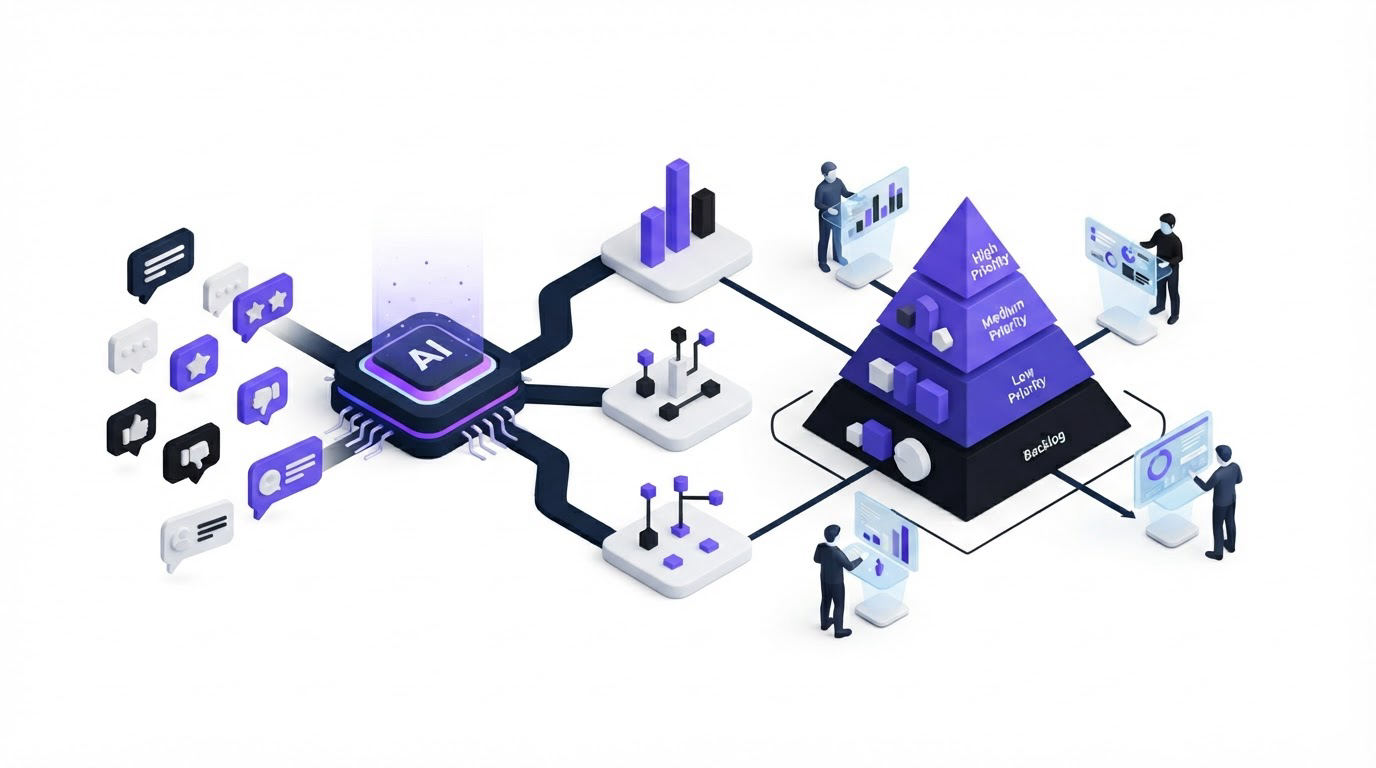
AI feature request analysis helps teams turn that raw input into a reviewable set of themes, duplicate groups, customer summaries, and priority recommendations. Upvoty provides a practical place to keep the evidence, review AI-assisted grouping, and connect decisions to a feedback board, roadmap, and changelog.
Quick answer: how to use AI feature request analysis
Use this workflow to analyze and prioritize feature requests:
- Collect requests in one system and retain source, customer, segment, and vote data.
- Ask AI to suggest duplicate groups and recurring themes from the request text.
- Review every proposed merge, then select a clear canonical request for each validated group.
- Generate a short customer-context summary for each theme, including use case, urgency, and affected segment.
- Rank validated themes using demand, strategic fit, revenue exposure, effort, and confidence in the evidence.
- Record the human decision, publish the appropriate roadmap status, and close the loop when work ships.
Prepare feedback for AI feature request analysis
AI can only work with the context available in the request record. Start by bringing submissions from your feedback board, sales conversations, support tickets, and in-app prompts into a consistent structure. Each record needs the original customer wording plus metadata that gives the request meaning.
At a minimum, retain the request title, full description, source, date, customer or account, segment, plan, and vote count. Add internal notes when a customer explains the business impact in a call. That note can carry more prioritization value than a short public submission such as “Please add reporting.”
Use a simple taxonomy before running analysis. Product area, job to be done, request type, and lifecycle stage usually provide enough structure. For example, “reporting,” “exports,” and “scheduled delivery” could all sit beneath an analytics product area while remaining separate request types.
Consider an illustrative project-management SaaS. Its feedback portal receives these submissions over two weeks:
“Email me a weekly project status report.”
“Can clients receive a PDF update every Friday?”
“Scheduled exports would save our account managers several hours.”
“Send an automated progress digest to stakeholders.”
The wording differs, yet all four requests may point to a single customer outcome: scheduled stakeholder reporting. Keep each original request intact. AI needs the individual language to identify patterns, and product managers need it when checking whether a proposed group holds together.
A consistent intake process makes this much easier. See this guide to organizing feature requests into a repeatable workflow for the operational foundation behind the analysis.
Group duplicate feature requests with AI, then verify the groups
Duplicate detection is often the fastest win from AI feature request analysis. Language models can recognize semantic similarity across different wording, including customer terminology that rarely matches internal product terms.
Give AI a bounded task. Ask it to propose groups, nominate a canonical request title, identify the shared problem, and show why each request belongs in that group. Require it to leave ambiguous items ungrouped. That last instruction reduces forced merges.
For the project-management example, AI may produce a proposed group titled “Scheduled stakeholder reports” and attach all four requests. A product manager should then inspect the details. The request for PDF updates could require branded, client-ready documents, while the weekly email request may only require a lightweight digest. Those needs could share a parent theme while requiring separate implementation decisions.
Review proposed duplicates using three questions:
- Do these customers describe the same job and expected outcome?
- Would one planned capability satisfy the core need across the grouped requests?
- Does each request preserve a meaningful difference in audience, format, timing, or workflow?
Approve a merge only when the evidence supports a shared outcome. Retain links to the original submissions, voters, and customer records after merging. The canonical post becomes the place where demand accumulates, while the original language remains available for research.
Upvoty’s Merge AI capability supports this review process by helping teams identify and merge overlapping feedback. Pair it with Smart Tags to keep validated themes searchable across the backlog.
Find recurring themes and summarize customer context
Duplicate groups answer “which requests overlap?” Theme analysis answers “what broader problem keeps appearing?” Both views are useful, and they serve different product conversations.
Ask AI to create themes at two levels. The first level captures the customer outcome, such as stakeholder reporting. The second captures the specific solution direction, such as scheduled email, PDF generation, or dashboard sharing. This structure prevents a solution idea from becoming the only lens for a broader customer need.
For each theme, request a concise summary that includes:
| Analysis field | AI output to request | Human review focus |
|---|---|---|
| Shared customer problem | One sentence describing the repeated outcome | Check that the wording reflects actual submissions |
| Affected users | Roles, segments, plans, or industries mentioned | Confirm account data and buyer relevance |
| Trigger and urgency | When the problem occurs and the stated consequence | Separate clear impact from general preference |
| Requested solution patterns | Common approaches customers suggest | Keep alternative approaches visible |
| Evidence confidence | High, medium, or low based on specificity and volume | Inspect source quality and ambiguous grouping |
In the example, the summary could state: “Account managers and client-facing project leads want recurring progress updates for stakeholders, mainly to reduce manual status-report preparation.” It may also identify a pattern: customers serving external clients mention PDFs, while internal teams ask for email digests.
That distinction leads to a better discovery question. Rather than immediately committing to “weekly PDF exports,” the team can investigate a reporting workflow that supports multiple delivery formats.
Add customer metadata before using the summary in a planning meeting. Segments in Upvoty let a team inspect whether requests come from trial users, long-term customers, enterprise accounts, or a specific user role. Theme volume gains meaning when it is tied to who needs the capability and why.
Prioritize AI-analyzed feature requests with human judgment

AI can structure evidence and produce a first-pass ranking. A product team still owns the decision. Product strategy, technical dependencies, market timing, accessibility requirements, contractual commitments, and opportunity cost require accountable judgment.
Use AI to prepare a decision brief for every validated theme. The brief should include total request count, unique account count, segment mix, representative quotes, related themes, known dependencies, and confidence level. Then apply your team’s prioritization method.
For scheduled stakeholder reporting, a team could assign a strong demand signal because requests appear across several accounts. The final priority may still remain below an authentication improvement if a security commitment has a fixed deadline. Record that reason beside the feedback theme. Future reviewers need to understand the trade-off.
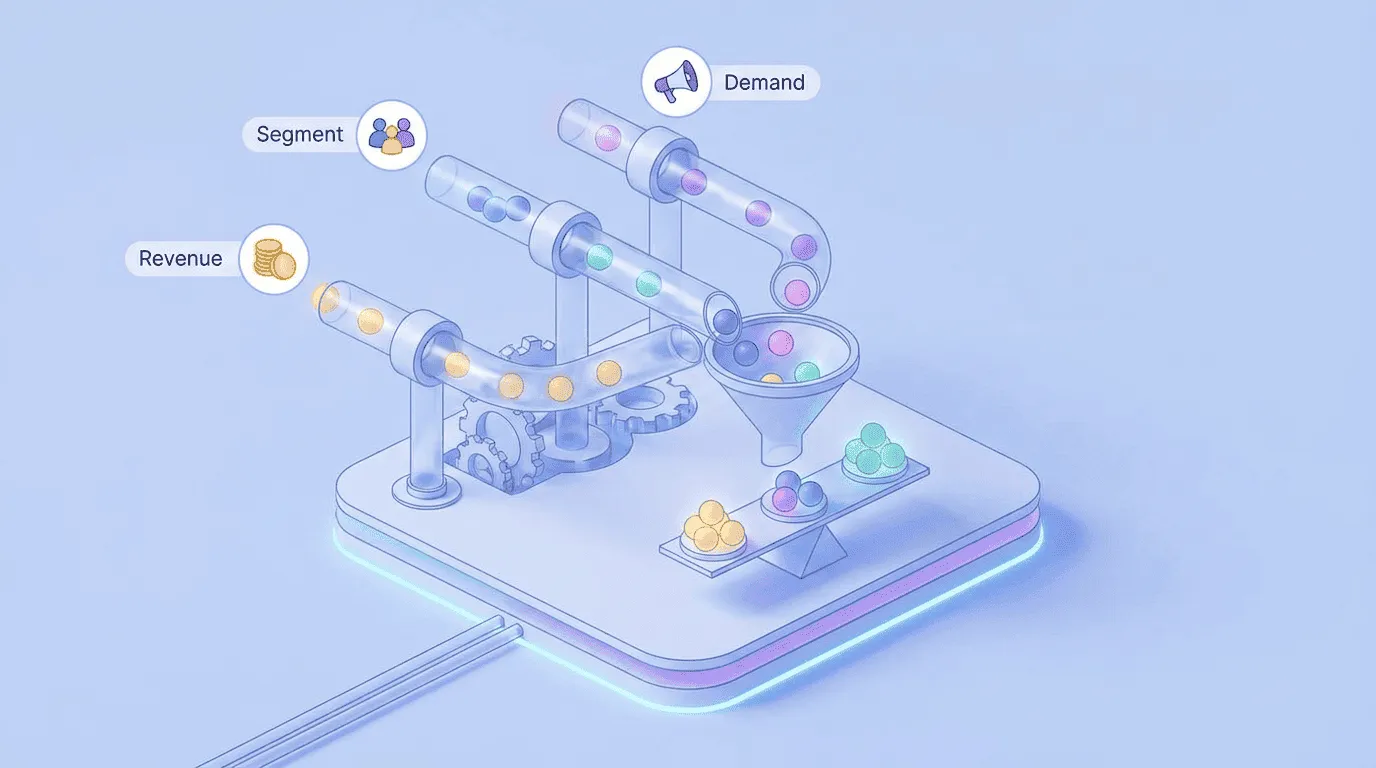
Avoid using raw votes as the full score. A request with 80 votes from a free-user community calls for a different discussion than a request from three high-retention enterprise accounts with an immediate renewal dependency. This article on prioritizing feedback by revenue, segment, and demand explains how to combine those signals.
Set a review threshold for AI recommendations. For example, every theme proposed for a roadmap status change should receive product, engineering, and customer-facing review. Higher-impact decisions deserve more source inspection, especially when the AI summary relies on short or vague requests.
The NIST AI Risk Management Framework provides a useful governance principle here: assign clear ownership for AI-supported decisions and evaluate outcomes over time. Keep a lightweight audit trail containing the AI suggestion, the evidence reviewed, the decision, and the rationale.
Use Upvoty to turn AI analysis into an accountable workflow
A spreadsheet export can work for an occasional analysis project. Ongoing feedback needs a system of record where the request, its voters, its related themes, and its final status stay connected.
Start with an Upvoty feedback board where customers can submit, comment on, and vote for ideas. As feedback arrives, apply tags and segments so similar requests carry shared context. Run Merge AI when overlapping ideas appear, then review the proposed matches before consolidating them into a canonical post.
The feedback dashboard gives the product team a focused place to inspect the validated request, its discussion, and the demand behind it. Add internal notes for sales-call context, account risk, implementation constraints, and open research questions. Assign an owner when the request enters active evaluation.
This view shows the kind of feedback workspace where request evidence can stay connected to product decisions.
!Upvoty feedback dashboard for managing feature requests and customer context
Once the scheduled-reporting theme has a confirmed scope, move it to the appropriate product roadmap status. A public status creates a visible promise, so use it after the team has enough confidence in the direction and timing. Keep discovery-stage themes in feedback review until that confidence exists.
When the capability launches, publish the update and notify the people who asked for it. A clear customer feedback loop with a changelog turns analysis into visible follow-through. It also creates a record that helps customers see how their input shaped the product.
Common mistakes in AI feature request analysis
The most costly failure mode is an overconfident merge. AI may group “scheduled exports” with “custom dashboards” because both involve reporting, even though they support different workflows. Require a reason for every group and inspect edge cases before aggregation changes demand counts.
Another problem is treating summaries as source material. An AI summary is a navigation aid for busy teams. Read representative requests and internal notes before committing engineering capacity. Preserve the original customer wording so researchers can test assumptions with users.
Teams also lose trust when a public roadmap moves based on weak evidence. Use AI to surface patterns, then validate the priority with segment data, qualitative interviews, feasibility input, and strategy. The resulting roadmap will be easier to explain to customers. For guidance on that communication, read how to build a public product roadmap customers can trust.
Finally, protect customer data during analysis. Minimize the fields shared with AI services, restrict access by role, and establish retention rules for exports. The UK Information Commissioner’s Office provides practical guidance on AI and data protection that can inform internal review practices.
FAQ about AI feature request analysis
Can AI automatically merge duplicate feature requests?
AI can identify likely duplicates and propose a merge. A product owner should approve the final grouping after checking the customer outcome, requested workflow, and implementation implications. Preserve the source requests so votes and nuance remain traceable.
How should AI influence feature prioritization?
Use AI to prepare a consistent evidence brief and surface patterns that manual review may miss. Make priority decisions through a human review that considers demand, customer segment, revenue exposure, strategy, effort, risk, and dependencies.
What data should I give AI for feature request analysis?
Include the original request text, date, source, votes, customer segment, account context, and internal notes that describe impact. Remove unnecessary personal data and restrict sensitive commercial information according to your organization’s data policies.
Can a public feedback board work with AI analysis?
Yes. A public board creates structured, customer-visible demand signals, while AI helps the internal team organize the volume behind those signals. The team can then share evaluated items through a roadmap and announce shipped work through a changelog.
AI feature request analysis works best when every recommendation remains connected to customer evidence and a named decision-maker. Use Upvoty to collect requests, review duplicate ideas, organize themes, and communicate the decisions that follow.