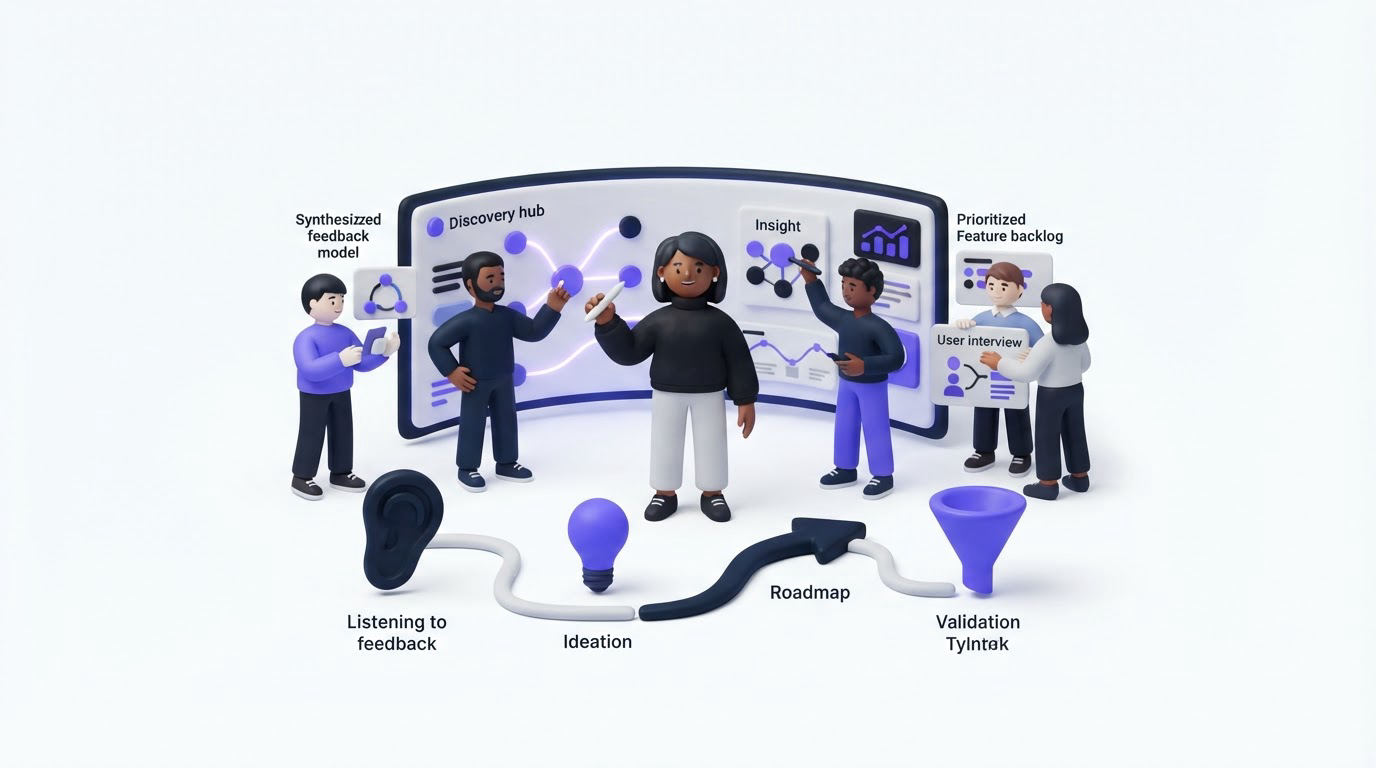
Feature requests arrive through support tickets, sales calls, product reviews, and message threads. By the time a product manager pulls them together, duplicate requests and missing customer context can turn a clear opportunity into a debate.
Product discovery software gives your team a shared place to collect evidence, evaluate demand, make decisions, and show customers what happens next. Upvoty brings feedback boards, prioritization context, roadmaps, and changelogs into that workflow.
How product discovery software works: quick answer
Use this workflow to turn incoming requests into defensible product decisions:
- Capture feedback where customers already interact with your product and team.
- Combine duplicate requests into one clear problem statement.
- Add customer segment, account context, and strategic relevance.
- Review demand alongside evidence from interviews, support, and delivery effort.
- Move selected work onto a roadmap with an outcome customers can understand.
- Publish the release and notify the people who supported the request.
Collect the right evidence for product discovery
Start with a structured place for customers to submit ideas. A public board works well when customers benefit from seeing, supporting, and discussing each other's requests. A private workspace suits enterprise accounts, internal teams, and research findings that require controlled access.
For a B2B scheduling product, imagine a customer submits: “Let managers export attendance reports by location.” A sales colleague records a similar need as “regional reporting for multi-site accounts,” while support receives “download attendance by branch.” These are three descriptions of one underlying job: location-level reporting.
Ask for enough context at submission to make later review practical. Useful fields include the use case, affected workflow, customer type, and a link to a support conversation. A short prompt such as “What decision would this report help you make?” produces stronger evidence than a generic comment field.
Use a feedback board for customer-submitted requests, then add internal research and account notes to the same record. This prevents a popular public request from separating from the commercial context your team needs for a decision.
Privacy also belongs in the collection design. Capture only data required for the decision and set a retention process for exported or sensitive customer details. The GDPR principles in Article 5 cover data minimization, purpose limitation, and storage limitation.
Organize product discovery feedback before you score it
Grouping similar requests is where a feedback repository becomes useful product discovery software. Create one canonical item for the scheduling example, name it “Location-level attendance reporting,” and merge supporting submissions into it. Preserve the original wording as supporting evidence because language often reveals the customer’s actual outcome.
Tag the canonical item with themes such as reporting, multi-location, and exports. Then record the affected segment: paid administrators, trial users, agencies, or another group relevant to your business. Smart tags and segments make that context easier to retrieve during planning.
A common failure mode appears when teams merge requests solely because the feature names sound alike. “Export reports” could mean a finance reconciliation need, a compliance archive, or a manager’s weekly staffing review. Read the underlying job before merging. Keep separate records when the desired outcome, audience, or product area differs.
Prioritize customer feedback with evidence, not vote totals alone
Votes show visible demand. Product discovery decisions also need customer value, strategic fit, urgency, confidence, and delivery constraints. Give each factor a clear owner so a request cannot advance based on a loud conversation alone.
For the scheduling example, the team may find that location-level reports are supported primarily by paid multi-site administrators. That evidence can justify a higher priority than a request with broader voting from trial users, especially when the product strategy focuses on expansion accounts. The request may still require validation through calls with administrators to define the required filters, permissions, and export format.
Use a simple review model that keeps the evidence visible:
| Decision input | What it tells you | How to use it |
|---|---|---|
| Unique supporters | Breadth of expressed demand | Identify recurring needs and emerging themes |
| Customer segment | Who experiences the problem | Weight strategic accounts and target personas appropriately |
| Qualitative comments | Why the problem affects work | Extract outcomes, constraints, and exact terminology |
| Research and support records | Depth and frequency of pain | Validate whether the request reflects an active workflow problem |
| Delivery considerations | Scope, dependencies, and risk | Shape the solution and planning sequence |
Keep the scoring model lightweight. Excessive formulas can give weak evidence a false sense of precision. For a fuller method, see how to prioritize customer feedback by revenue, segment, and demand.
AI can speed up initial clustering and summaries, especially when a team has a large volume of unstructured comments. Maintain human review for merged requests and priority decisions. The NIST AI Risk Management Framework provides useful guidance on governance and evaluation for AI-supported processes.
Turn product discovery into a roadmap customers can follow
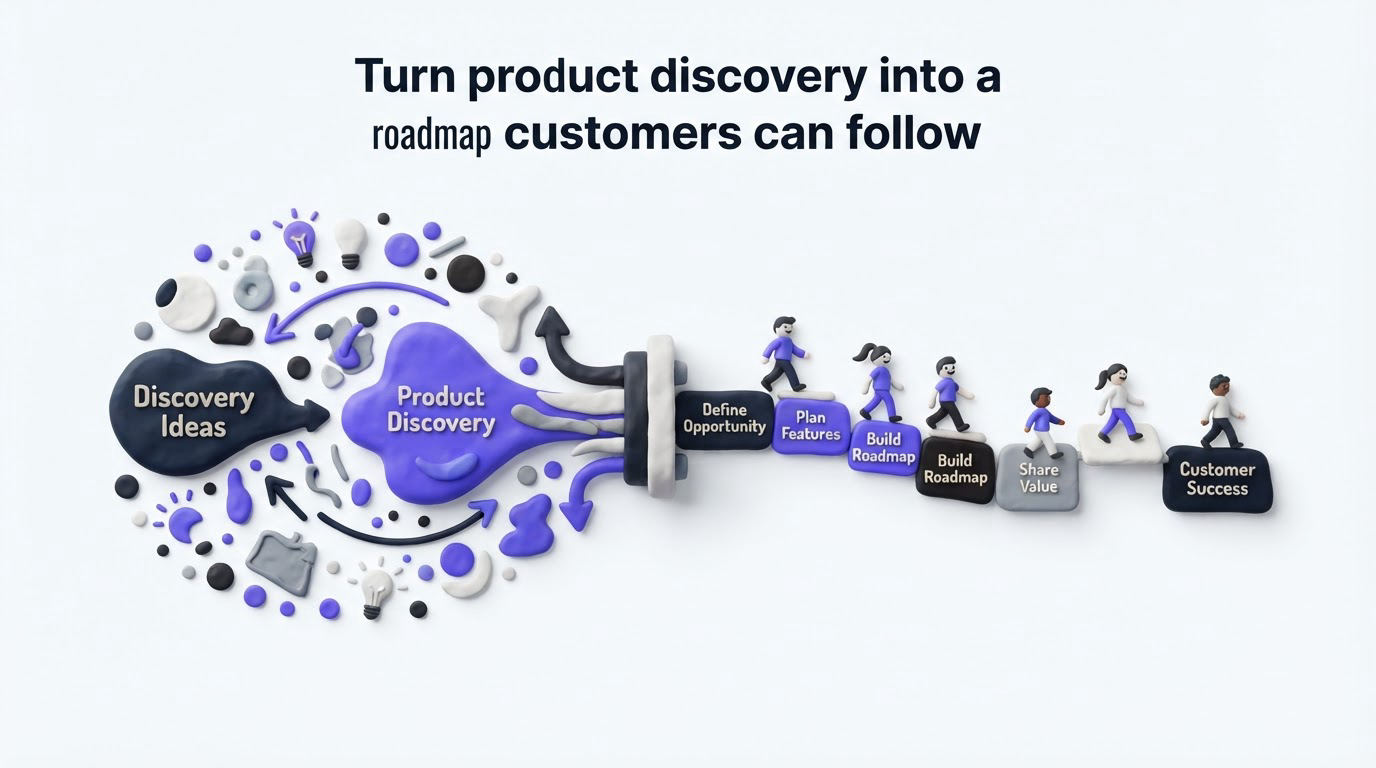
Once the team selects location-level reporting, publish the initiative at the right level of detail. A customer-facing roadmap entry might say: “Give multi-site managers reporting by location to support staffing and performance reviews.” That statement explains the outcome without committing the team to every interface detail before discovery and delivery are complete.
Use statuses that communicate progress clearly, such as Under Consideration, Planned, In Progress, and Released. Set expectations carefully. A roadmap is a communication tool and a planning artifact, so each status needs a shared internal definition.
When the feature ships, publish a changelog entry that explains who benefits, what changed, and where to find it. Then notify the supporters tied to the original request. This closes the loop and gives future contributors a reason to share useful context. Read how to build a public product roadmap customers can trust and how to close the customer feedback loop with a changelog for the communication details.
How Upvoty supports product discovery software workflows
Upvoty follows the same sequence a product team uses from incoming feedback to release communication.
First, create a public or private feedback space where customers and colleagues can submit ideas, vote, and comment. The board gives the scheduling team one visible record for location-level reporting rather than scattered versions across inboxes and calls.
!Public voting board for customer feedback and feature requests
Next, merge related submissions, apply tags and segments, add internal notes, and assign ownership. This keeps customer wording available while giving product, support, and sales the operational context they need. Teams that need deeper analysis can also use MCP capabilities to work with feedback in supported AI tools.
Then, move chosen initiatives to the product roadmap. Customers can see that location-level reporting has progressed from consideration to delivery, while the team retains control over the amount of detail shared publicly.
!Public product roadmap showing planned and in-progress work
Finally, announce the release through the changelog and notify voters. The workflow turns customer input into a traceable record of listening, prioritization, and action.
Choosing product discovery software for your team
Choose a product discovery platform based on the decisions your team needs to make repeatedly. A small product team may value a fast public board and a clear roadmap. A company selling to several segments may need private spaces, segmentation, internal notes, roles, and integrations with delivery tools.
Review these practical questions during evaluation:
- Can customers submit feedback with useful context and support related ideas?
- Can your team merge duplicates while retaining the original evidence?
- Can you distinguish strategic customer segments during prioritization?
- Can you run public and private discovery spaces when needed?
- Can you connect accepted work to roadmap and release communications?
- Can stakeholders export or access the data required for planning?
Canny, Featurebase, and Nolt are commonly considered in this category. Compare the workflow from submission through release communication, then test it with a real set of recent requests. Use the product feedback tools selection guide to structure that evaluation, and review Upvoty's features against your team's requirements.
Product discovery software FAQ
What is product discovery software used for?
Product discovery software collects customer and internal feedback, groups related evidence, supports prioritization, and communicates progress through roadmaps and release updates. It gives teams a durable source of evidence for product decisions.
Should product teams use a public feedback board?
A public board works well when customer visibility can create useful discussion and reduce duplicate requests. Private boards are better suited to sensitive feedback, internal research, and account-specific planning. Many teams use both for different audiences.
How do you stop feature voting from driving the roadmap?
Treat voting as one decision input. Add segment data, qualitative context, customer impact, strategic fit, research findings, and delivery considerations before moving an item forward. Document the decision rationale inside the feedback record.
Can product discovery software help close the feedback loop?
Yes. Connect each accepted initiative to a roadmap status and a changelog announcement, then notify the supporters when the work reaches release. Customers receive a clear answer, and product teams maintain a useful record of why the work mattered.
Bring your recent requests into one workflow, merge the repeated problems, and prioritize with the customer context beside every decision. Try Upvoty product discovery software to connect feedback, roadmaps, and release communication in one place.