
A product team can collect hundreds of feature requests and still struggle to answer three basic questions: who needs this, how important is it, and when will they hear from us? The friction usually appears between intake, product decisions, and customer communication.
Upvoty is a Featurebase alternative for teams that want to run that full feedback loop through branded boards, an in-app widget, prioritization tools, roadmaps, and changelogs. It fits especially well when product managers need public and private feedback spaces while keeping a clear operating workflow for the team.
Quick answer: how to choose a Featurebase alternative
Use this workflow to make the decision:
- Map every place feedback enters today, including support, sales, email, and product.
- Test a public board, a private board, and an in-app submission flow with your own request examples.
- Check how duplicates, segments, internal context, and request ownership support prioritization.
- Publish a small roadmap and change two items through to a changelog update.
- Verify how voters and affected accounts receive follow-up after a release.
- Review access controls, data handling, integrations, and export options before rollout.
How to compare a Featurebase alternative for feedback collection
Start with collection, since a poor intake process creates clutter everywhere else. Ask where a user will submit a request, whether they can search for existing posts first, and whether the team can keep sensitive ideas out of public view.
A useful trial includes three entry points: a public portal for broad product ideas, a private board for account-specific requests, and an in-app prompt for feedback at the moment a user hits friction. Upvoty supports feedback boards, configurable public or private visibility, and an in-app feedback widget for this setup.
Consider a 12-person B2B SaaS team whose customers repeatedly ask for scheduled PDF reports. Support tickets call the request “email reports,” sales calls call it “board packs,” and users write “weekly exports” in the product. The team sends all three paths to one /feedback board, asks users to search before posting, and merges the overlapping submissions into a single request: “Schedule and email PDF reports.”
That one decision prevents a common failure mode: three request counts that each look small, followed by an incorrect conclusion that the demand is weak. Give moderators a defined daily review window. Confirm that a post describes an outcome rather than a proposed interface, then merge duplicates before the product team starts scoring.
For public boards, set expectations before launch. Explain which topics belong there, what moderation covers, and which requests require a private route. The guide to public feedback board governance provides a practical policy structure for this work.
| Buying area | Test during the evaluation | Strong Upvoty fit | Question to test in Featurebase |
|---|---|---|---|
| Feedback intake | Submit through a portal and inside the product | Teams that need both branded boards and a dedicated feedback widget | Can users reach the right form from each product context? |
| Duplicate handling | Add three versions of the same request | Teams that need one demand signal before prioritization | How are similar posts found, merged, and tracked? |
| Internal review | Add account context, owner, and decision notes | Teams that need internal operating context alongside customer posts | Can product, support, and sales work from the same request record? |
| Roadmap publishing | Move an item from planned to in progress | Teams that want a customer-facing roadmap with controlled detail | How much visibility control exists by audience and status? |
| Release follow-up | Publish a release and notify affected voters | Teams that want release communication connected to requests | Can followers receive targeted, timely updates? |
How to prioritize feedback after feature voting
Votes show interest. Product decisions also need context about account fit, urgency, strategic direction, effort, and the users behind each request. Build a lightweight review model that combines those inputs instead of treating the highest vote total as an automatic commitment.
Continue the reporting example. The merged request has 34 votes, including users from seven paying accounts. The product manager applies a segment for customers on the reporting-heavy plan, checks internal notes from sales, and finds that three active deals mention scheduled reports. The request moves into discovery because it has broad demand and commercial relevance. It still lacks a delivery date while engineering checks PDF generation limits and email volume.
This is where a Featurebase alternative should give product teams enough structure to make the decision visible. In Upvoty, segments, internal notes, assignees, priorities, and analytics help turn a request list into a review queue. Use Merge AI to help identify related feedback when request volume makes manual review slow. Confirm the merged result before publishing it, especially when distinct customer needs share similar language.
Create an explicit rule for low-volume requests from strategically important accounts. For example, tag them for account review rather than allowing them to disappear below highly voted consumer-style ideas. This keeps voting useful while giving customer-facing teams a route to add evidence.
For a deeper scoring approach, see how to prioritize feedback by revenue segment and demand. It shows how to add account context without turning the process into a complex spreadsheet exercise.
How a Featurebase alternative should handle roadmaps and changelogs
Customers need a reliable view of progress, while product teams need room to change scope. A good public roadmap shares the level of certainty the team can genuinely support. Use broad statuses such as under consideration, planned, in progress, and released. Reserve dates for commitments that have passed delivery review.
In the reporting example, the team moves “Schedule and email PDF reports” to planned after discovery. The public /roadmap entry says that recurring report delivery is planned and describes the customer outcome. It avoids a detailed promise around export formats until technical design is complete. Once the first release ships, the entry moves to released and links to a changelog post that explains supported schedules, permissions, and the next limitation the team is addressing.
Upvoty gives teams a connected roadmap and changelog, so the customer can follow a request from idea to release. A roadmap carries forward-looking context. A changelog records what users can use now. Keep both current, because stale public status erodes trust quickly.
Use a public roadmap to show direction, then make the changelog the delivery record. The detailed guide on how to build a public product roadmap customers trust covers the right level of detail for each status. When release communication is your weak point, follow this workflow for closing the customer feedback loop with a changelog.
How Upvoty works as a Featurebase alternative
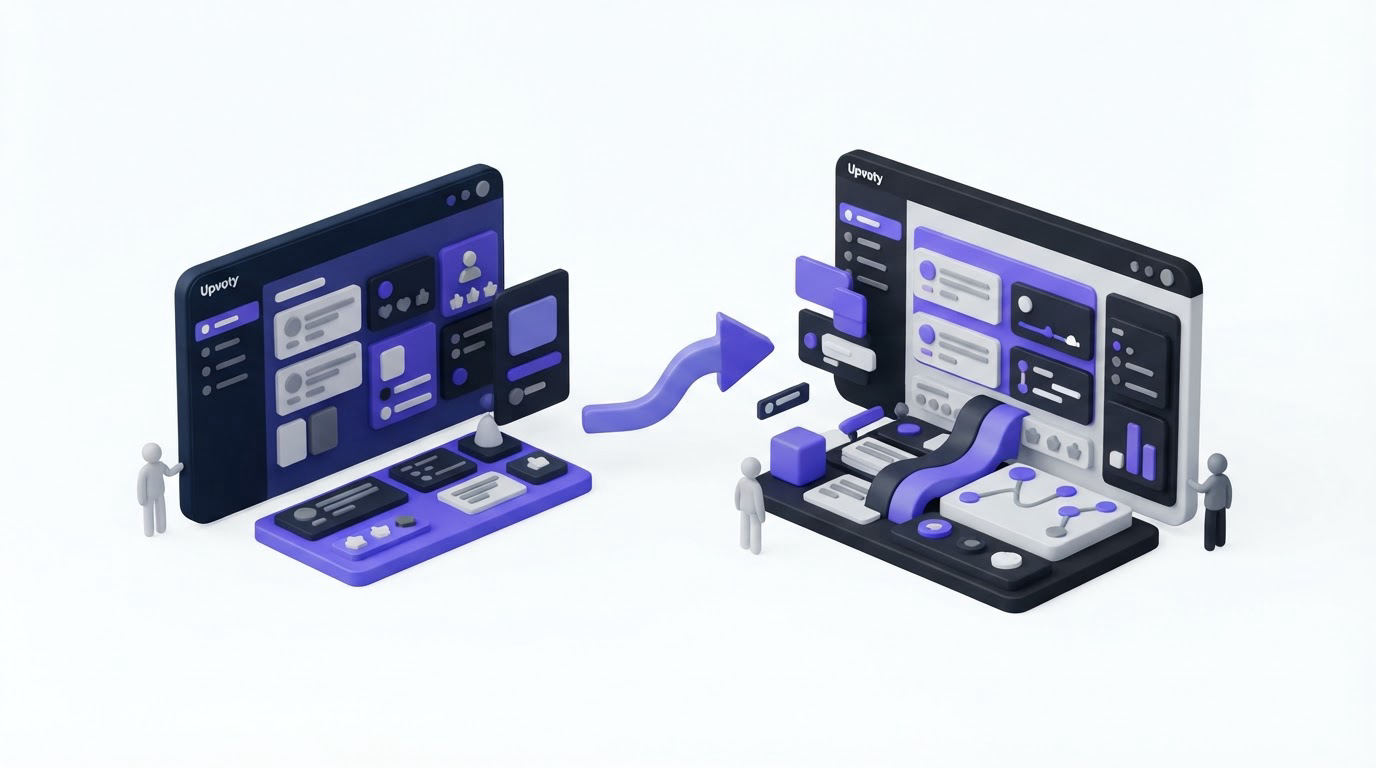
Upvoty is best for SaaS teams that want one connected workflow for gathering feedback, making decisions, publishing direction, and communicating delivery. It is particularly practical for teams with a product manager, a support lead, and a customer-facing owner who all need to contribute context around the same request.
Here is how the reporting request moves through Upvoty in day-to-day use:
- A customer submits “weekly exports” through the feedback widget or public portal.
- A moderator finds related “email reports” and “board packs” posts, then merges them into one clear request.
- The team applies segments, internal notes, an assignee, and a priority while checking the accounts and evidence behind the votes.
- After product review, the team moves the request to a planned roadmap status with a customer-safe description.
- When scheduled reports ship, the team creates a changelog entry and uses voter notifications to bring the update back to people who asked for it.
The dashboard below shows the kind of shared feedback workspace this process needs: a place for request review, status decisions, and customer context.
!Upvoty feedback dashboard for reviewing feature requests and customer insights
The trade-off is operational discipline. A portal alone will not keep requests clean, and automated notifications cannot repair vague roadmap statuses. Assign a moderator, set a review cadence, and give support and sales a simple rule for attaching account context. Teams that maintain those habits get a feedback system customers can trust.
What to check before moving from Featurebase to Upvoty
Run a focused pilot with real requests before making a migration decision. Import or recreate a representative sample that includes duplicates, high-vote ideas, private requests, and a recently released feature. Then ask the people who actually use the workflow to complete their normal tasks.
Check whether the customer experience matches your brand and information policy. Private feedback can protect sensitive account discussions, while a public board can build confidence through visible progress. For teams processing personal data from European users, ask each vendor for its data processing terms and subprocessors. The GDPR processor requirements in Article 28 provide a useful baseline for that review.
Also test accessibility directly in your branded portal and widget. Keyboard navigation, clear labels, and readable status colors help more customers submit and follow feedback. The W3C WCAG 2.2 standard gives your team concrete criteria for that check.
Choose Upvoty when your trial shows a better fit for these needs: branded feedback collection, mixed public and private workflows, structured request review, visible roadmaps, and changelog-based follow-up. Compare integrations early as well. A team using Jira or Linear should test the exact handoff it expects, including ownership and status responsibilities.
Common mistakes when choosing a Featurebase alternative
The first mistake is running a feature checklist without testing the workflow. Most tools can collect a request. The evaluation should show what happens when several users describe the same problem, a sales team adds account context, and a release changes the request status.
Another mistake is treating a public roadmap as a delivery calendar. Publish only the confidence level your product process can sustain. A small set of accurate roadmap entries is more useful than a long list that changes every week.
Teams also lose momentum when nobody owns customer follow-up. Put release notifications in the launch checklist. For the reporting example, the product manager owns the changelog entry, support verifies its customer language, and the account owner checks that affected accounts receive the update.
Finally, avoid judging demand by raw vote totals alone. Read the supporting comments, identify user segments, and record commercial or strategic context. Use the framework in Feature Voting Without Popularity Bias when a popular request conflicts with product direction or account evidence.
FAQ
Is Upvoty a good Featurebase alternative for early-stage SaaS teams?
Yes, when the team needs a practical feedback workflow before requests spread across support tickets and spreadsheets. Start with one board, one moderator, and a small set of roadmap statuses. Add private boards and segments as account needs grow.
Can customers submit feedback from inside the product?
Yes. Upvoty offers an in-app feedback widget, which lets teams place request collection where users are already working. Use a short prompt and searchable existing posts to reduce duplicate submissions.
Should every customer be able to see the product roadmap?
Visibility should follow your product and commercial policy. Public roadmaps work well for broadly relevant direction. Private boards or restricted views suit account-specific work, security-sensitive initiatives, and items still under early evaluation.
How do you close the loop after a feature ships?
Publish a changelog entry that explains the release in customer language, update the associated roadmap status, and notify the people who supported or followed the request. Make this part of the release process rather than a task left for a later date.
What should teams migrate first from Featurebase?
Move active requests, their status, supporting comments, and the user or account context needed for current prioritization. Archive stale ideas separately. Begin with the feedback areas your team reviews every week, then expand after the new process is working consistently.
If your team needs a connected path from requests to roadmap updates and release communication, try Upvoty with a representative set of real feedback. Run the reporting-request test above and involve product, support, and sales in the review. Read next: How Shopify App Teams Can Collect Feature Requests in Upvoty.