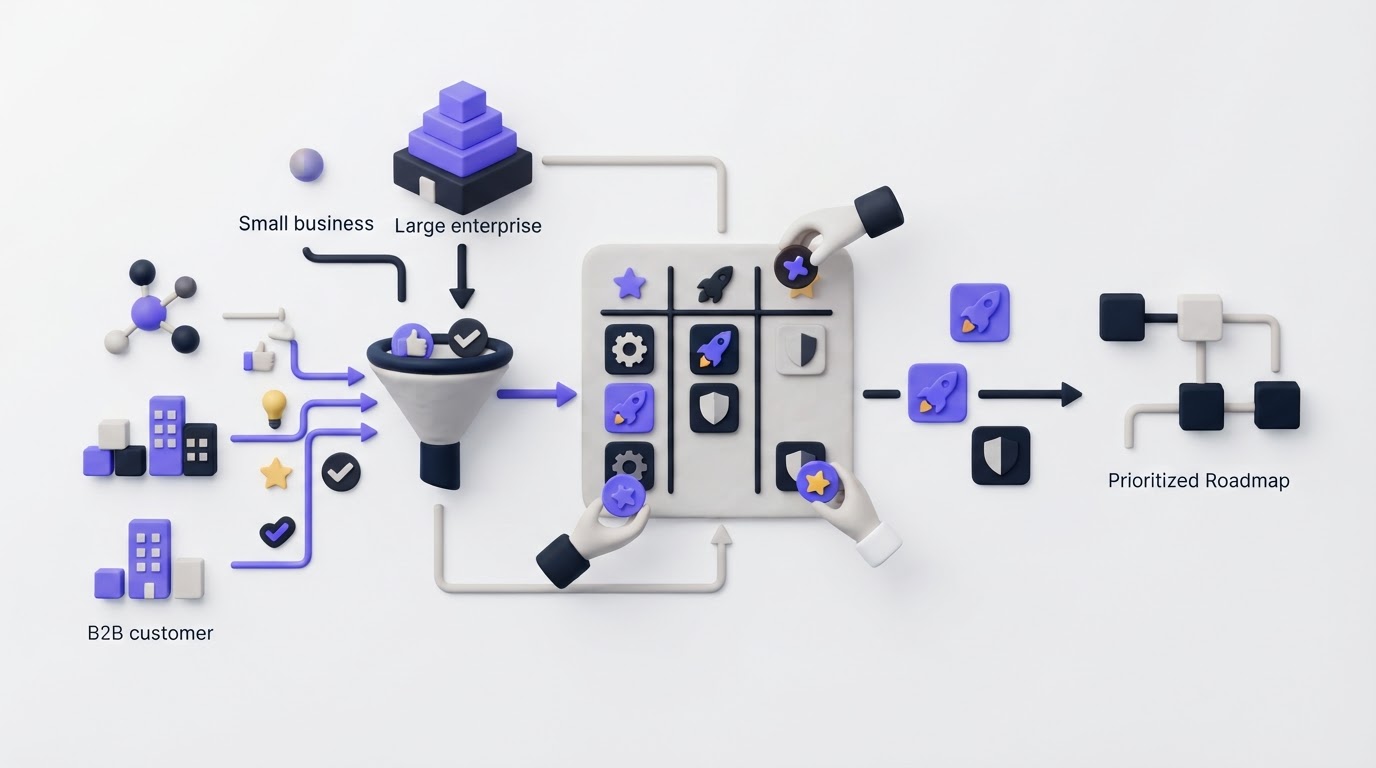
A request with 31 votes can look like an obvious roadmap winner until the product team learns those votes came from 22 low-value accounts. Meanwhile, a request with 14 votes may protect a renewal, unblock an enterprise rollout, and support the company’s target segment.
Feature voting gives B2B SaaS teams a reliable demand signal when each vote carries customer context. Upvoty helps teams collect requests in one place, group duplicate ideas, and assess votes alongside the account behind them.
Quick answer: how to prioritize feature voting in B2B SaaS
Use this workflow to turn feature voting into a B2B prioritization input:
- Collect votes by feature request and merge duplicate posts into one demand record.
- Identify the distinct accounts behind each request, rather than counting user votes alone.
- Add account tier, segment, renewal context, strategic fit, urgency, and implementation effort.
- Apply a simple weighted score that gives account context more influence than raw vote volume.
- Review the ranked list with Product, Sales, Customer Success, and Engineering before committing roadmap capacity.
- Publish clear statuses and notify voters when a decision or release changes the request’s state.
Why raw feature voting totals fall short in B2B SaaS
A vote represents interest. In B2B SaaS, the business effect depends on who expressed that interest, why they need the capability, and whether the request supports the product direction.
One enterprise account can have ten users voting for the same request. Counting every vote makes that account appear ten times more influential than a similarly sized account represented by one administrator. Normalize demand by distinct accounts before you start weighting it.
Raw totals also miss the commercial and operational context behind a request. A feature may support a renewal, remove a compliance blocker, reduce onboarding friction in a target segment, or solve a narrow workflow with limited long-term fit. Product teams need those facts beside the vote count.
Use feature voting as one input in a decision record. The record should make demand visible while leaving room for product strategy, technical dependencies, security work, and maintenance cost.
The context fields worth capturing
For each voter or account, keep a small set of fields that your team can maintain accurately:
- Account tier or contract value band
- Customer segment, industry, and plan
- Lifecycle stage, such as prospect, active customer, or renewal risk
- Strategic fit with the target market and product direction
- Use case and urgency stated in the request
- Account owner’s internal notes and confidence level
Avoid turning the feedback form into a long qualification survey. Ask customers for their use case, then enrich account details internally through your CRM or customer success process.
How to add account size and strategic fit to feature voting
Start with a repeatable scoring model. A simple model earns more trust than a complex spreadsheet that only one person understands.
First, choose a small number of account tiers. For example, label accounts as core, growth, and strategic based on criteria your leadership team already uses. Revenue can inform a tier, though it should sit alongside retention risk, expansion potential, market relevance, and implementation suitability.
Next, assign an account weight. A core account might receive 1 point, a growth account 4 points, and a strategic account 10 points. These values are decision rules, not universal truths. Set them during a quarterly planning discussion and apply them consistently.
Then add three product-side inputs: strategic fit, urgency, and estimated effort. Keep each on a 1-to-5 scale. The product manager owns fit and urgency after consulting the relevant teams. Engineering owns the effort estimate.
Here is a hypothetical example from a workflow automation SaaS called RelayDesk. Its team is choosing between SAML single sign-on, CSV invoice export, and regional data hosting.
| Feature request | Raw votes | Distinct account mix | Account-weighted demand | Fit and urgency points | Effort deduction | Priority score |
|---|---|---|---|---|---|---|
| CSV invoice export | 31 | 22 core accounts | 22 | 5 | 1 | 26 |
| SAML single sign-on | 14 | 3 strategic, 2 core accounts | 32 | 9 | 3 | 38 |
| Regional data hosting | 6 | 1 strategic, 2 growth accounts | 18 | 10 | 5 | 23 |
RelayDesk calculates the score as account-weighted demand plus fit and urgency, minus effort. SAML moves to the top because three strategic accounts need it for rollout and two are approaching renewal. CSV export remains valuable, yet it belongs in a smaller improvement stream with a lower delivery cost. Regional hosting warrants discovery work because the request could affect an important market, even though its current score sits lower.
The score provides a starting order. Product judgment still decides whether SAML depends on identity architecture work, whether a lighter export solves the invoice problem, or whether data hosting needs legal review before any commitment.
For a deeper version of this approach, see how to prioritize customer feedback by revenue, segment, and demand.
Treat account size as a signal, not an automatic override
An account with a large contract deserves visibility. It should never receive an unchecked promise through a public board. A single bespoke request can pull the product away from the customers you want to serve next year.
Create an explicit strategic-fit score to prevent this. Give a higher score when the request serves your ideal customer profile, strengthens a planned product capability, or solves a recurring problem across the target segment. Give a lower score when it requires an isolated workflow, an unusual integration, or long-term support work your team cannot sustain.
At RelayDesk, the sales team initially marked a custom accounting integration as high priority because it came from a strategic account. Product lowered its fit score after confirming that the integration used an accounting system outside the company’s supported market. Customer Success proposed an API-based workaround, and the roadmap remained focused on reusable capabilities.
Build a feature voting process that teams can audit
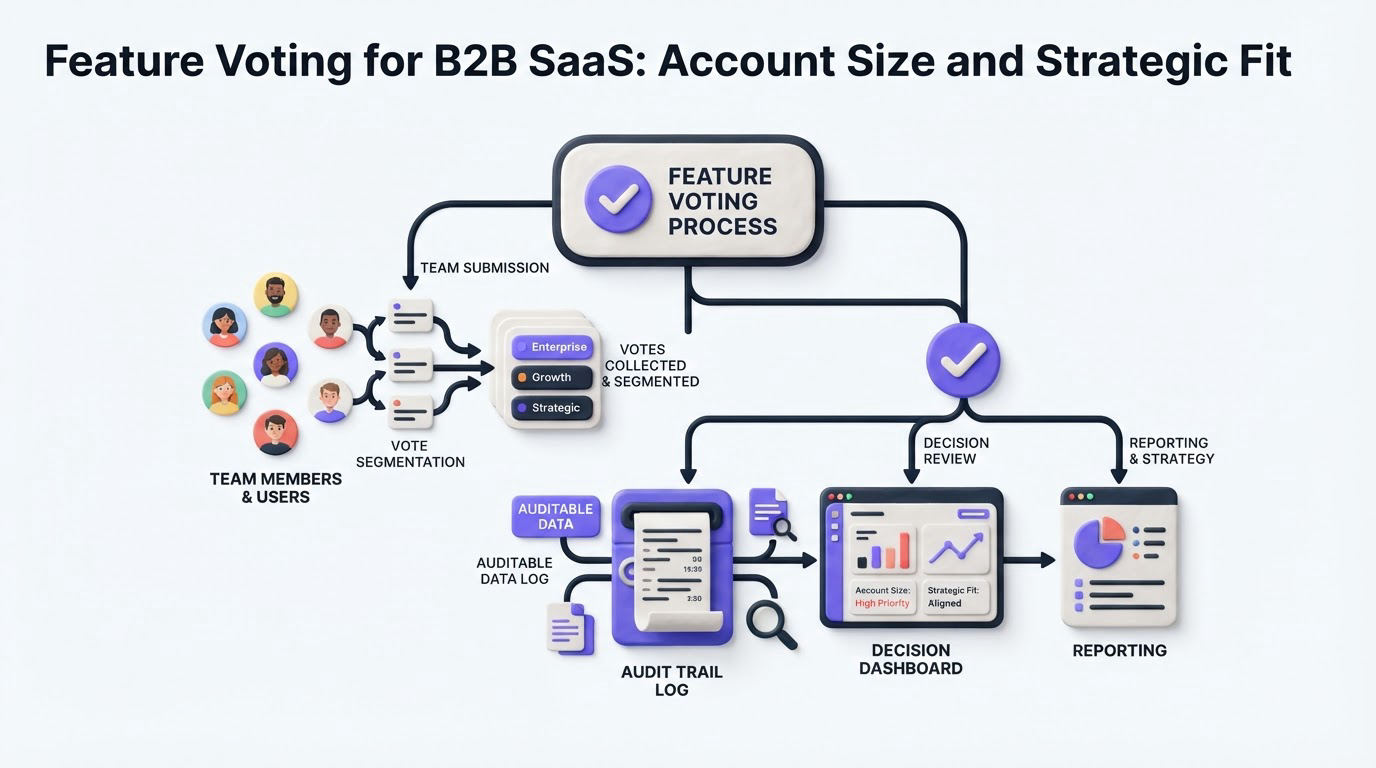
Feature voting becomes harder to trust when Sales, Support, and Product each maintain their own list. Centralize requests first, then define how information enters the record.
Send customers to one feedback board or embed a request form inside the product. Encourage them to search before posting so related requests accumulate under one item. A moderator should merge close duplicates and preserve the comments that explain the underlying job customers are trying to complete.
Use internal notes for account context that should stay private, including renewal timing, account health, commercial commitments, and details shared in calls. Public votes should remain useful to customers without exposing sensitive account information.
Set a review cadence. A weekly triage keeps incoming requests clean. A monthly cross-functional review turns grouped demand into discovery, planned work, deferred work, or declined work. Quarterly planning sets the capacity split between strategic bets, customer demand, reliability work, and technical foundations.
The feature request management workflow offers a practical way to route submissions, merge duplicates, and assign ownership before requests reach roadmap planning.
Keep customer data proportionate
Account enrichment can involve personal and commercial information. Limit collection to fields with a clear prioritization purpose, restrict internal access, and agree on retention practices with your privacy team. The European Commission’s data protection guidance explains core responsibilities for organizations handling personal data, while the NIST Privacy Framework provides a useful structure for privacy risk management.
A public request can show a vote total and status. Renewal risk, contract details, and internal account classification belong in private notes.
How Upvoty adds customer context to feature voting
Teams can run this process with a spreadsheet, CRM views, and recurring meetings. That setup creates copying work and makes it easy for request history to fragment. Upvoty brings the visible feedback workflow into one place while keeping account context available to the people who need it.
Start by creating feedback boards for the product areas customers understand. Customers submit ideas, search existing posts, vote, and add use-case comments. Similar requests can be combined so demand is concentrated on one feature record.
Next, apply segments for meaningful groups such as enterprise accounts, agencies, or customers on a particular plan. Add smart tags for themes such as security, billing, onboarding, or integrations. These labels let the team inspect demand by audience rather than relying on one universal total.
Use internal notes to record the account owner’s context, then assign a priority and owner for the next decision. The feedback record can carry the evidence from the board through triage instead of sending a product manager back through call notes and separate spreadsheets.
This dashboard view shows the practical benefit: requests, votes, statuses, and management actions can stay together during review.
!Upvoty dashboard for managing feature requests and customer feedback
When a decision is ready to share, move the request to a public roadmap status through Upvoty’s roadmap feature. After release, publish the update in a changelog and notify the relevant voters. This closes the loop without turning every feature request into a promise. Read more about closing the customer feedback loop with a changelog.
Common feature voting mistakes in B2B SaaS
The most common failure mode is treating a leaderboard as the roadmap. That approach favors broad, low-context requests and hides the commercial reasons behind smaller clusters of demand.
Another problem appears when Sales labels every deal-related request as urgent. Require a named account owner, a documented use case, and a clear statement of what changes if the request stays unbuilt. Product can then separate a true adoption blocker from a feature that supports negotiation.
Teams also lose signal by leaving duplicate posts open. At RelayDesk, SAML appeared as “Okta login,” “enterprise authentication,” and “SAML.” The first review combined them. The team could finally see five distinct accounts, the associated renewal dates, and the shared implementation need.
Finally, avoid publishing a “planned” status before discovery confirms scope. Use statuses that describe the current stage accurately, such as under review, researching, planned, in progress, and released. A trustworthy public product roadmap gives customers clarity while preserving space for technical discovery.
FAQ
How should B2B SaaS teams weight feature votes?
Weight votes at the account level using a small set of documented tiers, then add strategic fit, urgency, and delivery effort. Review the output with Product, Engineering, Sales, and Customer Success before making a roadmap commitment.
Should enterprise customers get more influence in feature voting?
Enterprise customers should receive more context and visibility during prioritization. Strategic fit protects the roadmap from one-off custom work that serves only a narrow use case. Use a shared scoring rule so account influence remains consistent and explainable.
How do you prevent one customer from casting many votes?
Track distinct accounts alongside individual voters. A board can show the social proof of user votes while your internal prioritization view counts account representation and account tier.
What should happen after a feature request is prioritized?
Assign an owner, capture the discovery decision, and update the request status. When the work ships, publish a changelog entry and notify voters with the outcome, release details, or any relevant limitations.
Feature voting works best when every request carries enough context to support a real product decision. Use Upvoty to bring requests, account segments, internal review, roadmap status, and customer updates into one feedback workflow.