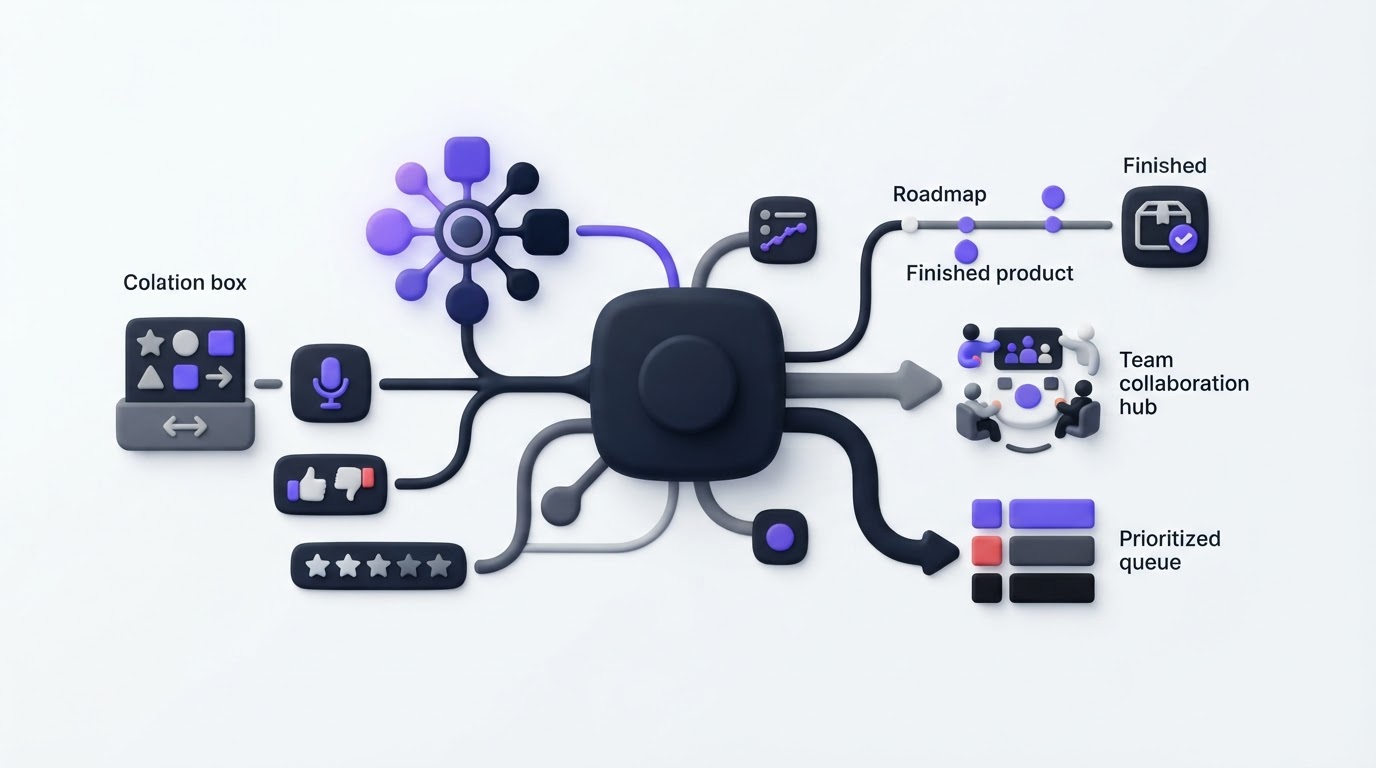
Feature requests arrive in support tickets, sales calls, product reviews, and direct messages. When each source lives separately, product teams spend hours relaying the same request and customers receive vague answers about what happens next.
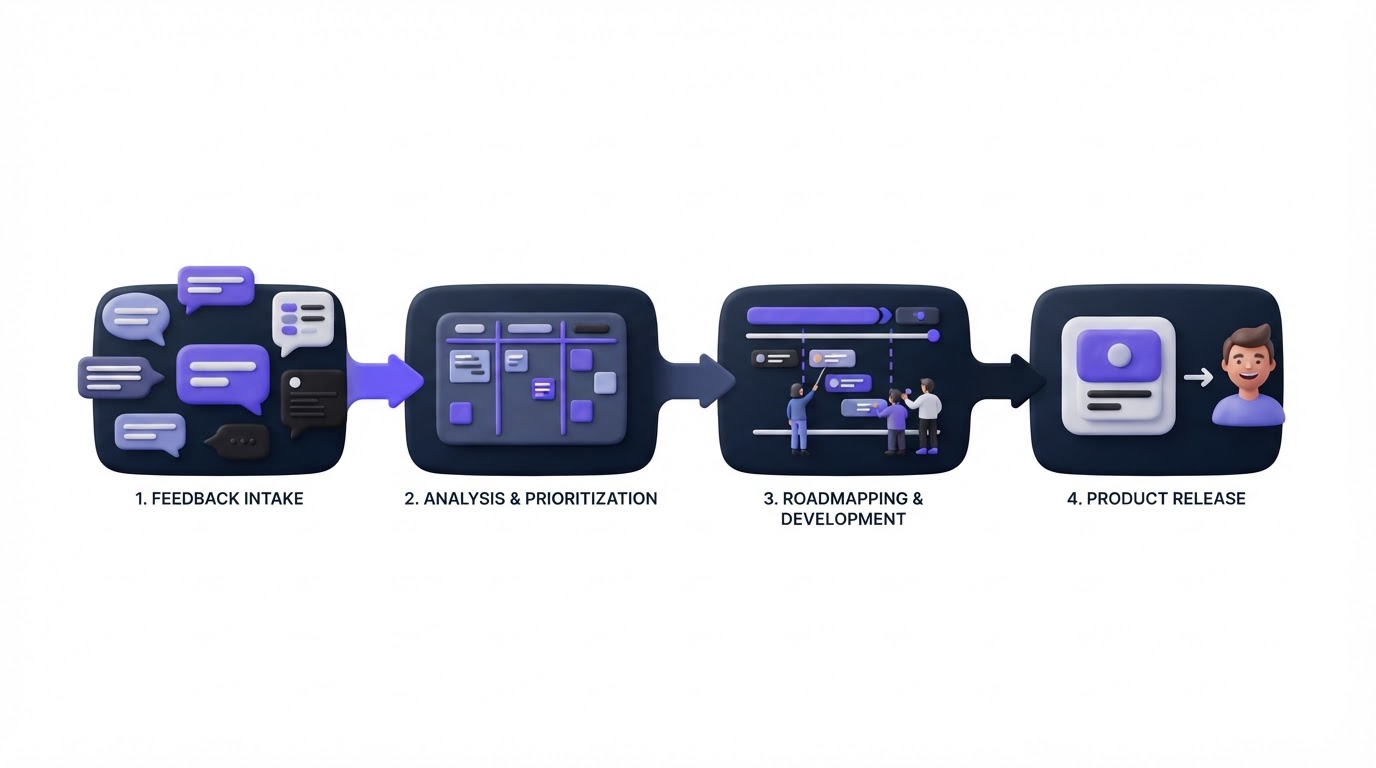
Upvoty gives teams one place to collect feedback, identify repeated demand, prioritize work with context, and communicate progress. A useful process starts with the workflow below.
Quick answer: how to use feedback management software
- Collect requests from a public portal, embedded widget, support conversations, and internal teams.
- Merge duplicates so every requester and vote strengthens one product idea.
- Add customer context such as segment, revenue tier, account owner, and problem type.
- Prioritize ideas using demand, strategic fit, effort, and customer impact.
- Publish selected items on a roadmap with clear statuses.
- Announce releases in a changelog and notify the people who requested them.
How feedback management software collects requests in one place
Start by defining the places where customers already express product friction. A public feedback board works well for feature ideas that benefit from voting and discussion. An in-app widget captures feedback when the customer is inside the relevant workflow. Internal submissions give support, success, sales, and leadership a consistent route for customer evidence.
For example, consider RoutePilot, an illustrative B2B scheduling SaaS company. Its support team kept seeing requests for a "technician arrival window" feature in Intercom, while enterprise prospects raised the same issue during demos. The product manager created a single submission category called Scheduling and added a feedback board to the customer portal. Sales could now submit a request on a prospect's behalf, and customers could vote on the same post.
Choose a public board when open discussion builds trust and makes duplicate requests easier to spot. Choose a private board for beta features, internal tooling, or accounts with contractual confidentiality requirements. Upvoty supports private or public feedback spaces, so the collection model can match the audience.
A short submission form produces stronger evidence. Ask for the job the customer is trying to complete, the current workaround, and the impact of the issue. Keep required fields limited. Long forms reduce submissions and produce rushed answers.
If your product serves people in the EU, collect only the personal data needed to process the request and explain how it will be used. The GDPR data protection principles provide a practical baseline for purpose limitation and data minimization.
How to organize and merge customer feedback
Raw request volume creates a misleading backlog. "Add arrival windows," "let us set ETAs," and "customers need a better arrival estimate" may describe one underlying job. Store them together before any prioritization meeting.
At RoutePilot, the product manager found 27 posts related to arrival expectations. Six used the term ETA, nine asked for time windows, and the remainder described missed appointments. The team merged the overlapping posts into one canonical request: Give customers a configurable technician arrival window. The merged post retained the voters and linked the original wording for context.
This is where a dedicated system earns its place. Use tags for themes such as scheduling, reporting, onboarding, and mobile. Use segments to separate feedback from trial users, self-serve customers, and enterprise accounts. Add internal notes for sales commitments, support severity, and technical constraints. Keep those notes out of the public conversation.
AI-assisted merging can speed up the first pass through a high-volume inbox. Review every suggested merge before applying it. Similar wording can hide different needs, especially when one request concerns a reporting view and another concerns the underlying data.
The following structure keeps review meetings focused on decisions rather than cleanup:
| Feedback field | RoutePilot example | How the team uses it |
|---|---|---|
| Canonical request | Configurable technician arrival window | One record for votes and updates |
| Source | Portal, sales, support | Shows where demand originates |
| Segment | Enterprise, self-serve | Reveals who experiences the problem |
| Evidence | 27 linked posts and call notes | Preserves detail behind the request |
| Product status | Under review | Sets an honest expectation |
| Owner | Product manager | Creates a clear next action |
For a fuller setup process, see this guide to collecting, organizing, and prioritizing feature requests.
How to prioritize feedback with customer context
Votes indicate demand. Product decisions also require customer impact, strategy, delivery effort, risk, and timing. A request with 80 votes from free users may deserve less urgency than a request from three expansion-ready accounts that affects a core workflow.
RoutePilot scored the arrival-window request with four inputs: 27 linked requests, strong relevance to its scheduling strategy, recurring support burden, and a medium engineering estimate. The team chose it for the next planning cycle because it improved a central customer experience and addressed a repeated reason for delayed sales evaluations.
Use a repeatable review cadence. Weekly triage keeps new posts organized. Monthly product reviews create room for deeper prioritization. Record the decision and the reason in the request. That record helps customer-facing teams give accurate replies months later.
Segmenting feedback is especially valuable when demand comes from different customer groups. Read how to prioritize customer feedback by revenue, segment, and demand before relying on vote totals alone.
Avoid treating the loudest individual request as the roadmap. Look for a clear problem, a defined audience, and corroborating evidence from behavior, support volume, or account conversations.
How Upvoty manages feedback from request to release
A manual spreadsheet can work during an early stage, then its limits appear when duplicate requests, ownership, and customer updates multiply. Upvoty is designed around the complete feedback loop.
First, configure a branded portal or place the in-app feedback widget where users can submit ideas without leaving the product. Create separate boards when you need different audiences, such as customers, beta users, or internal staff.
Next, review new posts in the feedback dashboard. Apply smart tags, add internal context, assign an owner, and merge overlapping submissions with Merge AI when it helps identify likely duplicates. The canonical post becomes the working record for the request.
Then, use segments and analytics to understand who is asking. RoutePilot could compare enterprise demand with self-serve demand before assigning the scheduling work a priority. Team roles keep moderation and decision rights clear as more colleagues participate.
This view shows the feedback dashboard where teams can review requests and keep the underlying context together.
!Upvoty dashboard for managing customer feedback requests
After a decision, move approved work to a public product roadmap. RoutePilot could publish the arrival-window item as Planned, then In Progress when engineering begins. Customers see progress without needing a separate support reply for every status change.
Finally, publish the completed work in a changelog and notify the voters. Describe the release in customer language, including what changed and where to find it. The team can also explain when a request has been declined or parked, which prevents a silent backlog from becoming a trust problem.
How to choose feedback management software
Evaluate the workflow your team needs six months from now. A tool that only collects votes creates extra work when you need segmentation, decisions, roadmap communication, and release updates.
Look for these practical capabilities:
- Public and private boards for the audiences you serve
- Duplicate merging and moderation controls
- Customer segmentation and feedback analytics
- Internal notes, owners, and priority fields
- Roadmap and changelog publishing
- Integrations with the systems where your team works
Integration depth deserves careful review. RoutePilot's product manager needed request context available to the support and engineering teams, so connections to tools such as Intercom, Jira, or Slack could reduce manual handoffs. Use the native integration that fits your operating process, then define who owns updates on each side.
Also review data controls before rollout. The NIST Privacy Framework is a useful reference for assigning accountability and managing data-processing risk as feedback data grows.
Common feedback management software mistakes
The most expensive mistake is collecting requests without an owner or review cadence. Posts accumulate, customers see no movement, and the board becomes a record of unanswered expectations.
Another frequent problem is publishing every internal idea on a public roadmap. Share items once the team can stand behind the level of commitment implied by the status. A roadmap should communicate direction and progress, not expose unfiltered brainstorming.
RoutePilot also avoided a common release mistake. Its first draft changelog said only "Scheduling improvements." That wording gave voters no proof that their request was heard. The revised post explained that admins could set configurable arrival windows and that customers would see those windows in appointment notifications. Specific release communication makes the feedback loop visible.
For practical examples, read how to close the customer feedback loop with a changelog and how to build a public product roadmap customers can trust.
Feedback management software FAQ
What is feedback management software used for?
Feedback management software collects customer ideas and issues, organizes related requests, adds decision context, and communicates product progress. Product, support, success, and sales teams use the shared record to give customers consistent answers.
Should customers be able to vote on feature requests?
Voting gives customers a simple way to support an existing idea and reduces duplicate submissions. Pair vote totals with account segment, urgency, strategic fit, and delivery effort during prioritization.
Can feedback management software support private product feedback?
Yes. Private spaces suit internal teams, beta programs, and customer groups with sensitive requirements. Set the audience before publishing a board, then keep internal discussion and account context restricted to your team.
How often should a product team review feedback?
Review new items weekly to merge duplicates, moderate submissions, and route ownership. Hold a deeper prioritization review monthly or alongside your planning cycle. Maintain visible statuses between meetings so customers can see progress.
What should a product changelog include?
State what shipped, who benefits, and where users can access it. Link the release to the original feedback item where appropriate, then notify the voters who asked for it.
Bring your requests, decisions, roadmap, and release updates into one working system with Upvoty feedback management software. Set up a board, review the first group of submissions, and give customers a clear view of what happens next.