
Feature requests sit in support tickets, sales-call notes, and chat threads while product teams try to choose the next release. That scattered trail makes duplicate demand hard to see and leaves customers waiting for an answer.
Upvoty gives product teams one place to collect requests, understand who is asking, prioritize work, and show progress publicly or privately.
Quick answer
Use a customer feedback platform with this five-step workflow:
- Capture feedback through a portal, embedded widget, and team channels.
- Merge similar requests into one clear problem statement with supporting context.
- Prioritize demand using votes, customer segments, revenue context, and product fit.
- Publish selected work on a roadmap with plain-language status updates.
- Announce released work through a changelog and notify the people who voted.
How a customer feedback platform collects feedback in one place
Start with the places where customers already speak. A public portal works well for active users who want to browse and vote. An embedded widget captures feedback while a customer is using the product. Support, sales, and customer success teams need a reliable route for adding requests they hear in conversations.
Consider a workflow SaaS at app.example.com. An operations manager submits a request for "export filtered tasks to CSV" through the in-app widget. A sales representative later records the same need from a procurement call. The product team creates one canonical request, preserving both sources and the customer context behind them.
Use feedback boards when customers should be able to submit, comment on, and vote for ideas. Add an in-app feedback widget when the best moment to ask is inside the product, such as after a user has applied filters or completed a workflow.
Keep submission forms short. Ask for the problem, the desired outcome, and enough context to reproduce the situation. Add fields for product area, plan, account type, or use case only when those fields will influence a decision.
Collect personal data with purpose and restraint. Article 5 of the GDPR sets out principles including purpose limitation and data minimization. For public forms, use clear field labels and instructions that support the WCAG 2.2 guidance.
| Feedback source | Best input to capture | Main operational risk | Best use in a product decision |
|---|---|---|---|
| Public feedback board | Customer-written request and votes | Duplicate posts around popular ideas | Measure visible demand and gather use cases |
| In-app widget | Product area and moment of friction | Vague one-line submissions | Identify workflow-specific pain points |
| Support conversation | Account context and urgency | Requests remain trapped in ticket history | Surface recurring blockers and workarounds |
| Sales conversation | Buyer requirement and deal context | A single prospect dominates planning | Assess market fit and segment demand |
| Internal team submission | Evidence, links, and owner notes | Opinion enters without customer proof | Preserve field intelligence for review |
How a customer feedback platform organizes duplicate requests
A growing board needs a consistent structure. Create categories around product areas, then apply tags for themes that cross those areas, such as reporting, permissions, performance, or onboarding. Use one request title that describes the customer outcome. Add examples and linked evidence in the body.
For the app.example.com team, "CSV export," "download filtered tasks," and "export project view" point to the same underlying need. Merge them into "Export filtered task views." Keep the original wording in internal notes so the team retains the detail behind the request.
Merge early, before separate posts split votes and comments. A fragmented board creates misleading demand because each request looks smaller than the whole problem. AI-assisted merging can speed up the review of similar submissions, while a product owner should confirm the final grouping and preserve meaningful edge cases.
Set a weekly moderation rhythm. Review new posts, merge duplicates, tag uncategorized items, and ask follow-up questions where the requested outcome remains unclear. This cadence prevents a feedback portal from turning into an archive.
How a customer feedback platform prioritizes customer demand
Votes give a useful demand signal. Product decisions also require context: which customer segment is asking, whether the request solves a repeated workflow problem, the size of the affected opportunity, technical dependencies, and the product strategy for the quarter.
For the export request, the team sees demand from operations users who run filtered views each week. The request depends on permissions work already planned for audit-log filtering. That dependency moves the request toward the next planning cycle because the underlying access controls create a safer release path.
Assign an owner and a priority level to each serious request. Then record the reason for the decision. A short note such as "Planned after permissions update" gives support and sales teams a factual response instead of a vague promise.
Use segments to separate broad demand from concentrated demand. Ten requests from one specific plan can reveal an important retention issue. A smaller number of requests across several customer types can signal a product-wide improvement. The practical scoring approach in this customer feedback prioritization guide shows how to weigh revenue, segment, and demand together.
How a customer feedback platform turns decisions into a public roadmap
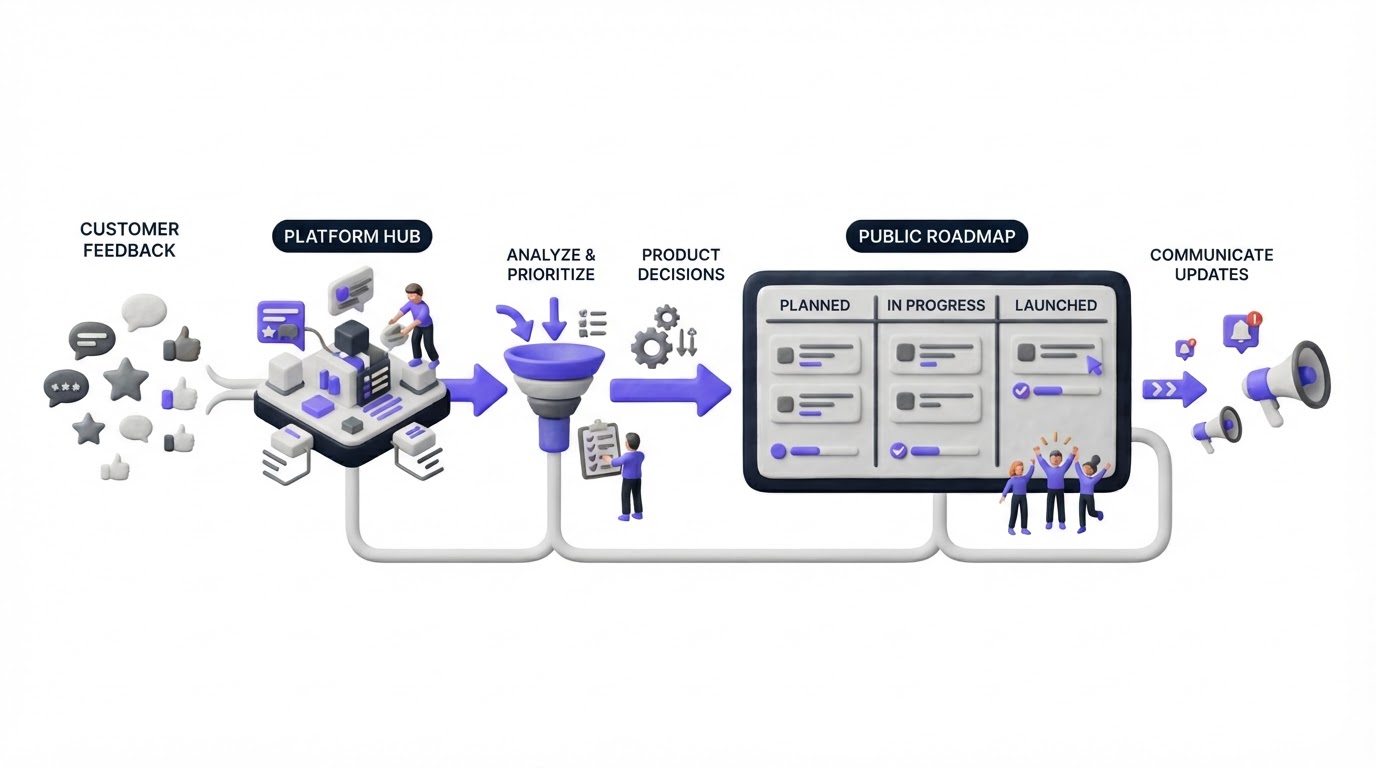
A roadmap answers the question customers ask after submitting an idea: where does this stand? Publish only the level of detail that helps customers understand direction and status. Keep internal dates, dependencies, and sensitive commercial work in a private workspace.
For the export request, the product team moves the post to Planned once the permissions dependency is scheduled. The public roadmap shows the outcome, "Export filtered task views," and a short explanation of the intended capability. It avoids a release-date promise until delivery confidence is high.
Use clear statuses such as Under Review, Planned, In Progress, and Released. Customers can interpret these states quickly, and support teams can point to one source of truth. Read how to build a public product roadmap customers can trust for the status rules and communication choices that keep a roadmap credible.
How Upvoty runs the customer feedback workflow
Upvoty is built for the full feedback loop, from the first request through the release update. Begin by setting up a branded board for the product area customers should influence. Choose public access for open product input, or use private access for customer advisory groups and internal teams.
Next, place the widget in app.example.com near the workflow where users encounter the issue. New ideas arrive in the dashboard alongside requests submitted through the portal. The product owner reviews the queue, merges related posts, adds smart tags, and uses segments to see which groups support each request.
This view shows the operational workspace where teams review requests, context, and demand before planning.
!Upvoty dashboard for managing customer feedback and feature requests
When the team selects the export work, they assign a priority, add an internal decision note, and move it to the product roadmap. Voters can follow the request, while the team controls the information shown publicly. Once released, publish the update in the changelog and use automatic voter notifications to close the loop.
The result is a connected record: customer request, product decision, roadmap status, and release communication. That visibility reduces repeat questions and gives every team a shared answer.
What to look for when choosing a customer feedback platform
Choose a platform based on the workflow your team needs to run each week. A simple voting board may suit an early-stage product with a small, focused audience. Teams with multiple customer segments and a regular release cadence benefit from connected feedback, prioritization, roadmap, and changelog capabilities.
Check how the platform handles these practical scenarios: duplicate requests, private feedback, account context, moderation, roadmap permissions, and voter updates. Also involve the teams who will use it daily. Support needs a fast way to add evidence. Product needs clear ownership and prioritization. Customers need an understandable experience that feels connected to the product.
Compare tools against your actual workflow before moving data. Canny, Featurebase, and Nolt each offer different approaches to feedback collection and communication. For a focused feature-by-feature review, see the Upvoty versus Canny comparison and the broader product feedback tools selection guide.
Customer feedback platform FAQ
What is a customer feedback platform?
A customer feedback platform is a system for collecting requests, organizing related ideas, assessing demand, communicating product decisions, and updating customers when work ships. It gives product, support, and sales teams a shared record of what customers need.
Should feedback boards be public or private?
Use public boards when open voting and roadmap visibility support your product strategy. Use private boards for advisory customers, beta programs, internal teams, or ideas that require commercial context. Many teams use both: a public board for broad input and a private board for sensitive discussion.
How do you prevent feature voting from driving every decision?
Treat votes as one decision input. Review the customer segment, problem severity, strategic fit, implementation dependencies, and supporting evidence. Capture the decision rationale on the request so everyone understands the path forward.
How do you close the feedback loop after a release?
Move the request to Released, publish a changelog entry that explains the customer outcome, and notify voters. Include a screenshot or brief usage note when the change needs adoption guidance. The process in this guide to closing the customer feedback loop helps teams make release communication repeatable.
Build a feedback process customers can see and your team can maintain. Start a customer feedback platform with Upvoty to collect requests, make better product decisions, and keep voters informed through every stage.