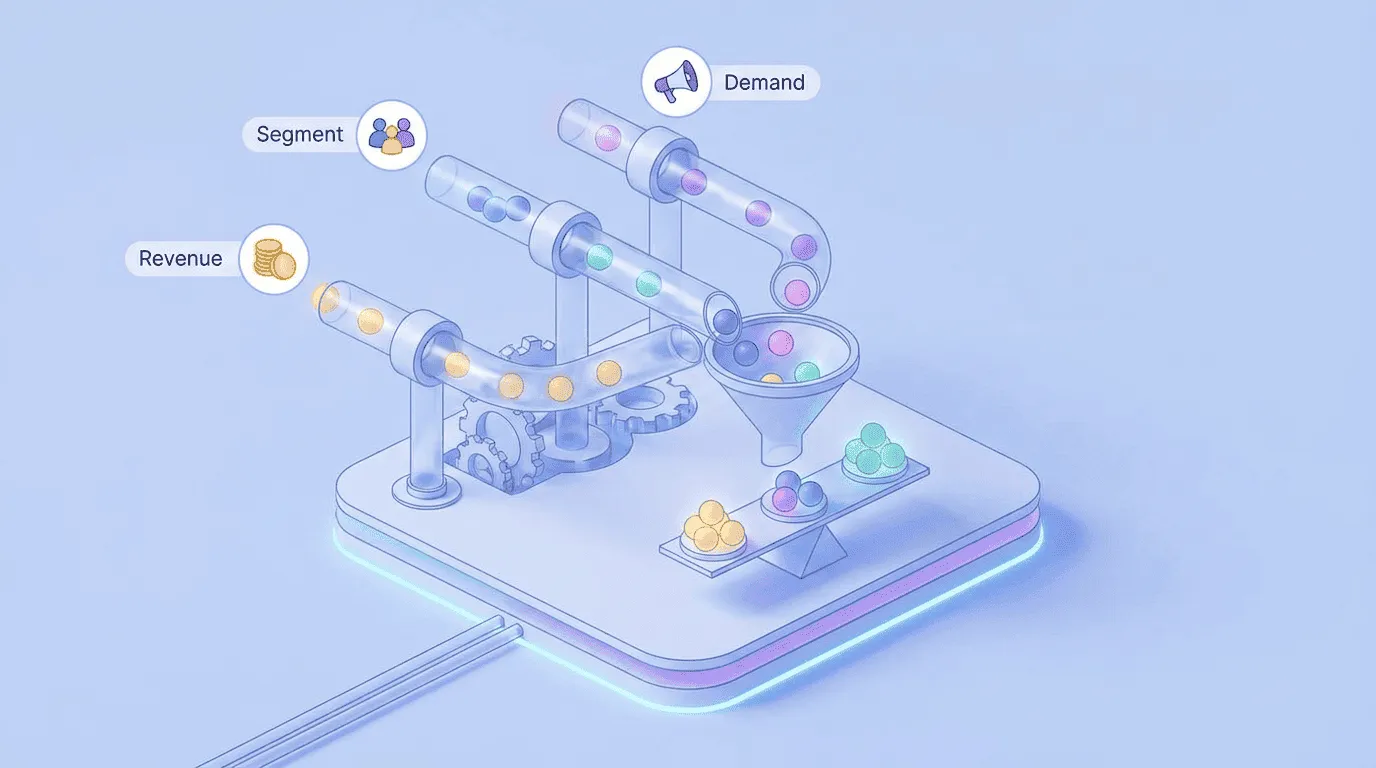
A product team moves a feature from discovery into development, but the public roadmap still calls it “under consideration.” Meanwhile, a sales rep sends a screenshot of the internal delivery board to a prospect and turns a rough target into an apparent commitment.
This usually happens because one roadmap is being asked to serve two audiences. Upvoty helps teams separate customer communication from internal planning, but the team still needs clear rules for what belongs in each view.
Quick answer: how to create a customer-facing roadmap
Use this workflow to separate a private roadmap from a customer-facing roadmap:
- Define the decision each roadmap must support.
- List the audience for each view and what they need to know.
- Keep discovery evidence, commercial context, dependencies, and estimates private.
- Publish customer outcomes, broad status, and enough context to explain direction.
- Replace precise delivery dates with honest time horizons unless a date is genuinely committed.
- Assign an owner and review the external view at least whenever an item changes status.
- Connect feedback, roadmap updates, and changelog announcements so customers can follow progress.
The public version is not a filtered copy of the delivery backlog. It is a communication layer built from selected roadmap decisions.
Customer-facing roadmap vs private roadmap
A private roadmap helps the product team make and revise decisions. It can include uncertain opportunities, rejected approaches, target accounts, estimated effort, technical dependencies, risks, and disagreements that are still being resolved.
A customer-facing roadmap explains where the product is heading. Its job is to set useful expectations without exposing information customers cannot interpret or the company should not disclose.
Consider a fictional B2B reporting product at app.example.com. Customers have repeatedly requested scheduled PDF reports. The internal item contains interview notes, a list of affected accounts, an early engineering estimate, a dependency on a rendering service, and a concern about infrastructure cost. It also records two possible implementations.
The customer-facing card at feedback.example.com/roadmap/scheduled-reports says that scheduled report delivery is planned, explains which reporting workflow it should improve, and gives customers a place to follow the item. It does not publish the estimate, vendor discussion, account names, or implementation debate.
Here is a practical division of information:
| Roadmap element | Private roadmap | Customer-facing roadmap | Reason |
|---|---|---|---|
| Customer problem | Detailed evidence and interview notes | Concise description of the problem | Customers need context, not raw research records |
| Status | Discovery, validation, design, blocked, development, QA | Under consideration, planned, in progress, shipped | External statuses should remain understandable |
| Priority | Numeric score, strategic weight, account impact | Usually omitted | Internal scoring changes and is easy to misread |
| Delivery date | Working estimate with confidence level | Broad horizon or committed date only | False precision creates avoidable promises |
| Dependencies | Technical systems, vendors, staffing | Mention only when it explains a visible delay | Most dependencies are operational detail |
| Customer evidence | Account names, revenue context, quotations | Aggregated need without identifying details | Protects confidentiality and sales context |
| Rejected options | Full decision record | Final direction when useful | Public debate can confuse the intended outcome |
| Owner | Product and engineering owners | Optional public contact or team | Internal accountability does not require public names |
Do not maintain two unrelated sources of truth. The external roadmap should be generated from decisions made in the private process, even if the fields and language differ.
Define the purpose of each roadmap first
Start by writing one sentence that describes the job of each roadmap.
For the reporting product, the private roadmap exists to help product, design, engineering, and leadership decide what to investigate and build. The customer-facing roadmap exists to show customers which reporting problems the team has acknowledged, which improvements are planned, and when meaningful progress occurs.
That wording creates a useful test. If a field does not help customers understand direction or progress, it probably does not belong in the external view. If information affects prioritization, feasibility, staffing, or commercial risk, it usually belongs in the private view.
The private roadmap can also contain work that should never appear publicly. Examples include reducing cloud costs, replacing a fragile service, preparing for a contract renewal, responding to a security issue, or testing an acquisition idea. Customers may benefit from the result without needing advance notice of the work.
A customer-facing roadmap also does not need to show every customer request. Publishing a request signals that the company has considered it important enough to communicate. Requests can remain on a feedback board while the team gathers evidence. A roadmap card should represent a product decision, not merely the existence of demand.
This is why feature voting needs interpretation. Vote totals can identify interest, but they do not account for strategic fit, customer segment, effort, urgency, or the severity of the underlying problem.
Choose the audience for your customer-facing roadmap
“Customers” is too broad to be an operating definition. A roadmap viewed by trial users, paying customers, enterprise buyers, implementation partners, and public visitors creates several different communication risks.
Decide who can see the roadmap before deciding what it contains. A fully public roadmap can support transparency and product discovery. A private customer portal can include more account-relevant context without exposing plans to every visitor. Some teams use both, with a short public view and a richer authenticated view.
For the reporting product, suppose scheduled PDF reports matter mainly to finance teams on higher-volume plans. The public description can still explain the workflow, but plan eligibility should not be implied until the packaging decision is final. If selected customers are helping validate the feature, detailed prototypes and interview questions belong in a private research channel rather than the public card.
Access control is also useful when a company serves distinct product lines. An administrator using one module does not need to sort through plans for another. Segmenting views can make a roadmap more relevant, but too many versions create maintenance work and inconsistent messages.
Keep the structure simple enough to review. If nobody can state which audience sees which item, information will eventually leak or become stale. Upvoty supports private or public access, allowing teams to match visibility to the intended audience rather than forcing every item into one public feed.
For governance of comments, submissions, and sensitive requests around the roadmap, use the same rules described in this guide to public feedback board moderation.
Decide how much detail a customer-facing roadmap needs
A useful external card answers three questions: what customer problem is being addressed, what stage the work has reached, and what customers should do next. More detail is not automatically more transparent.
The first draft of the scheduled reports card might say, “Build cron-based PDF generation with configurable recipients, retry logic, storage retention, and an email delivery provider.” That is implementation language. It narrows the perceived solution before discovery is complete and means little to most customers.
A better description is: “Schedule a dashboard or report to be delivered to selected recipients, reducing the need to export and send recurring reports manually.” It describes the expected outcome without committing to architecture.
Internally, preserve the technical version. Engineering still needs decisions about time zones, recipient permissions, failed deliveries, file retention, and audit logs. Those details belong in specifications and delivery tickets linked from the private roadmap.
Status labels need the same discipline. Five to seven external states are usually enough. “Under consideration,” “planned,” “in progress,” and “shipped” are easy to understand. Internal work may pass through opportunity assessment, validation, design review, technical planning, development, quality assurance, staged release, and monitoring.
GitHub provides a useful primary example through its public roadmap repository, where public issues communicate themes and stages without exposing every internal delivery task. The important lesson is the abstraction level, not the specific labels.
Avoid putting sprint numbers on customer cards. Most customers do not know the dates of your sprints, and a sprint assignment can change for reasons unrelated to product commitment.
Set dates and update cadence for a customer-facing roadmap
Dates are where external roadmaps most often create trouble. A precise date looks authoritative even when it came from an early estimate.
Use broad horizons such as “now,” “next,” and “later,” or calendar periods such as a month or quarter, only when those periods match how the team actually plans. Do not publish quarters merely because other companies do. If priorities can change every two weeks, a roadmap promising delivery three quarters ahead will require constant correction.
The reporting product initially places scheduled reports under “Q2” after a short engineering discussion. Discovery then finds that recipient permissions require a broader access-control change. The public date remains untouched for six weeks because everybody assumes someone else owns it. Sales continues to quote Q2.
The failure was not the dependency. The failure was publishing a target without a confidence rule or named owner.
Set an update trigger for every status transition, material scope change, and expected delay. Add a recurring review as a safety net. A weekly review suits an active roadmap with frequent releases. Monthly may be enough for a smaller product, provided status changes are updated when they happen rather than waiting for the meeting.
Internally, record the target, confidence, assumptions, and last review date. Externally, explain changed expectations directly. “We moved this item back because permission controls need to be completed first” is more credible than silently changing Q2 to Q3.
The official Scrum Guide describes the Product Backlog as an emergent, ordered list rather than a fixed contract. Even teams that do not use Scrum should preserve that ability to revise plans as evidence and constraints change.
Move feedback into the customer-facing roadmap without promising every request
Feedback should enter a review process before it reaches the roadmap. Otherwise, a busy feedback board becomes a public backlog and every popular request starts to look approved.
For scheduled reports, several submissions may describe the same underlying need: email a dashboard every Monday, send monthly reports to clients, automate PDF exports, or deliver reports without logging in. Merge those requests while retaining the voters, comments, account context, and original wording. The team can then assess one opportunity instead of four titles.
This work needs care. A request to email an internal dashboard may have different permission requirements from a request to send client-facing reports. Merge only when the underlying outcome and likely product decision are genuinely shared. The practical method in merging duplicate feature requests helps preserve those differences.
Once the opportunity is validated, create the external roadmap card. Link it to the relevant feedback so voters can follow progress. When development begins, update the status and add a short note if the expected scope has changed.
After release, move communication to the changelog. A roadmap says what is expected. A changelog says what customers can use now, including limitations, access requirements, and instructions. Use the process for closing the customer feedback loop with a changelog rather than assuming customers will notice a shipped label.
The handoff should preserve context from request to release. That continuity is what turns roadmap publishing into feedback management rather than a collection of disconnected posts.
How to manage a customer-facing roadmap in Upvoty
The manual workflow above can be run with documents, spreadsheets, and delivery boards, but the repeated copying creates drift. Upvoty removes part of that handoff by keeping feedback boards, roadmap communication, and release updates in one customer-facing workflow.
Start with the feedback board. Customers submit reporting requests and vote on existing posts. The product team moderates wording, reviews comments, and merges duplicates instead of creating four roadmap entries for scheduled delivery.
Next, keep internal decision context out of the public discussion. Use internal notes for account details, evaluation comments, and other material customers should not see. Priorities and assignees give the team operational fields without placing those fields on the public card.
When the decision is ready to communicate, add it to the Upvoty roadmap with a customer-readable title, outcome-focused description, and appropriate status. Set the board or portal visibility based on whether the audience is public or restricted.
This is what the roadmap dashboard provides for the team managing those status changes:
!Upvoty dashboard for creating and managing a product roadmap
As scheduled reports move into development, update the external status without publishing engineering subtasks. When the feature ships, publish the release through the changelog and notify the people who supported the request. Customers see a coherent path from submitted need to delivered update.
The public result stays intentionally simpler than the private planning record:
!Customer-facing public roadmap showing customers what is coming next
This setup does not remove prioritization or editorial judgment. It removes duplicate publication work and makes stale status easier to spot.
Connect affiliate feedback to your customer-facing roadmap
Affiliate and referral channels can surface product questions before they reach support. Partners may hear repeated objections from prospective customers, notice unclear positioning, or request capabilities that would help a narrow promotional use case. Treat those signals as feedback, not automatic roadmap commitments.
Create a defined intake route for partner observations. If a team manages an affiliate program with a tool such as Affonso, the product owner can still direct product requests into the same feedback review process used for customers. Record the source and relevant audience internally, then assess whether the problem also appears in customer interviews, support conversations, or product usage.
Keep commission arrangements, partner performance, campaign details, and individual names off the customer-facing roadmap. If the underlying need is accepted, rewrite it around the customer outcome. For example, an affiliate request for a special campaign report might reveal a broader need for shareable reporting rather than a reason to publish “affiliate dashboard” immediately.
Close the loop directly with the partner who raised the issue, even if the request is declined. The public roadmap should communicate product direction to its intended audience. It should not become a record of private channel negotiations.
Common customer-facing roadmap mistakes
Most roadmap problems come from unclear publishing rules rather than the visual format. Watch for these failure modes:
- Copying internal ticket titles into the external roadmap without rewriting them for customers.
- Publishing exact dates before dependencies and confidence have been reviewed.
- Treating the highest vote count as an automatic commitment.
- Leaving delayed items unchanged because the explanation feels uncomfortable.
- Showing every maintenance task and burying meaningful customer outcomes.
- Moving an item to “shipped” without telling voters what changed or how to use it.
Another mistake is making the external roadmap too vague. Cards titled “Improve analytics” or “Better performance” protect the team from commitment, but they give customers no useful information. State the problem, affected workflow, and intended outcome. Uncertainty can be honest without being empty.
Avoid deleting declined items without explanation when customers have invested time in them. A short response can say that the team is not planning the request because it conflicts with the product direction, serves too narrow a workflow, or requires work that is not currently justified. Do not disclose confidential prioritization data to prove the decision.
Finally, review the roadmap from a salesperson’s perspective. Could a card be copied into an email and reasonably interpreted as a contractual promise? If so, revise the status, date, or wording. Public transparency does not cancel the need for careful expectation management.
Customer-facing roadmap FAQ
Should a customer-facing roadmap include exact release dates?
Only include an exact date when the organization has made a real commitment and understands the remaining dependencies. For most planned work, a broad time horizon or status is safer and more accurate. If a published date changes, update it promptly and explain why.
Is a customer-facing roadmap the same as a public roadmap?
Not always. A customer-facing roadmap may require authentication and be visible only to paying customers, selected accounts, or a specific user segment. A public roadmap is accessible more broadly. The content principles are similar, but access determines how much context can be shared safely.
What should stay off a public product roadmap?
Keep customer names, revenue data, security weaknesses, legal matters, acquisition plans, staffing constraints, raw interview notes, vendor negotiations, and unconfirmed delivery estimates private. Technical detail should also stay internal unless customers need it to understand compatibility, migration, or another practical effect.
How often should a customer-facing roadmap be updated?
Update it whenever an item changes status, scope, timing, or likelihood. Add a scheduled review to catch anything missed. Weekly reviews suit active products, while a monthly review can work for a smaller release cadence. Ownership matters more than the meeting frequency.
Should customers be allowed to vote on roadmap items?
Voting can show breadth of interest and identify people to contact for research, but totals should not make the decision. Review the customer segment, urgency, strategic fit, current workaround, and implementation cost. Votes are evidence, not a queue position.
Do we need separate tools for internal and external roadmaps?
Not necessarily. Delivery tickets and detailed technical planning may remain in an engineering system, while a feedback platform handles customer submissions, public statuses, and release communication. The key is to define which system owns each field and how status changes move between them.
What happens when a planned roadmap item is cancelled?
Change the status and explain the decision in plain language. If possible, state whether the underlying problem will be addressed another way. Contact affected customers directly when they made plans around the item. Quietly removing it damages trust more than an honest cancellation.
A private roadmap should support difficult internal decisions, while the customer-facing version should communicate selected outcomes with clear ownership and honest timing. Use Upvoty to connect feedback, roadmap updates, and release communication without exposing the details that belong inside the product team.