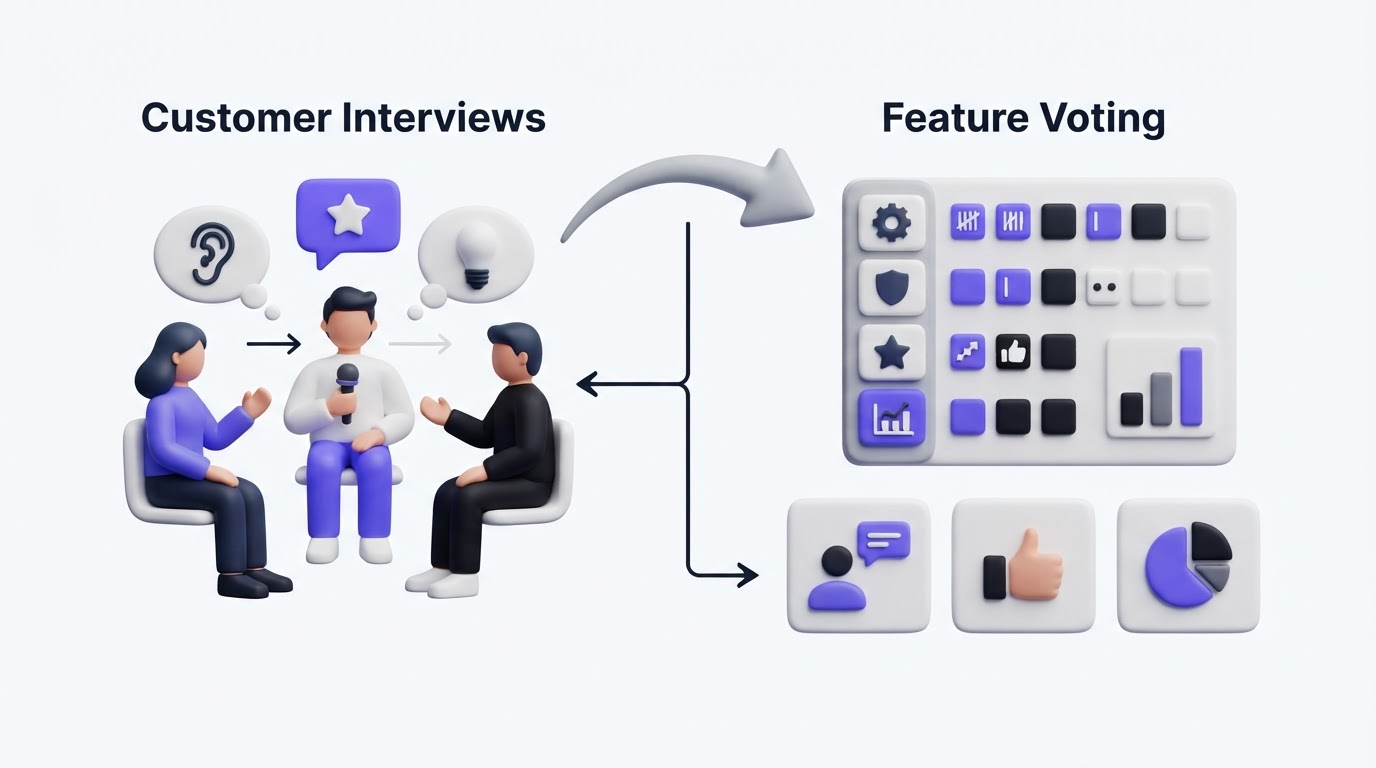
A feature request with 100 votes can still be a poor next bet when voters need different outcomes, face different constraints, or only want a temporary workaround. A memorable interview can create the opposite risk when one customer’s urgent problem receives more attention than the wider customer base deserves.
Feature voting and interviews work best as a connected research loop. Upvoty gives product teams a shared place to collect votes, organize requests, and turn high-signal demand into focused customer conversations.
Quick answer: Use feature voting to find patterns and recruit relevant participants, then use interviews to understand the circumstances behind the pattern.
- Collect and merge similar feature requests into one clear problem statement.
- Segment voters by customer type, plan, lifecycle stage, or use case.
- Select interview participants from meaningful voter groups, including a few non-voters.
- Ask about the last time they faced the problem before discussing a proposed feature.
- Record the job, current workaround, urgency, and consequences of leaving the problem unresolved.
- Prioritize with vote volume, affected segment, interview evidence, strategic fit, and delivery effort together.
What feature voting tells you before an interview
Feature voting gives you a visible measure of expressed demand. It can show which problems recur, which requests attract support across time, and which customer groups participate in feedback.
Start with a clean board. Merge duplicates before treating vote totals as evidence. A request called “better reporting,” another called “download SLA metrics,” and a third called “weekly support-performance export” may describe the same underlying job. If they remain separate, each post understates demand and makes interview recruitment harder.
Use a precise title for the merged request, then preserve the original wording in internal notes. The title might become: “Export support SLA data by team and date range.” That wording is concrete enough for voters to recognize the issue and for the team to investigate.
Consider a hypothetical B2B support platform. Its feedback board shows 86 votes across three requests related to SLA reporting. At first glance, the product team may see a clear case for building a reporting dashboard. Segmenting the voters reveals a more useful picture: 52 votes come from support operations managers at larger accounts, 24 come from team leads, and 10 come from smaller teams.
That pattern provides a research direction. It does not yet tell the team whether people need dashboards, scheduled exports, alerts, data access for finance, or a way to prepare quarterly business reviews.
Keep these limits in view:
- Vote totals reflect the people who saw the request and chose to participate.
- A vote signals interest, while urgency still needs investigation.
- One account may have several voters, which can be useful or misleading depending on the decision.
- Quiet customer groups may have a real need that never reaches the board.
- Broadly worded requests often collect votes for several different jobs.
For a full intake and cleanup process, see this guide to collecting, organizing, and prioritizing feature requests.
How to recruit customer interviews from feature voting
Recruiting from feature voting gives interviews a clear purpose. Invite people whose vote connects to the decision in front of the team, rather than filling sessions with whoever replies first.
Export the last 90 days of votes first. For each high-interest request, group voters by segment, account size, role, product usage, and vote date. Add customer health or revenue context where your team has permission to use it. The goal is a participant set that represents the decision, rather than a group of highly engaged respondents from one role.
For the reporting example, recruit two support operations managers, two team leads, one newer customer, and one customer who has never voted. The non-voter is valuable because their workflow may reveal a need that the request title failed to capture.
Ask customer success or account managers to introduce appropriate customers when relationships are sensitive. Give participants a short, honest invitation: you are studying how they prepare and share SLA information, and their feedback will inform product decisions. Avoid promising delivery during recruitment.
A small round of focused sessions often exposes repeated patterns quickly. Nielsen Norman Group’s guidance on qualitative testing with small participant groups explains why repeated usability findings commonly emerge early. For feature discovery, continue recruiting until the major jobs, workarounds, and segment differences are clear enough to support a decision.
How to run customer interviews after feature voting
Use the vote as an entry point, then move quickly into recent behavior. A voter can tell you what they clicked. Their story explains the conditions that made the request important.
Open with a time-bound question: “Tell me about the last time you needed to report on SLA performance.” Ask them to walk through the event from start to finish. Listen for tools opened, people involved, data moved between systems, deadlines, approval steps, and the cost of delay.
Follow with questions such as:
- “What triggered the need for this report?”
- “How do you handle it today?”
- “Which part takes the longest or creates the most risk?”
- “Who uses the output after you create it?”
- “How often does this happen, and what changes during a busy period?”
- “What would make the current workaround unacceptable?”
Avoid leading with “Would you use an SLA dashboard?” That framing turns an interview into a feature pitch. Ask about the work first, then show a lightweight concept only after you understand the existing process. The UK Government’s user research guidance also emphasizes research with users throughout service development, which supports this ongoing approach rather than a single validation event.
In the support-platform example, the interviews show that operations managers export data every Friday for executive reviews. Team leads mainly need a simple view to spot breaches during the week. The same 86 votes describe two related jobs with different frequency, audience, and urgency.
The team now has a stronger decision: start with a scheduled CSV export that includes the fields operations managers already assemble manually, then assess a weekly breach view separately. A polished dashboard may still belong on the roadmap, though the interviews have clarified its role and sequencing.
How to combine feature voting and interview evidence
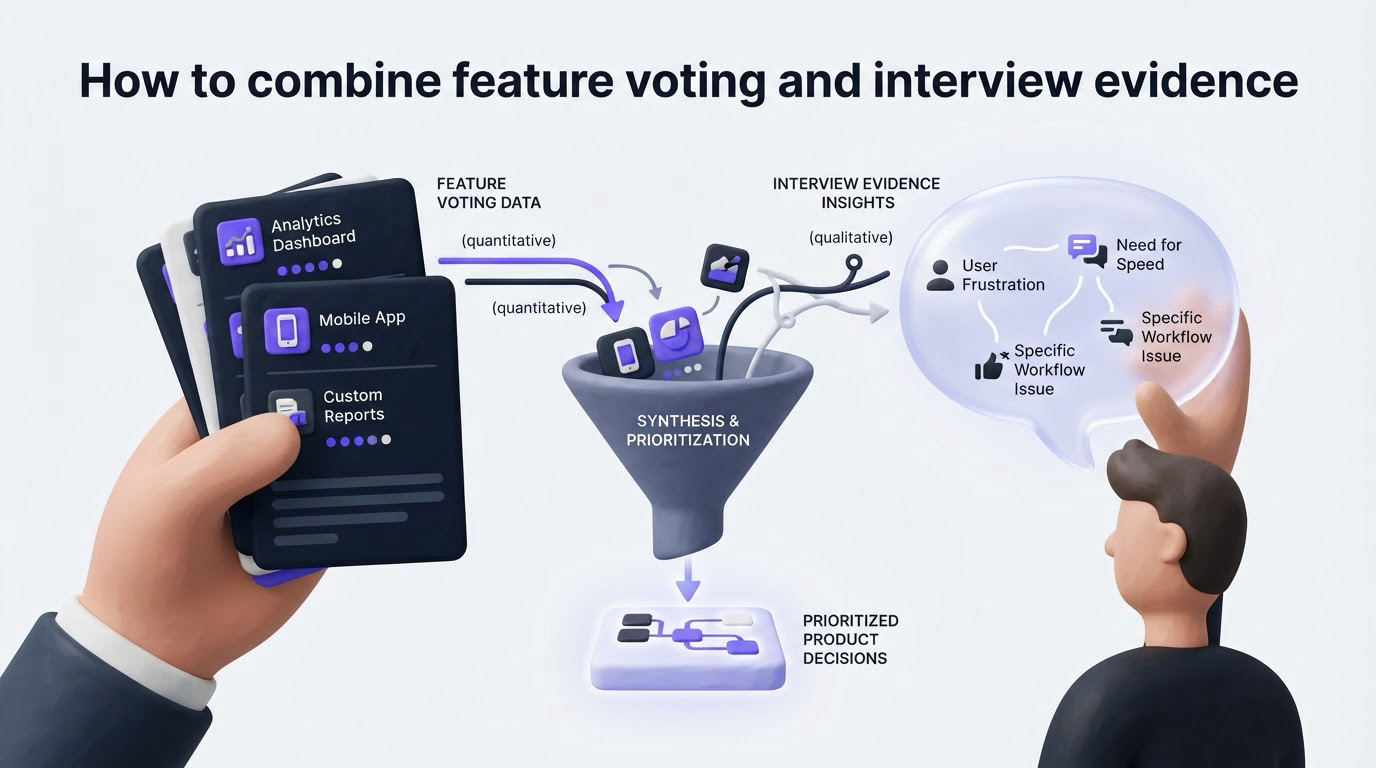
Put vote data and interview findings in one decision record for each candidate initiative. Treat both as evidence with different strengths.
| Evidence source | What it can tell you | What to record | Common risk |
|---|---|---|---|
| Feature voting | Breadth of expressed demand and visible support by segment | Vote count, voter roles, account groups, request age, duplicates merged | A broad request combines several jobs |
| Customer interviews | Workflow, urgency, desired outcome, language, and workaround | Recent example, trigger, frequency, consequence, quoted problem statement | A vocal participant receives excessive weight |
| Product and business data | Usage patterns, retention context, strategic relevance, and effort | Affected workflow, adoption signals, dependencies, delivery scope | Teams mistake correlation for cause |
Use a simple review meeting. Read the merged request, inspect voter segments, review interview notes, and write one problem statement in plain language. For example: “Support operations managers need a reliable weekly SLA export for executive review because manual spreadsheet preparation takes too long and creates reporting errors.”
Then decide what the evidence supports. In this case, it supports a targeted export workflow. It does not yet support a complete analytics suite. Scope the first release around the validated job, define a success signal, and keep follow-up research open.
Teams with mixed customer bases should also weight who is affected. Ten votes from a strategic segment can deserve serious attention, especially when interviews reveal a frequent and costly workflow. Read how to prioritize customer feedback by revenue, segment, and demand for a practical framework that adds this business context without reducing every decision to vote totals.
Use Upvoty to connect feature voting, interviews, and delivery
A shared system prevents the research trail from splitting across spreadsheets, call recordings, and internal messages. Here is how this workflow can run in Upvoty.
First, collect requests on feedback boards, where customers can submit ideas and vote on existing posts. Review incoming posts regularly, merge overlapping requests, and keep the merged post centered on one customer problem.
Next, use segments to see who supports the request. Build your interview shortlist from the segments relevant to the decision, then document recruitment status, interview links, and key observations in internal notes. The public post remains focused for customers while the team keeps research context in the workspace.
!Upvoty feedback dashboard showing organized product feedback and request management
After interviews, assign a priority and owner based on the combined evidence. Move validated work to a public product roadmap when you can describe the outcome customers should expect. Avoid publishing a roadmap item when the research still points to several competing jobs.
Once the work ships, publish the release through the changelog and notify voters. This closes the loop with people who supplied the original demand signal and gives the team another chance to learn from adoption. For practical guidance on that follow-through, read how to close the customer feedback loop with a changelog.
Common mistakes when combining feature voting and interviews
The most frequent mistake is treating the highest-voted post as a ready-made specification. A request title is a starting hypothesis. Interviews reveal the actual workflow and help teams identify the smallest useful outcome.
Another failure mode is interviewing only power users. They often explain a product deeply, though their workflows can differ from administrators, new customers, or users with lower product maturity. Recruit across the segments that make up the vote pattern.
Teams also lose evidence when interview notes live outside the feedback process. Put findings beside the request while the details are fresh. Include the participant’s role, context, exact problem, and whether their situation matched other interviews.
Finally, avoid presenting every research finding as a public commitment. Customers benefit from visibility, but roadmap communication needs clear confidence levels. This guide to building a public product roadmap customers can trust explains how to share direction without creating avoidable expectations.
FAQ about feature voting and customer interviews
How many votes should a feature have before I interview customers?
There is no universal threshold. Interview when a request affects an important segment, aligns with a strategic problem, appears repeatedly in sales or support conversations, or shows a growing vote pattern. A lower-vote request from a key customer group can justify research quickly.
Should I interview everyone who votes on a feature request?
No. Select a purposeful sample across roles and segments. Start with participants closest to the workflow, then add contrasting perspectives such as new users, occasional users, and non-voters. Continue when each additional conversation may change the decision.
Can feature voting replace customer interviews?
Feature voting measures visible support. Interviews uncover the job behind that support, the current workaround, and the consequences of delay. Product teams need both evidence types for decisions with meaningful delivery cost.
What should I do when interview feedback conflicts with vote totals?
Check whether the request title combines multiple needs. Segment the voters, compare their workflows, and split the request when separate jobs emerge. Prioritize the problem with the strongest combined case for reach, urgency, strategic value, and feasible delivery.
Use Upvoty to keep votes, interview context, priorities, roadmap updates, and release communication connected. Start by choosing one active request, recruit a small cross-section of voters, and let their recent workflows shape the next product decision.