Feature requests arrive through support tickets, sales calls, chat messages, and spreadsheets. Duplicates hide the true level of demand, while customers receive little evidence that anyone reviewed their suggestions. Upvoty brings those requests into a shared voting board connected to a public roadmap and changelog.
Quick answer: how to use idea voting software
A practical idea voting workflow follows these steps:
- Create a feedback board for a defined product or customer group.
- Collect ideas through a customer-facing submission form.
- Merge duplicate requests without losing important context.
- Let customers vote and explain why they need each idea.
- Prioritize requests using votes, customer value, effort, and strategy.
- Move accepted ideas to a public product roadmap.
- Announce completed work through a product changelog.
Why product teams use idea voting software
A shared voting board gives customers one visible place to submit, find, and support product ideas. It replaces the fragmented process of copying requests from support conversations into a private spreadsheet.
Consider a B2B reporting product whose customers keep asking for scheduled CSV exports. One customer asks for a monthly email attachment. Another wants daily exports sent to an SFTP server. A third requests a weekly download link for finance reports.
A spreadsheet might record these as three unrelated rows. Idea voting software can group the requests under a broader idea such as feedback.example.com/reporting/scheduled-exports, while preserving the comments that explain different delivery and security requirements.
That context is important. A vote says that somebody wants an outcome. It does not specify the implementation you should build.
The following comparison shows why a purpose-built board works better once feedback volume grows:
| Collection method | Customer visibility | Duplicate handling | Voting support | Best fit |
|---|---|---|---|---|
| Email inbox | None | Manual | None | Sensitive one-to-one feedback |
| Spreadsheet | Internal only | Manual filtering | Manual counting | Early products with very low request volume |
| General survey | Limited to survey participants | Weak | Fixed-response scoring | Time-boxed research questions |
| Idea voting software | Shared or public | Requests can be consolidated | Built in | Ongoing feature discovery and prioritization |
For a broader evaluation of collection methods, use this product feedback tools selection guide.
How to set up an idea voting board
Start with a narrow purpose. A board called “Ideas” gives customers no guidance and quickly becomes a mixture of bugs, billing questions, integration requests, and broad product suggestions.
Create boards around products or clear areas of ownership instead. The reporting product might use separate boards for reporting, integrations, and account administration. Its board description should state what belongs there, how submissions are reviewed, and where customers should report urgent defects.
Keep submission fields short. Ask for a title, a description of the desired outcome, and enough contact information to follow up. Long forms reduce participation and often produce speculative business cases rather than useful detail.
If you collect personal information, only request what the workflow requires. The data minimization principle in Article 5 of the General Data Protection Regulation provides a useful standard even when a company operates outside the European Union.
This Upvoty voting board shows how feature requests can be presented for public discovery and voting.
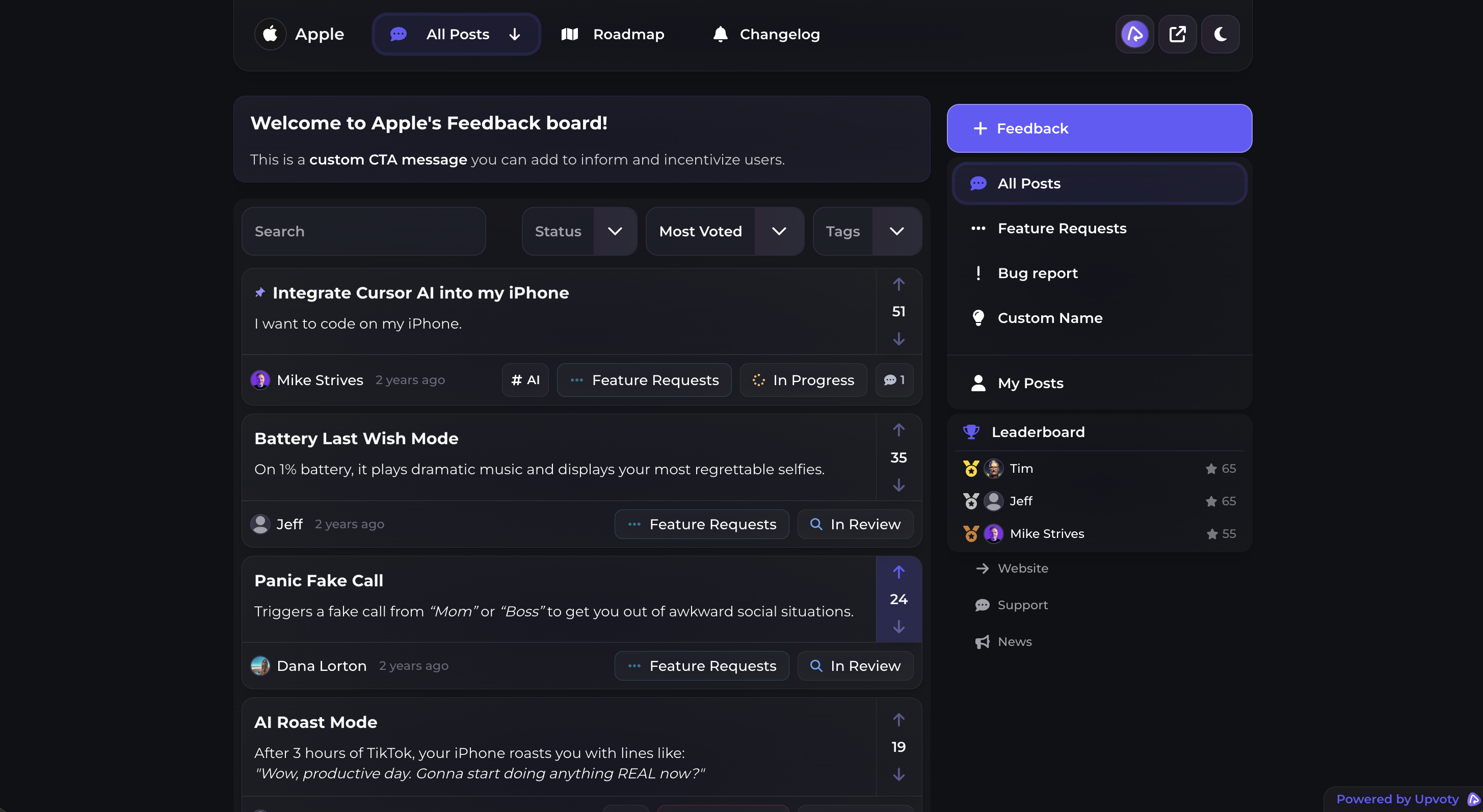
Explore the feedback board features to see how this part of the workflow is organized.
How to organize ideas and merge duplicate requests
Review new submissions on a regular schedule. Daily review is reasonable for a busy public board, while a smaller product may only need two review sessions each week.
Search for related requests before approving a new idea. When two submissions describe the same desired outcome, merge or consolidate them under one clear title. Redirecting attention to a single request prevents votes from being split across several nearly identical posts.
Do not merge requests based only on a shared keyword. In the reporting example, “scheduled email exports” and “automated SFTP exports” both concern scheduled delivery, but the second request may come from customers with security or compliance constraints. Combining them without preserving that distinction could push the team toward an implementation that satisfies neither group.
Keep the main idea broad enough to represent the outcome, then retain the original comments. Ask follow-up questions when the intended use remains unclear. This feature request management workflow explains how to move from raw submissions to reviewable product inputs.
How to collect useful feature votes
Invite customers to vote at moments when they already have the problem in mind. A support agent discussing export limitations can send the relevant board URL. A customer success manager can share it after a quarterly review. Product teams can also link to the board from an application menu or help center.
Avoid asking people to “vote for what we should build next.” That wording implies that the largest number automatically wins. Instead, explain that votes help the team measure demand and identify customers for follow-up research.
Require enough identity information to limit obvious vote manipulation, especially when the board influences a public roadmap. At the same time, remove unnecessary friction. Voting controls should also be usable on small screens and by keyboard users. The W3C guidance on minimum target size explains why interactive controls need adequate spacing.
How to prioritize customer ideas beyond vote count
Sort by votes to find patterns, not to make the final decision. A highly voted cosmetic improvement may have less value than a smaller request blocking renewals, regulated customers, or a strategic product direction.
For the scheduled export example, assume the consolidated idea receives 41 votes. Twelve come from small teams that want email attachments. Four come from larger accounts asking for SFTP delivery and audit records. The raw count favors email, but customer interviews reveal that secure delivery is a purchasing requirement for the second group.
Review each serious candidate against a consistent set of factors:
- Number of unique customers supporting the request
- Customer segment and use case
- Revenue retained or expansion supported
- Strategic fit with the product direction
- Development and maintenance effort
- Risks, dependencies, and security requirements
Document the decision next to the request. If secure scheduled exports fit the product strategy but need infrastructure work, mark the idea as under consideration rather than promising a date.
The Steve Jobs clip below is a useful reminder to work backward from the customer experience instead of starting with an available technical feature.
For a more detailed scoring process, read how to prioritize feedback by revenue, segment, and demand.
How idea voting connects to a public product roadmap
Once the team commits to an idea, move it from the voting board to a roadmap stage customers can understand. Use labels such as planned, in progress, and completed only when they match your internal delivery process.
Do not publish an exact release date unless the team is prepared to manage that commitment. Public roadmaps work best as communication tools, not fixed contracts. Explain what problem is being addressed and update the entry when scope changes.
In the reporting example, the roadmap item could become “Automated delivery for scheduled exports.” Its description can state that the first release focuses on secure scheduled delivery, while email attachments remain under review. Customers then see a decision rather than a vague promise.
Upvoty provides dedicated product roadmap software for publishing these decisions. The guide to building a public roadmap customers can trust covers status wording and expectation management in more detail.
How idea voting software works in Upvoty
Upvoty removes the handoffs between a submission form, prioritization spreadsheet, public roadmap, and release announcement.
First, create a feedback board and give customers a single URL for ideas. Users can review existing submissions before adding another one, which directs support toward the established request rather than creating an isolated ticket.
Next, review incoming feedback in the management dashboard. Consolidate overlapping requests and retain the customer comments that explain the underlying need. Votes accumulate on the shared idea, giving the product team a visible demand signal.
Then evaluate the request with the customer context available to your team. For scheduled exports, that means separating convenience requests from security-dependent purchasing requirements before choosing scope.
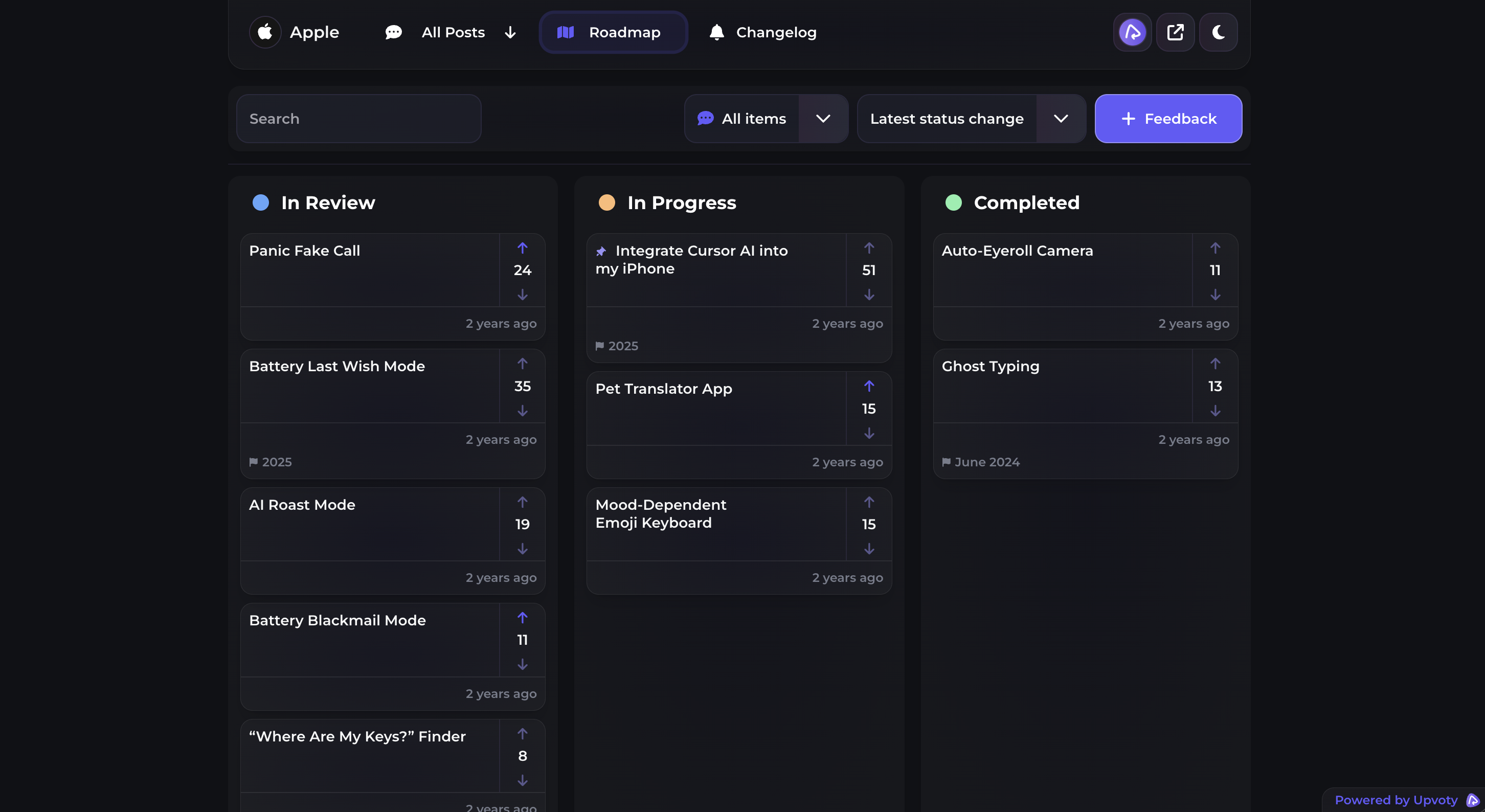
When the team commits to the work, publish it on the roadmap. Customers who supported the idea can see that it has progressed without asking support for an individual update.
This roadmap view shows how planned product work can be communicated publicly.
Finally, publish the completed feature through the product changelog. Explain what shipped, who it helps, and how to use it. This closes the loop from initial vote to delivered change. The practical process is covered further in the guide to closing the customer feedback loop with a changelog.
How to choose idea voting software
Test a product with one real request rather than relying on a generic feature checklist. Submit the request as a customer, attempt to find a duplicate, vote, review it as an administrator, publish it to a roadmap, and announce it as completed.
Check whether the workflow remains understandable at every stage. Also review access controls, branding options, moderation, exports, and the amount of administration required. If you are comparing Upvoty with Canny, Featurebase, or Nolt, confirm current capabilities and pricing on each vendor’s own pricing page. Upvoty’s current plans are available on the pricing page, and a live product demo lets you inspect the workflow before committing.
A common failure mode is selecting the board with the longest feature list while overlooking the work required after voting. Collection alone leaves customers waiting. Choose software that supports the complete path from request to decision, roadmap communication, and release update.
Idea voting software FAQ
Does the idea with the most votes always get built?
No. Votes measure visible demand, but product teams still need to consider customer segment, strategic fit, effort, risk, and the severity of the underlying problem. Publish clear review criteria so customers understand that voting informs prioritization rather than controlling it.
Should an idea voting board be public or private?
A public board helps customers discover duplicates and see demand from other users. A private board may be better for internal products, confidential enterprise feedback, or unreleased concepts. Some teams use separate boards for public requests and restricted customer groups.
Can idea voting software replace customer interviews?
No. Votes identify where to investigate. Interviews explain the workflow, constraints, urgency, and expected outcome. Contact customers who voted for a serious candidate before defining the solution.
How often should product teams review submitted ideas?
Set a schedule based on submission volume and publish it. Busy boards may need daily moderation, while a smaller SaaS product can review requests once or twice a week. Consistency matters because unreviewed duplicates quickly weaken vote data.
What should happen when a requested feature is rejected?
Update the request with a brief, direct explanation. Mention whether the idea conflicts with product direction, creates disproportionate maintenance work, or is already possible through another workflow. Do not leave rejected requests indefinitely marked as under review.
Turn scattered feature requests into a visible process customers can follow. Create your idea voting workflow with Upvoty and connect voting, prioritization, roadmap updates, and release communication in one place. Read next: Feature Voting Without Popularity Bias: How to Read Results. Read next: Release Notes Software for Product Teams. Read next: Roadmap Prioritization Software for Product Teams.