
Feature requests arrive through support tickets, sales calls, shared documents, chat messages, and half-remembered meeting notes. Product managers then spend hours finding duplicates, checking who asked, and explaining why the loudest request is not automatically the most valuable.
Feature request software puts that work into one repeatable process. Upvoty gives product teams a central place to collect requests, validate demand, communicate priorities, and report shipped improvements.
How to use feature request software: quick answer
A practical feature request workflow follows these steps:
- Send every request to a central feedback board.
- Merge duplicate ideas without losing voter or customer context.
- Let customers vote and add specific use cases.
- Prioritize requests using demand, customer value, and product strategy.
- Move selected requests onto a customer-facing roadmap.
- Update request statuses as product decisions change.
- Publish completed features and notify the people who requested them.
Capture every feature request in one place
Start by choosing one system of record. Support, sales, success, and product teams should send requests there instead of maintaining separate spreadsheets or private project boards.
Consider a fictional B2B reporting product called LedgerLoop. Requests currently arrive through its help desk, an internal sales channel, and calls with account managers. One customer asks for scheduled CSV exports. Another asks to “automate reports.” A third requests a weekly email containing usage data.
Those requests sound related, but they are not necessarily the same. LedgerLoop creates a public board at feedback.ledgerloop.example and asks customer-facing teams to record the customer’s desired outcome, current workaround, account segment, and original wording. That context prevents a vague title from becoming an oversized product commitment.
Keep the submission form short. Ask for a title, explanation, and use case. Collect account or contact information only when it will support follow-up, and apply the European Commission’s guidance on GDPR data minimization when deciding which fields are required.
The following Startup School session is useful for learning how to ask follow-up questions without steering customers toward a preferred answer.
Organize feature requests and remove duplicates
Duplicate management is not basic housekeeping. It determines whether product managers see one strong demand signal or six disconnected suggestions.
LedgerLoop receives “scheduled CSV exports,” “email my report,” and “send analytics every Monday.” The product manager does not immediately combine all three. Scheduled file delivery may solve the first request, while the third customer might only need a formatted email summary.
The team creates one parent request for scheduled report delivery, links the relevant submissions, and keeps the original comments attached. A separate request remains open for email summaries. Customers can now vote on the outcome they actually want.
Avoid categories that mirror internal departments. Customers rarely know whether an improvement belongs to reporting, infrastructure, or account management. Use product areas and outcomes they recognize, then apply internal tags for triage.
For a complete process covering intake, moderation, and status changes, use this feature request management workflow alongside your board configuration.
Use feature voting without letting votes control the roadmap
Feature voting gives product teams evidence of recurring demand. It does not make the roadmap decision for them.
A request with broad voting support might have low strategic value, significant security costs, or a workable alternative. A request from a small number of customers could be essential for renewals in a target segment. Record both the vote and the customer context.
LedgerLoop’s broad “improve reporting” request initially attracts attention. Yet the comments describe unrelated problems: exports, chart formatting, saved filters, and permissions. Treating the total as one demand signal would mislead the team. The product manager splits the request into clear outcomes and asks existing voters to confirm which problem affects them.
Public voting also helps customers discover existing ideas before posting duplicates. A well-run feedback board should make search, voting, discussion, and status information easy to find. Check its interface against the W3C’s Web Content Accessibility Guidelines if customers with different access needs will use it.
Prioritize customer feedback with useful context
Prioritization becomes easier when each request contains more than a vote total. Review who requested it, why they need it, the frequency of the problem, revenue relevance, strategic fit, delivery cost, and risk.
LedgerLoop sees that scheduled CSV exports support finance administrators at several target accounts. The weekly summary request is useful but serves a narrower workflow, while the broad reporting item remains poorly defined. The team advances scheduled exports for discovery, keeps email summaries under consideration, and returns the vague reporting request to research.
This decision is documented on the request rather than disappearing into a planning meeting. Sales and support can see the reasoning and stop promising uncertain delivery dates.
Do not turn prioritization into a scorecard with false precision. Weighted formulas can help compare similar requests, but a score of 74 is not objectively better than 71 when effort estimates and revenue assumptions remain uncertain. Use scoring to expose trade-offs, then apply product judgment.
The guide to prioritizing feedback by revenue, segment, and demand explains how to keep commercial context without allowing one large account to dictate the roadmap.
Publish feature requests on a product roadmap
Once a request has passed discovery and the team intends to work on it, move it to a visible roadmap stage. Use plain statuses such as planned, in progress, and completed. Add dates only when the delivery team can support them.
LedgerLoop places scheduled exports in “Planned” after confirming the scope: administrators can schedule a CSV report for weekly delivery to approved recipients. The roadmap entry does not promise custom formats or unrestricted email addresses. The boundary is explicit.
A customer-facing roadmap reduces repeated status questions, but publishing every internal initiative can create noise or expose work that should remain private. Security projects, experimental bets, and contractual commitments may need separate handling. The Upvoty roadmap supports a public view of the work customers need to follow, while internal delivery details can stay in the team’s project system.
If roadmap language routinely causes confusion, review these tips for writing a clear product roadmap before publishing more items.
Close the feature request feedback loop
Shipping the feature is not the final workflow step. Update the original request, explain what changed, and notify the customers who voted or commented.
LedgerLoop releases scheduled CSV exports with recipient controls and a weekly schedule. The completion note links to the relevant setup instructions and states what is not included. Customers asking for formatted email summaries can see that their separate request remains open.
Publish the update in a product changelog so people who did not follow the original request can still discover it. A useful changelog entry explains the customer problem, the released behavior, and any action required. “Reporting improvements” is too vague.
The main failure mode here is silent delivery. When a requested feature ships without notifying the requester, the company loses the trust benefit created by listening in the first place.
How Upvoty feature request software runs the workflow
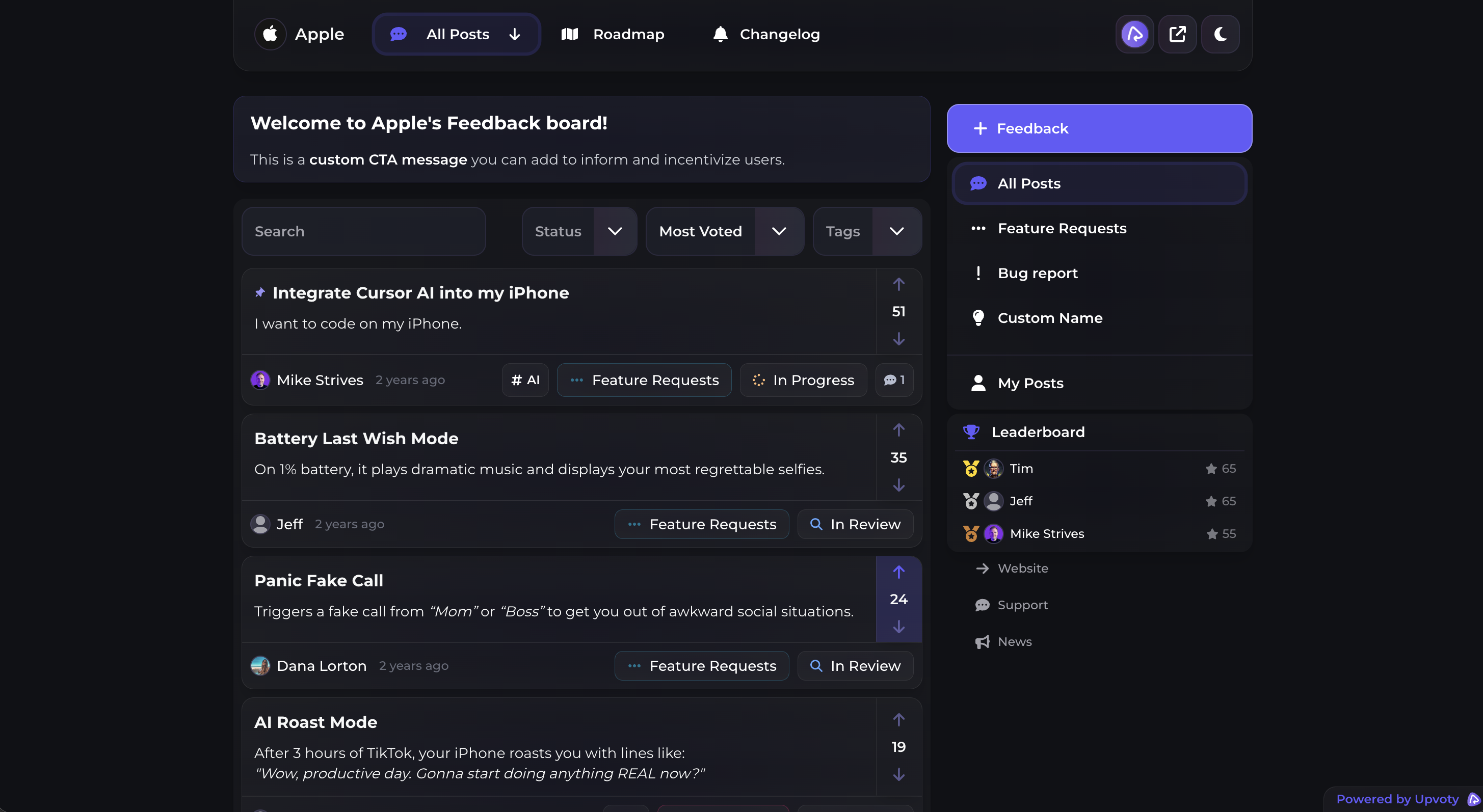
Upvoty brings the customer-facing parts of this process together. A user first visits a feedback board, searches existing requests, submits an idea, or votes on one that already exists. Product teams review those submissions in the dashboard, preserve comments, and organize the requests for decision-making.
This is what the public voting experience can look like when customers browse requests and add their support.
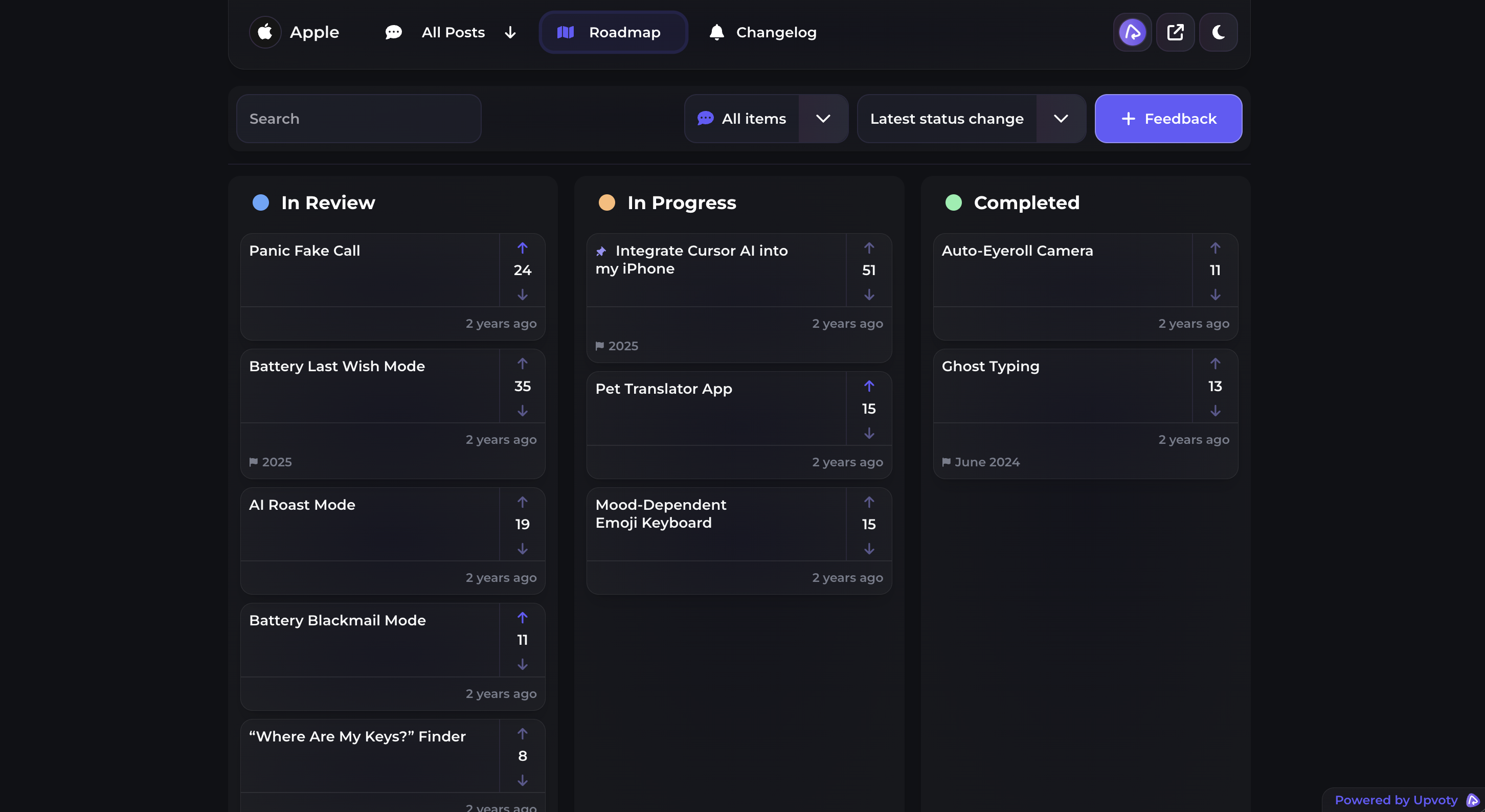
Next, the team evaluates demand and changes the status of each request. Selected work can appear on the public roadmap, giving customers a current view without requiring support agents to answer the same question repeatedly.
The roadmap view shows customers which ideas are planned, being worked on, or completed.
When the product change ships, the team marks the request complete and publishes an update through the changelog. That sequence keeps collection, validation, roadmap communication, and release communication connected.
Upvoty does not remove the need for product judgment. It removes the scattered documents and manual status chasing around that judgment. Review the live Upvoty demo to see whether the workflow matches how your team handles requests.
Compare feature request software before buying
When comparing Upvoty with Canny, Featurebase, Nolt, or a general-purpose ticketing tool, test the full path from submission to release. Do not make the decision from a feature grid alone.
| Workflow area | What to test | Warning sign |
|---|---|---|
| Request capture | Submit an idea as a customer and as an internal team member | Requests require copying between disconnected systems |
| Duplicate handling | Search for an existing idea and preserve the original customer context | Merging removes comments or requester information |
| Voting | Vote, comment, and change a request without product-team assistance | Vote totals have no customer or use-case context |
| Prioritization | Review demand alongside segment and commercial relevance | The tool treats the highest vote count as the decision |
| Roadmap communication | Move a request through realistic public statuses | Internal tasks and customer communication are forced into one view |
| Release follow-up | Complete a request and publish a customer-readable update | Requesters cannot tell what shipped or whether they were notified |
Also check moderation controls, branding, permissions, data handling, and the effort required to maintain the board. If you are considering an AI customer feedback platform, ask which actions AI performs, how classifications can be reviewed, and whether the original customer wording remains available. Automated grouping can save time, but an incorrect merge can hide distinct needs.
Use the product feedback tools selection guide to prepare a structured trial. Compare current plan limits and costs directly on each vendor’s own pricing page, and review Upvoty pricing for its current options.
Feature request software FAQ
What is feature request software used for?
It collects customer ideas, groups related requests, records votes and comments, supports prioritization, publishes roadmap statuses, and communicates completed work. It replaces scattered intake channels with a traceable workflow.
Should feature request voting decide what gets built?
No. Voting shows demand, but product teams should also examine customer segment, strategic fit, urgency, implementation effort, risk, and the quality of the underlying use case. Votes are evidence, not an automatic commitment.
Can a feature request board be public?
Yes. A public board lets customers search existing ideas, vote, comment, and monitor statuses. Teams should moderate submissions and keep confidential requests, security work, and sensitive account information private.
Do we still need a project management tool?
Usually. Feature request software handles customer input and external communication. Engineering tasks, sprint planning, technical specifications, and dependencies generally belong in the delivery system used by the development team.
How do we move feature requests out of spreadsheets?
Clean the spreadsheet before importing or recreating requests. Remove obsolete items, group obvious duplicates, retain requester details where permitted, and assign an owner to review ambiguous entries. Redirect every intake channel to the new board on a specific date so the spreadsheet does not remain a second source of truth.
Is feature request software only for SaaS companies?
No. Any organization that develops a product or recurring service can use it. SaaS teams benefit because they receive continuous requests from many accounts, but ecommerce apps, internal platforms, mobile products, and membership services face the same collection and communication problems.
Replace scattered requests with a board customers can search, a roadmap they can follow, and updates that close the loop. See how Upvoty supports your feature request workflow and decide whether it fits your product team. Read next: Product Roadmap Software That Connects Feedback to Delivery. Read next: Feature Voting Without Popularity Bias: How to Read Results. Read next: Feature Prioritization Software. Read next: Release Notes Software for Product Teams. Read next: How to Merge Duplicate Feature Requests Without Losing Customer Context. Read next: Feature Request Tracking Software.