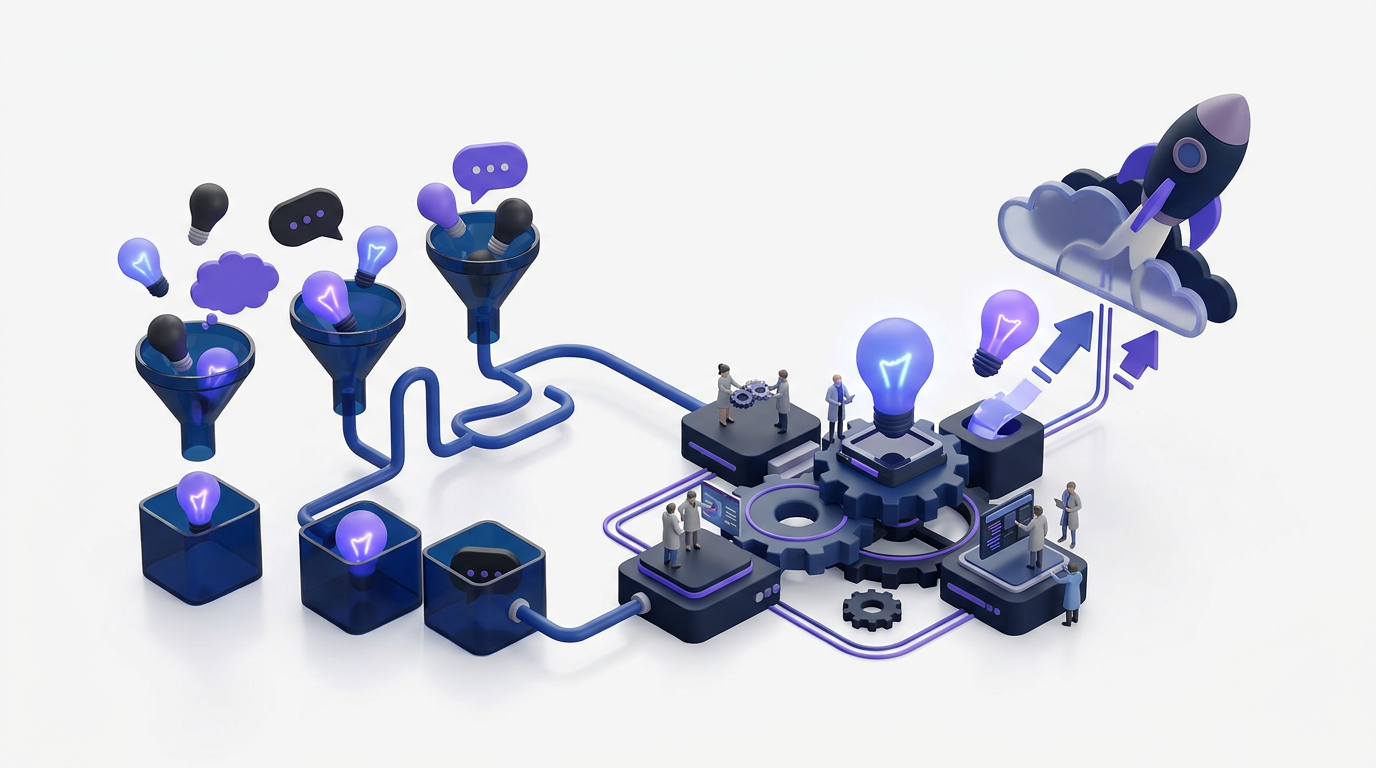
Feature requests arrive through support tickets, calls, chat messages, sales notes, and internal conversations. Without one workflow, duplicate ideas pile up, customer context disappears, and product decisions become difficult to explain. Upvoty provides customer idea management software that brings collection, prioritization, roadmapping, and updates into one system.
Quick answer: how customer idea management software works
Use the following workflow to turn customer ideas into product decisions:
- Capture ideas from a feedback board, widget, or connected customer channel.
- Consolidate duplicate requests without discarding comments or voter context.
- Add customer, account, segment, and use-case information to each idea.
- Prioritize ideas using demand, strategic fit, impact, and delivery effort.
- Move selected ideas onto a customer-facing product roadmap.
- Publish completed work in a changelog and notify interested customers.
Each step should preserve the original customer signal. A vote without context is weak evidence, while a request tied to a specific workflow, account type, and business problem gives the product team something it can assess.
How customer idea management software captures requests
Start by replacing scattered submission points with a shared intake process. Customers should be able to submit an idea without opening a support ticket, while support and sales teams should still have a route for recording feedback they receive during conversations.
A public or private feedback board gives customers a searchable place to post requests and vote on existing ones. An in-product feedback widget reduces friction further because users can submit feedback while they are working.
Consider an illustrative B2B billing platform. Several customers want to export transaction data, but they describe the need differently:
- “Add CSV exports to the transaction screen.”
- “Let finance download settled payments.”
- “We need transaction data for month-end reconciliation.”
These could be one underlying request, but only after the team checks the use cases. The first customer may need an occasional download, while the third may actually require an automated accounting integration.
Use a custom submission form to ask where the capability is needed, what the customer does now, and what blocks them. Keep the form short. Customers will abandon a questionnaire that feels like a product requirements document.
If the board is public, set moderation rules before inviting customers. Decide which posts can be viewed externally, which account details must remain private, and how moderators will handle sensitive information. The practical guidance on governing public feedback boards explains where public visibility helps and where private handling is safer.
How to consolidate customer ideas without losing context
Duplicate management is more than tidying a board. Merging the wrong posts can hide distinct problems and produce misleading vote totals.
For the billing platform, the team should first compare the three export requests. If all customers need a manual file from the same transaction page, merging them is reasonable. Keep each comment, vote, and customer association attached to the consolidated idea. If one customer needs scheduled delivery to an accounting system, preserve that as a separate request.
Name the merged idea around the outcome, such as “Export filtered transactions as CSV.” Avoid using the wording of whichever customer posted first. A clear title makes the request easier to find and reduces future duplicates.
AI can assist with identifying similar submissions, but similarity is not proof that two requests belong together. Review the suggested match before merging. Upvoty’s guide to merging duplicate feature requests without losing context covers this review in more detail.
How customer feedback context improves prioritization
Raw voting answers one narrow question: which visible options attracted clicks. It does not tell you whether the request comes from a target segment, supports an important workflow, affects retention, or requires a disproportionate amount of engineering work.
Add context before comparing ideas. For the CSV export request, the product team might record that it affects finance administrators, appears during month-end close, and currently forces customers to copy data manually. That information is more useful than the vote count alone.
Segment requests by customer type, plan, use case, or another attribute relevant to your product strategy. Then compare demand within those segments. A smaller number of requests from the product’s core audience can matter more than broad interest from users outside the intended market.
The team should also review who did not vote. Public boards tend to favor active users who know the board exists. Read how to interpret feature voting without popularity bias before treating the ranking as a ready-made roadmap.
For deeper prioritization, combine customer evidence with strategic fit, expected impact, delivery cost, dependencies, and confidence. The customer feedback prioritization guide shows how segment and commercial context can strengthen that decision without allowing a single large account to dictate the roadmap.
How to turn prioritized ideas into a customer-facing roadmap
Once the team approves the CSV export, change its internal status and decide what customers should see. A public roadmap can show that the idea is planned or in progress, but it should not promise a release date the team cannot support.
Use broad, understandable statuses. “Under consideration,” “planned,” “in progress,” and “shipped” are easier for customers to interpret than internal development stages. Keep technical tasks and unresolved dependencies in the delivery system rather than exposing every engineering detail.
The roadmap entry should explain the intended outcome. For example: “Export filtered transaction records as a CSV file for reconciliation and reporting.” That is clearer than “Build export service.”
If approved work moves into Jira, Linear, or another issue tracker, define which system owns each status. Avoid two-way status changes without clear rules because an internal workflow update can accidentally publish a customer promise. Atlassian’s official documentation explains how Jira workflows control issue status and transitions, which is useful when mapping public stages to delivery stages.
Use the recommendations in building a public product roadmap customers can trust to choose what to publish and how to communicate uncertainty.
How customer idea management software closes the feedback loop
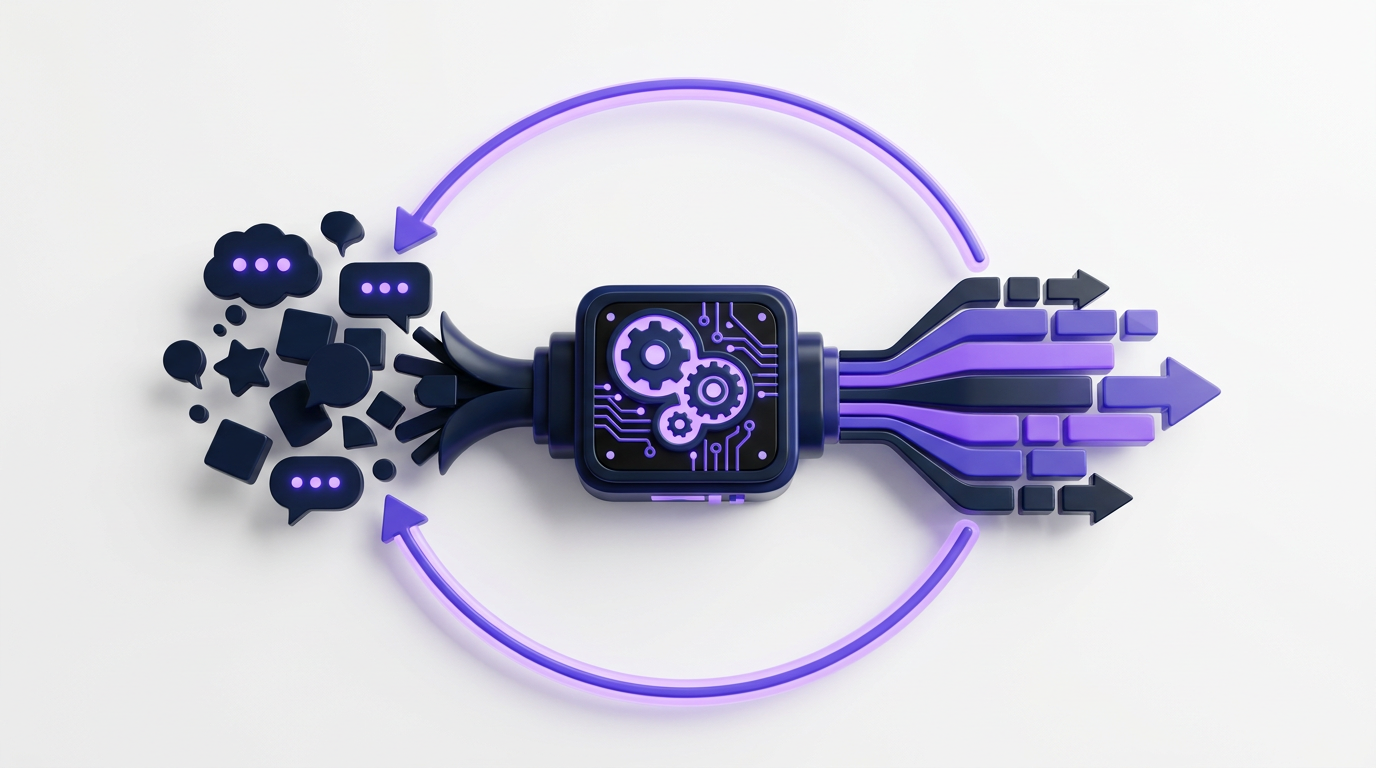
Shipping the feature is not the final step. Return to the people who requested or voted for it and explain what changed.
For the billing platform, the completion update should tell customers where to find the export action, which filters apply, and what the downloaded file contains. If the initial release supports manual CSV downloads but not scheduled exports, say so. Clear scope prevents customers from assuming every related use case was completed.
Publish the release in a changelog, move the roadmap item to shipped, and notify voters. This connects the original request to the delivered outcome. It also shows other customers that submitting feedback can lead to a visible response, even when the team does not build every suggestion.
Closing the loop also includes declined ideas. Give a concise reason when appropriate, such as limited relevance to the target customer or a conflict with the product’s direction. Do not leave requests permanently marked as under review.
The process in closing the customer feedback loop with a changelog covers how to write updates that are useful rather than promotional.
How customer idea management works in Upvoty
A manual version of this workflow can work at low volume, but it requires constant copying between forms, spreadsheets, issue trackers, email tools, and roadmap documents. Upvoty removes much of that transfer work while keeping the customer-facing and internal parts connected.
A customer first submits an idea through a public or private board, a portal, or an in-app widget. Other users can find the idea, add votes, and explain their own use cases. Your team moderates the submission and uses Merge AI to identify potential duplicates, then confirms whether they should be combined.
The feedback dashboard provides the working view for reviewing and organizing submissions.
!Upvoty dashboard for managing customer ideas and feature requests
Next, the team adds tags, segments, priorities, assignees, and internal notes. Approved ideas can move to the product roadmap, where customers see an appropriate public status without gaining access to internal delivery notes.
This is how the roadmap appears as the product team organizes upcoming work.
!Upvoty dashboard for creating and managing a public product roadmap
When the feature ships, the team publishes a changelog update and uses automatic voter notifications to contact customers who showed interest. The request, roadmap entry, release note, and customer notification remain part of one continuous process.
How to choose customer idea management software
Evaluate tools against the workflow your team will actually run. A polished voting page is not enough if product managers still need to copy every useful request into separate systems.
| Approach | Customer submission | Duplicate handling | Prioritization context | Public roadmap and updates | Best fit |
|---|---|---|---|---|---|
| Shared inbox | Email or support message | Manual search | Usually stored in conversations | Separate tools required | Very low feedback volume |
| Spreadsheet | Manual entry or form | Manual filtering | Flexible but inconsistent | Manual publishing | Early-stage teams testing a process |
| Issue tracker | Usually entered by staff | Technical issue linking | Strong delivery context, limited customer context | Often too detailed for customers | Engineering-led internal work |
| Customer idea management software | Board, portal, or widget | Similarity review and merging | Votes, comments, segments, tags, and internal notes | Connected roadmap, changelog, and notifications | Product teams with recurring customer demand |
Check whether the software supports private boards, moderation, data export, roles, SSO, integrations, and a custom domain where those requirements apply. Review accessibility as part of the buying process as well. The W3C’s Web Content Accessibility Guidelines provide the recognized criteria for assessing customer-facing interfaces.
Data handling matters when submissions contain names, email addresses, or account information. Review retention, access, deletion, and processor terms against the official General Data Protection Regulation text and your own legal requirements. Upvoty also publishes its GDPR information for procurement review.
When comparing Upvoty with Canny, Featurebase, or Nolt, test the same end-to-end scenario in each product. Submit a duplicate idea, preserve its context, prioritize it, place it on a roadmap, and notify the voter after completion. A feature list will not reveal where staff need to repeat work. For one detailed evaluation, see the Upvoty and Canny comparison, and check each vendor’s own pricing page for current numbers.
Common customer idea management mistakes
The first failure mode is collecting more data than the team can review. Assign an owner and a regular review schedule before opening a board. An unanswered feedback portal quickly becomes evidence that the company is not listening.
The second is treating votes as commitments. Voting indicates interest, not delivery value or feasibility. Keep final prioritization with the product team and explain that votes inform decisions rather than determine them.
The third is publishing roadmap dates too early. Share direction when confidence is low, then add timing only when dependencies and capacity are understood.
Finally, do not force every request into public view. Security concerns, account-specific problems, contractual details, and sensitive customer information belong in a private workflow.
Customer idea management software FAQ
What is customer idea management software?
It is software for collecting customer suggestions, consolidating duplicate requests, preserving comments and account context, prioritizing ideas, publishing roadmap decisions, and notifying customers when work is completed. It differs from a survey tool because it manages ongoing product demand rather than a single research exercise.
Can customer idea software replace an issue tracker?
Usually not. Customer idea software manages external demand and communication, while an issue tracker manages technical delivery. Connect the two, but define which system owns public status and which owns engineering tasks.
Should our customer feedback board be public or private?
Use a public board when customers benefit from discovering and discussing existing ideas. Use a private board for confidential products, enterprise accounts, internal teams, or feedback that may contain sensitive information. Some organizations need both.
How do we stop feature voting from becoming a popularity contest?
Analyze votes by customer segment, account relevance, use case, and strategic fit. Review comments for the problem behind each vote, and consider less active customers who may never visit the board. Votes are evidence, not the final priority score.
Does AI automatically decide which customer ideas to build?
It should not. AI can help detect similar submissions, organize requests, or identify patterns, but product teams still need to verify context and make prioritization decisions. Automatic merging can erase important differences between requests if no one reviews the match.
How quickly should we respond to a submitted idea?
Acknowledge it promptly, then set a realistic review cadence. You do not need to accept or reject every suggestion immediately. Customers mainly need confirmation that the idea was received and a status that does not imply a false commitment.
Replace scattered requests with a workflow that carries customer context from submission through release. Explore Upvoty to create feedback boards, prioritize ideas, publish a customer-facing roadmap, and notify voters when their requests are shipped. Read next: How to Measure the Business Impact of a Feedback Management Platform.